Copyable Smishing SLAs: 3 Hour Investigation, 1 Hour Mitigation

Set your investigation SLA in a typical range of a few hours, mitigation varying from shortly after confirmation up to about a day based on severity, and recovery within a few days for full account and system verification. These targets apply per affected user for isolated incidents; once multiple reports land inside the same window, escalate the entire cluster to a campaign-level SLA with tighter timeboxes. Credential compromise always triggers rapid response: revoke sessions and reset credentials promptly after confirmation, regardless of how the investigation clock is running.
TL;DR:
- Investigation SLAs for smishing should be set between 3 to 6 hours depending on incident severity, with mitigation steps initiated within 30 minutes to a few hours after confirmation.
- Rapid credential revocation is crucial, ideally within one hour of confirmed compromise, and accounts should be monitored for 30 days afterward.
- Thresholds for escalation to campaign-level SLAs occur when multiple reports reference the same sender or lure text within a short window, typically around one hour.
- Response protocols must classify incident priorities automatically, such as escalating second victims to the highest priority, and assign explicit ownership for each phase to ensure accountability.
- External reporting should include malicious sender information to carriers and relevant authorities, while internal steps like legal or finance notifications occur in parallel for specific threats.
Table of Contents
- What Are the Recommended SLA Timeboxes for Smishing Response?
- How Do You Build an Editable Smishing Response SLA Template?
- What Workflow and Metrics Prove Your Smishing SLA Is Working?
- How Does a Smishing Incident Playbook Map to SLA Deadlines?
- How SmishAlert Helps Security Teams Meet Smishing Response SLAs
- Sources
- FAQ
What Are the Recommended SLA Timeboxes for Smishing Response?
The reasoning behind these numbers starts with a hard operational truth: SMS and RCS messages never pass through your SIEM, your email gateway, or your EDR stack. That’s the core finding behind the detection gap analysis from Future of SecOps, which notes that responders have to rely on downstream signals in identity provider logs and mobile threat defense telemetry instead of native message inspection. By the time those signals surface, the human-in-loop window for stopping credential misuse has often already narrowed to minutes.
That’s why a smishing response SLA has to run tighter than a typical email phishing SLA. Northeastern University’s published service-level playbook sets investigation SLAs at 3 to 6 hours and mitigation at 2 hours for specific incident substeps, with a 48-hour overall SLA and a 12-hour intake window for compromised accounts. Those numbers make a useful floor, and most enterprise IR teams will want to sit at or below them depending on incident type:
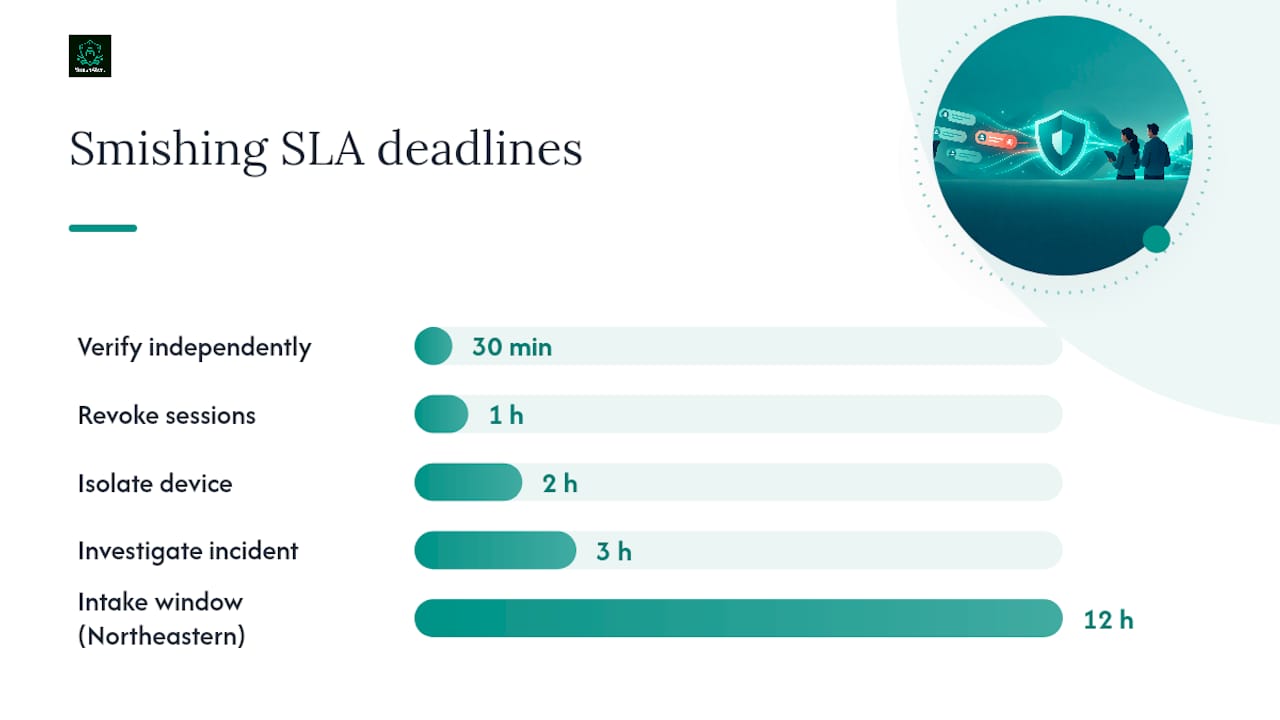
- Credential entry only, no MFA bypass: investigate within 3 hours, mitigate within 1 hour of confirmation.
- MFA approval granted to the attacker: treat as active compromise immediately, skip the standard investigation window, and escalate to mitigation within 30 minutes.
- Malicious app install or profile push: isolate the device within 2 hours and begin forensic capture before wiping anything.
- Payment or gift card fraud initiated: notify finance within 1 hour, alongside standard mitigation.
Statistic callout: Northeastern’s model pairs a moderate intake window with an overall SLA under two days for compromised accounts, a ratio worth borrowing even if your absolute numbers differ. Scale rules should follow similar logic, with escalating SLA timeboxes for increased numbers of affected users, and automatic elevation to a campaign SLA when multiple reports reference the same sender, link, or lure text within a short time window.
How Do You Build an Editable Smishing Response SLA Template?
Every SLA is only as good as the ticket system enforcing it; designing ticketing and automation playbooks that enforce SLA handoffs ensures effective enterprise security integration. Build the template as a table you can drop directly into ServiceNow, Jira Service Management, or whatever ITSM platform your organization already runs, and assign explicit ownership to each row so no phase sits without an accountable name attached.
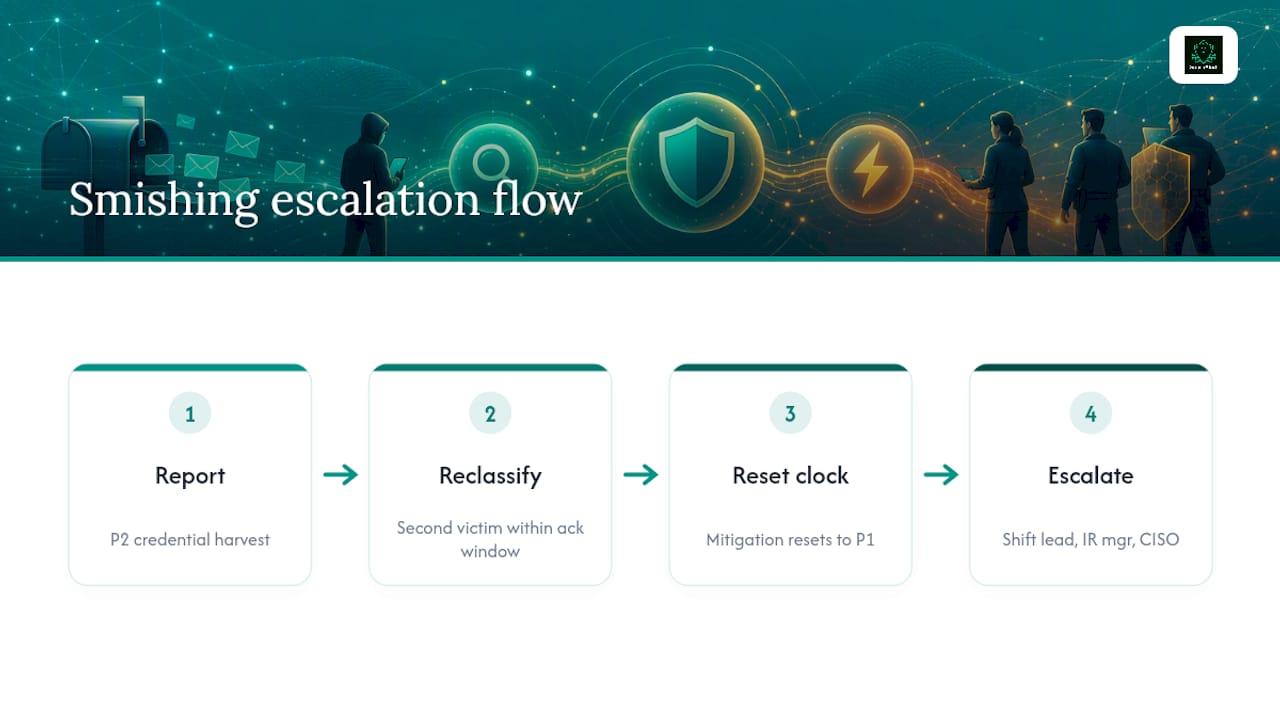
Priority reclassification matters as much as the initial target. A P2 credential harvest that surfaces a second victim within the acknowledgment window should auto-reclassify to P1, which resets the mitigation clock to the tighter tier rather than letting the original priority ride through resolution. Escalation owners should be named individuals, not “the security team”: a shift lead for after-hours triage breaches, the IR manager for anything crossing the campaign threshold, and the CISO for incidents implicating executive accounts or payroll systems.
What Workflow and Metrics Prove Your Smishing SLA Is Working?
The workflow underneath every SLA target runs through six checkpoints: report, acknowledge, verdict, action, closure, and post-incident review. Each checkpoint needs a defined artifact, not just a status change, or you end up with a ticket history that says “resolved” without anything a compliance auditor could verify a year later.
- Report: capture the message screenshot, sender number or short code, and full link text without clicking it.
- Acknowledge: log the ticket with a timestamp and assign a triage owner inside the SLA window.
- Verdict: pull identity provider sign-in events and mobile threat defense alerts to confirm malicious intent.
- Action: execute containment, whether that’s session revocation, device isolation, or a carrier report.
- Closure: document what was revoked, reset, or isolated, with confirmation from the account owner.
- Review: feed the incident into campaign correlation to check for repeat senders or lure patterns.
Minimal evidence for safety means screenshots and headers, never a clicked link; preserve URLs as plain text strings for later sandbox analysis instead. The enterprise smishing defense guidance from DecryptionDigest recommends monitoring a confirmed-compromised account for 30 days after remediation, which your closure artifact should reference explicitly.
Pro Tip: Track reporting rate separately by channel. A mobile phishing reporting gap analysis found that improving email reporting numbers tells you nothing about whether SMS threats are even reaching your queue.
Core KPIs to track weekly: reporting rate by channel, time to verdict, time to revoke credentials, percentage of reports confirmed as part of a coordinated campaign, and SLA breach rate by phase. A breach rate climbing on the mitigation phase specifically usually points to a helpdesk bottleneck on session revocation, not a detection failure.
How Does a Smishing Incident Playbook Map to SLA Deadlines?
A workable playbook needs seven steps, each carrying its own SLA checkpoint: pause, verify, report, preserve, contain accounts, contain devices, protect funds and data. That sequence, drawn from the mobile phishing response guide published by EncryptCentral, gives every responder an unambiguous next action instead of a vague “investigate the incident” ticket.
Three example timelines show how the sequence compresses under pressure:
- Credential entry, no MFA involved: verify independently within 30 minutes, investigate within 3 hours, revoke sessions within 1 hour of confirmed compromise, force a password reset from a clean device per the DecryptionDigest response framework.
- MFA approval granted to attacker: skip standard triage sequencing entirely; this is confirmed compromise the moment approval is logged, so mitigation starts immediately rather than waiting on a verdict.
- Malicious app or profile installed: isolate the device from the network within 2 hours and begin forensic capture before any wipe, following containment guidance on preserving volatile evidence.
Statistic callout: Northeastern’s compromised-account model pairs a 12-hour intake window with 2-hour mitigation on specific substeps, a pattern worth mirroring for any organization building its first formal smishing SLA.
External reporting runs in parallel, not after. Report the sending number to the carrier and log the campaign with the Anti-Phishing Working Group, FTC, and FBI IC3 when multiple reports point to the same coordinated source. Notify finance the moment a payment or gift card request surfaces, and loop in legal whenever the incident touches regulated data or executive impersonation.
How SmishAlert Helps Security Teams Meet Smishing Response SLAs
Every SLA phase above depends on one thing your team can’t control by policy alone: how fast a suspicious message actually reaches you. Some platforms close that gap by enabling users to report suspicious text messages directly from the channel where the attack landed, without forwarding to email or waiting on a help desk ticket to start the clock. That single change moves your acknowledgment SLA from a manual bottleneck to something measurable from the first minute.
Once a report lands, SmishAlert’s automated analysis produces a verdict on sender reputation and message content, then correlates that report against others across your user population to flag coordinated campaigns before a second victim clicks the same link. For teams running SIEM or ticketing integrations, SmishAlert enriches each incident with the evidence bundle your IR playbook already requires: sender data, message content, and correlation history ready for your ITSM system. Deployment options cover employee protection, customer and member reporting without an app install, and an MSP/MSSP partner model for teams managing SLAs across multiple client environments. If your organization is evaluating how to close visibility gaps around executive impersonation reaching mobile devices, SmishAlert’s product overview is the place to start.
Sources
- Northeastern University — Service level agreements
- Smishing in 2026: where the attacks are actually landing | Future of SecOps
- Enterprise Smishing Defense 2026: SMS Phishing Attack Guide
- Smishing, vishing, and mobile phishing response guide | EncryptCentral
FAQ
What Is a Reasonable Smishing Response SLA for Investigation?
Most IR teams target 2 to 6 hours for investigation, tightening toward the lower end when credentials or MFA are involved. Northeastern University’s published SLA model uses 3 to 6 hours for specific incident substeps as an operational benchmark.
How Fast Should Credential Revocation Happen After Confirmed Smishing Compromise?
Session revocation and password resets should happen within an hour of confirmed compromise, ideally from a clean device. Enterprise smishing defense guidance also recommends monitoring the account for 30 days afterward.
When Should a Smishing Incident Escalate to a Campaign-Level SLA?
Escalate once multiple reports reference the same sender, link, or lure text within a short rolling window, commonly one hour. Campaign-level SLAs run tighter than single-user SLAs because coordinated attacks spread faster across an organization’s user population.
What Should Be Reported Externally During a Smishing Incident?
Report the malicious sending number to the carrier, and for coordinated campaigns, file with the Anti-Phishing Working Group, the FTC, and FBI IC3. Internal reporting to finance and legal should happen in parallel whenever payment fraud or regulated data is involved.
Does SmishAlert Have Published Pricing for Its SLA-Related Plans?
SmishAlert does not publish pricing for its Employee Messaging Protection, Customer & Member Scam Reporting, Messaging Threat Intelligence, or MSP/MSSP Partner Program plans. Current pricing is available directly through SmishAlert’s product page.