
Cut Smishing Dwell Time in Hours: Five Interval SOC Playbook
The fastest way to reduce smishing dwell time is to combine frictionless reporting, automated correlation, and rapid SOAR-backed containment while prioritizing protection for high-risk identities. Measure the attack chain as five discrete intervals: receipt→report→triage→containment→remediation. Everything else in a smishing response program exists to shorten one of those five gaps.
TL;DR:
- Automatic correlation of reports enables rapid detection of smishing campaigns, reducing dwell time by identifying shared infrastructure and messaging patterns.
- Prioritized automation for high-risk identities, such as executives and payroll staff, allows faster containment and significantly cuts response time.
- A breakdown of response intervals reveals the greatest dwell time gains occur at the report-to-triage and containment-to-remediation stages.
- Integrating smishing detection tools with SIEM and SOAR platforms automates containment actions, eliminating manual handoffs and delays.
- Implementing frictionless reporting options and automated enrichment drastically shortens the warning-to-action window, especially when targeting critical accounts.
Table of Contents
- A Compact, Prioritized Playbook You Can Adopt in Hours to Weeks
- How to Measure Smishing Dwell Time and What Actually Matters
- Designing a Closed-Loop Detection Pipeline for Messaging Threats
- Technical Controls and Integrations That Reduce Dwell Time in Practice
- Containment Runbook: Step-by-Step Triage to Remediation for Smishing Incidents
- Prioritization: An 80/20 Rollout to Cut Dwell Time Fastest With Limited Resources
- Where SmishAlert Fits the Playbook and How to Pilot It
- Sources
- FAQ
A Compact, Prioritized Playbook You Can Adopt in Hours to Weeks
Most SOCs already have the pieces needed to cut smishing dwell time. What’s usually missing is the sequence that connects reporting to containment without a human having to manually stitch queues together.
- Stand up frictionless reporting. Give employees, customers, and members a low-friction way to report suspicious texts: SMS forwarding to a short code, a lightweight reporting widget, or a portal that doesn’t require an app install. The FCC’s guidance on smishing recommends forwarding suspicious texts rather than replying, and that same instinct scales into an organizational reporting workflow.
- Automate artifact extraction. Every report should trigger automatic capture of the sender number, embedded URLs, message metadata, and a screenshot, without an analyst copying and pasting from a phone.
- Correlate reports across users. A single report is noise. Ten reports referencing the same URL or sender pattern within an hour is a campaign, and that correlation needs to happen automatically, not during a weekly review.
- Push containment back into your stack. Confirmed indicators should flow straight into carrier filters, SIEM watchlists, and email/URL blocklists without a manual ticket-and-wait cycle.
Each step removes a manual handoff. Manual handoffs are where dwell time hides.
How to Measure Smishing Dwell Time and What Actually Matters
Dwell time for smishing isn’t one number. The 2025 Verizon DBIR frames it as several linked intervals, and treating it that way is the only way to find where your program is actually slow.
Break the chain into:
- Receipt→report: how long between a user getting the message and telling security about it.
- Report→triage: how long before an analyst or automated system opens the report.
- Triage→containment: how long to block the sender, URL, or session.
- Containment→remediation: how long to rotate credentials and confirm the identity is clean.
Segment every one of these by channel (SMS versus iMessage versus WhatsApp), by role (executive versus general staff), by device ownership (managed versus BYOD), and by business process (payroll, help desk, finance approvals). A median that looks fine in aggregate often hides an executive population with a report→triage time three times slower than everyone else. Report these figures to leadership monthly, alongside confirmed-exposure rate and credential-revocation time, not as a training-completion percentage.
Designing a Closed-Loop Detection Pipeline for Messaging Threats
A closed-loop pipeline treats every report as raw telemetry, not a one-off complaint ticket. The CISA advisory on Scattered Spider describes exactly this pattern: intake feeding enrichment, enrichment feeding correlation, correlation feeding automated response.
Intake can come from multiple directions at once:
- Managed device agents on corporate-owned phones.
- BYOD reporting through a portal or forwarding number, with no MDM enrollment required.
- Web-based reporting widgets for customers and members who received a fraudulent text impersonating your brand.
- Carrier spam-forward channels feeding directly into your intake queue.
Once a message lands, automated enrichment should pull sender reputation, URL reputation, WHOIS data on the destination domain, and a sandboxed render of any landing page. Correlation logic then matches these enriched artifacts across recipients, looking for shared infrastructure, sender patterns, or near-identical message text, which is how a scattered set of individual reports becomes a detected campaign.
Pro Tip: Route correlation output directly into your SIEM as a distinct alert type, separate from generic phishing alerts. Smishing campaigns often cluster by department or geography in ways email phishing doesn’t, and a dedicated alert category makes that pattern visible instead of buried in a shared inbox.
Integration points matter as much as the logic itself. SIEM handles analytics and long-term pattern detection. SOAR executes the actual playbook steps. Ticketing APIs hand confirmed incidents to IR for human review. Skip any one of those three and the loop stays open.
Technical Controls and Integrations That Reduce Dwell Time in Practice
Email-focused SIEM and XDR platforms are effectively blind to smishing unless someone feeds them message-level telemetry. A phishing email leaves headers and a mail gateway log; a smishing message leaves nothing unless the recipient reports it. That’s the visibility gap driving most of the dwell time problem in mobile channels today.
Identity telemetry and EDR pick up where message data leaves off. Once a credential is captured, the signal shifts to anomalous logins, new MFA device enrollments, and impersonated help-desk requests. Neither message telemetry nor identity telemetry alone tells the full story. You need both feeding the same analyst view.
A practical integration pattern looks like this:
- Ingestion. Reports arrive from any channel and get normalized into a single format.
- Enrichment. Automated lookups attach reputation, sandbox, and correlation data.
- SIEM alert. Enriched, correlated data generates a prioritized alert, not a raw report dump.
- Automated SOAR playbook. Confirmed threats trigger blocklist updates, URL takedown requests, session revocation, and MFA-device unenrollment without waiting on a human to execute each step manually. Tools built for incident response automation show how this kind of playbook logic already works well in adjacent SOC workflows.
- Analyst review. A human confirms the automated actions and closes or escalates the ticket.
Removing steps 3 and 4 from a manual queue is usually where the biggest dwell time reduction actually happens.
Containment Runbook: Step-by-Step Triage to Remediation for Smishing Incidents
Once a report is confirmed as a real threat, the clock matters more than the paperwork. CISA’s guidance on Scattered Spider style attacks lays out a sequence that holds up well as a general containment runbook.
- Preserve evidence first. Capture the message, sender metadata, URL, headers, and a screenshot before anything gets deleted or the account gets locked.
- Triage scope. Determine whether this is a single-target attempt or part of a coordinated campaign, and identify every identity or workflow potentially exposed.
- Act immediately on confirmed threats. Block the sender and URL, kill active sessions, rotate credentials, and unenroll any suspicious MFA device tied to the account.
- Escalate to telecom and finance when warranted. Contact the carrier if a SIM swap is plausible, and alert payroll or finance immediately if the lure targeted a payment workflow.
- Follow up methodically. Monitor for repeat attempts, audit any help-desk actions taken on the account, and push new indicators into detection rules.
Pro Tip: Rotate credentials before you unenroll a suspicious MFA device, not after. CISA’s countermeasure guidance notes that removing the device first can prompt a re-enrollment attempt on a still-valid password, giving the attacker a second bite at persistence.
For accounts tied to critical access, this is also the moment to push toward phishing-resistant MFA rather than simply reissuing SMS codes that got the account compromised in the first place.
Prioritization: An 80/20 Rollout to Cut Dwell Time Fastest With Limited Resources
Not every identity needs the same response speed on day one. A small set of accounts, executives, payroll administrators, SSO admins, and help-desk staff who can reset credentials, carries most of the actual business risk.
- Identify that short list first and build automated escalation rules specifically for reports touching those roles.
- Set a tighter SLA for high-sensitivity reports (minutes, not hours) and let general-population reports run on a slightly longer cycle.
- Run a two-to-four-week pilot focused only on that group and measure report→containment time before and after.
- Bring the before/after numbers to leadership. A concrete drop in containment time for your highest-risk accounts justifies expanding the program faster than any awareness metric will.
Where SmishAlert Fits the Playbook and How to Pilot It
Everything in this runbook depends on closing the loop between a reported message and an executed containment action, and that’s the specific gap SmishAlert is built to close. Traditional email security platforms lose visibility the moment an attack moves to a text message, which means the reporting, enrichment, and correlation steps above often end up stitched together manually across disconnected tools.
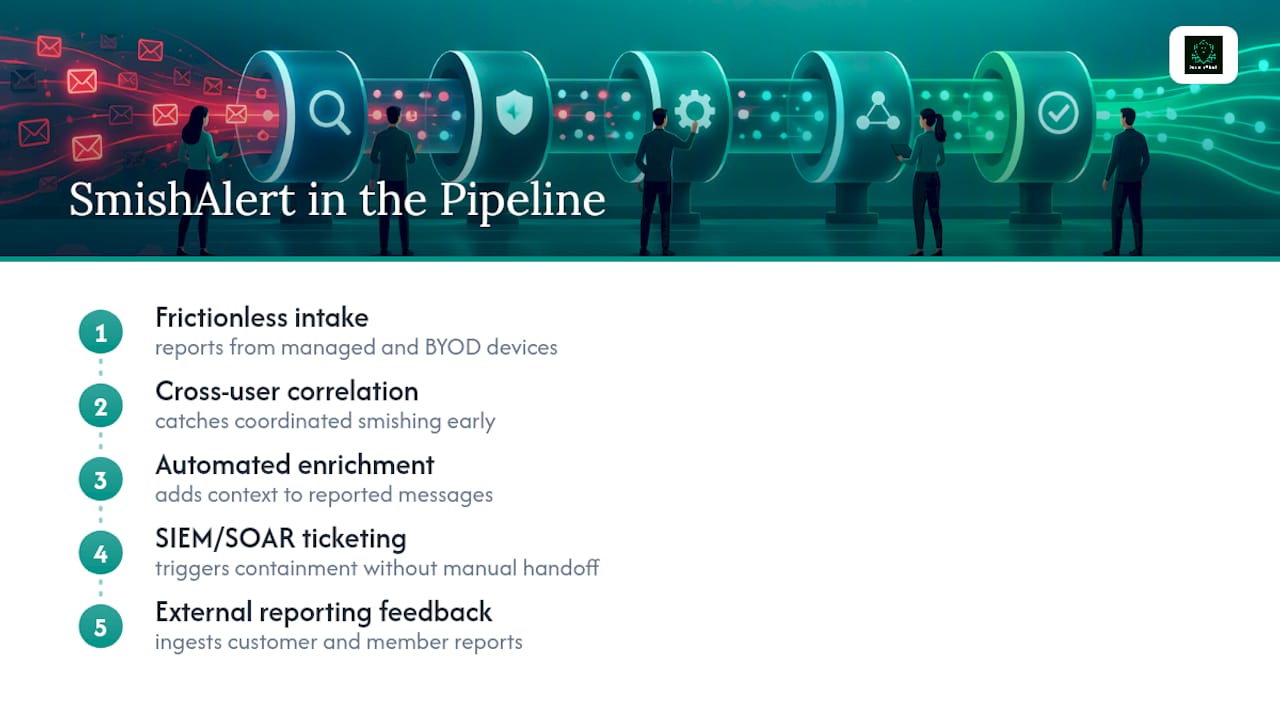
SmishAlert maps directly onto the pipeline described in this guide: frictionless intake for employees and executives on managed or BYOD devices, cross-user campaign correlation to catch coordinated smishing attempts early, automated enrichment of reported messages, and SIEM/SOAR ticketing so confirmed threats trigger containment without a manual handoff. It also extends reporting to customers, members, and students who receive brand-impersonation texts, feeding that intelligence back into the same correlation engine security teams already rely on. Organizations weighing how to protect employees from executive impersonation via text can see how that specific attack pattern gets caught earlier when reporting and correlation aren’t siloed.
The practical next step is a pilot scoped to your highest-risk identity group, run against the report→containment metrics outlined earlier in this guide. Review the SmishAlert product overview to see how intake, enrichment, and SIEM/SOAR integration fit your existing stack before scoping that pilot.
Sources
- 2025 Data Breach Investigations Report (Verizon DBIR)
- Scattered Spider advisory (CISA)
- Avoid the temptation: smishing scams (FCC guidance)
FAQ
What Is Dwell Time in Cybersecurity?
Dwell time is the elapsed period between an attacker’s initial compromise and its detection. For smishing specifically, it’s more useful to break that single number into discrete intervals: receipt to report, report to triage, triage to containment, and containment to remediation.
How Do You Calculate Dwell Time for a Smishing Incident?
Calculate it as the sum of the four intervals above, but track each interval’s median and percentile separately rather than reporting one blended average. A program can look healthy on average dwell time while hiding a slow report→triage step for a specific department or device type.
What Is the 80/20 Rule in Cybersecurity?
Applied to smishing response, it means a small set of high-impact identities, executives, payroll administrators, SSO admins, and help-desk staff, carry most of the real business risk from a successful attack. Prioritizing tighter reporting SLAs and automated escalation for that group produces faster dwell-time gains than spreading equal effort across the entire employee population.
Which Mitigation Is Most Effective in Reducing Security Breaches Through Phishing?
CISA identifies phishing-resistant MFA, such as FIDO or WebAuthn-based authentication, as one of the strongest available protections, since it removes the SMS codes and push-approval flows that smishing campaigns are specifically designed to intercept. Pairing that with fast, automated containment closes the window even when a message does get through.
How Does SmishAlert Reduce Smishing Dwell Time?
SmishAlert shortens the receipt→report and report→containment intervals by giving employees, executives, and customers a frictionless way to report suspicious texts, then automatically correlating those reports across users to detect campaigns and feeding confirmed threats into SIEM and SOAR workflows. Current pricing and plan details are available directly on the SmishAlert site.