
Within an Hour, Share Smishing Intel: 5 Step SOC Playbook

When a smishing report lands in your queue, share smishing intel by capturing the message artifacts, forwarding the sample to 7726, and opening a SOC triage ticket within the hour. The triage analyst or the designated abuse inbox owns that first step. Speed matters here more than polish: fast reporting lets carriers block senders and lets your team spot the campaign before it reaches the next thousand phones.
TL;DR:
- Reporting smishing requires capturing detailed message artifacts, including full text, screenshots, sender info, timestamps, and URL destinations within an hour to enable rapid blocking and campaign detection.
- Sharing intelligence at scale, especially through platforms like 7726 and APWG, helps identify active campaigns faster by correlating patterns across multiple reports and indicators.
- Collecting and analyzing domain registration patterns, URL obfuscation tactics, and rapid certificate issuance are key to identifying and blocking smishing infrastructure early.
- Confirmed threats should trigger immediate technical responses such as domain blocking, credential resets, and updating detection controls, along with targeted workforce briefings.
- Using secure, standardized workflows for internal and external sharing, including proper redaction and adherence to legal and privacy policies, enhances threat response effectiveness.
Table of Contents
- What Is Smishing and What Should SOCs Collect First?
- Why Sharing Smishing Intelligence Improves Detection and Containment
- SOC Triage Playbook: Collect, Enrich, Correlate, Act
- Where to Report Smishing: Carriers, APWG, and Regulators
- Which Indicators and Domain Tactics Should SOCs Watch For?
- How to Escalate Smishing Reports to Carriers and Partners
- Legal and Privacy Considerations When Sharing Smishing Data
- Best Practices for Sharing Smishing Intelligence Securely
- Building the Workflow That Turns Reports Into Detections
- What to Do With Confirmed Smishing Intelligence
- Which Collaboration Frameworks Support Smishing Intel Sharing?
- How SmishAlert Closes the Mobile Reporting Gap
- Sources
- FAQ
What Is Smishing and What Should SOCs Collect First?
Smishing is phishing delivered over SMS, RCS, or app-based messaging rather than email, and it is a subset of a much larger problem: messaging-based social engineering that also includes voice calls, QR codes, and impersonation inside apps like WhatsApp or iMessage. Treat smishing as one attack vector within that broader category, not a synonym for all of it.
Every reported message is a piece of telemetry, but only if the intake process captures the right fields. When a user forwards a suspicious text, ask for:
- The full message text, copied verbatim, not paraphrased
- A screenshot showing the entire thread, including prior legitimate messages
- The sender’s number or short code exactly as displayed
- The timestamp and the recipient’s time zone
- The device platform (iOS, Android, carrier)
- Any clicked URL, both the raw shortened link and its expanded destination
Thread context matters because attackers increasingly inject smishing messages into existing conversation threads or spoof short codes tied to known brands. A message that appears to continue a real delivery notification or bank alert thread carries inherited trust, and that context can bypass simple keyword filters that only scan the message body in isolation.
Why Sharing Smishing Intelligence Improves Detection and Containment
A single reported text tells you almost nothing on its own. Ten reports sharing the same landing page, certificate fingerprint, or registrar pattern tell you a campaign is active, and that correlation is what turns a user complaint into a high-confidence indicator of compromise.
Carriers and domain registrars generally will not act on a single unverified tip. They act on volume and pattern. Reporting to 7726 at scale is exactly why the code works: carriers ingest large volumes of forwarded spam and use that data to identify and block prolific senders, often faster than any single enterprise could act alone.
Smishing infrastructure also moves fast. Newly registered domains supporting a campaign frequently have a short operational lifespan, sometimes days, before the operators rotate to new hosting. That narrow window is exactly why sharing indicators quickly, and pushing them into EDR, mobile threat defense, URL filtering, and SIEM correlation rules, prevents the next wave of clicks rather than just documenting the last one.
SOC Triage Playbook: Collect, Enrich, Correlate, Act
Treat every user-submitted smishing report the way you’d treat a phishing email forwarded to your abuse mailbox: as raw telemetry that needs enrichment before it becomes actionable intelligence.
- Intake. Confirm you have the screenshot, full message text, device OS, recipient time zone, recipient number, and whether the user clicked the link or entered credentials.
- Enrichment. Expand any shortened URL to its final destination, run a passive DNS lookup on the resolved domain, check WHOIS/registrar creation date, and query certificate transparency logs for related certificates issued to the same or adjacent domains.
- Correlation. Compare the landing page against other recent reports for lexical similarity, shared hosting infrastructure, identical certificate fingerprints, or a common SMS delivery vendor signature. Cross-recipient correlation in the first 72 hours often reveals area-code-tailored targeting that a single report would never expose.
- Response. Temporarily block the domain if it was registered recently, push a SIEM or URL-filter rule, notify the carrier and the registrar’s abuse contact, and if credentials were entered, force an MFA reset and password rotation for the affected user.
- Escalation. Define who validates the finding, who owns carrier and registrar communication, and at what threshold the case moves to legal or customer operations.
Pro Tip: Build a standing SLA where any smishing report tied to executive impersonation or payroll fraud auto-escalates to a senior analyst within 30 minutes. These campaigns tend to move faster than generic bulk smishing because the payoff per victim is higher.
Where to Report Smishing: Carriers, APWG, and Regulators
Reporting channels split into three categories: carrier-level blocking, industry-wide threat sharing, and regulatory or criminal reporting. Each does something different, and skipping one weakens the response.
- APWG’s SMS reporting portal: APWG accepts uploaded malicious SMS messages and landing pages, and uses aggregated submissions to track and help block senders across the ecosystem.
- FTC and IC3: for incidents with financial impact or criminal intent, file through reportfraud.ftc.gov and the FBI’s IC3; consumer-facing incidents can also route through the FCC complaints portal.
- Machine-readable sharing: for automated distribution to partners and vendors, STIX/TAXII packages with minimal metadata speed ingestion. For human-submitted reports, a compact CSV or JSON template works: message_id, timestamp, sender, recipient, raw_text, screenshot_url, expanded_url, who_reported, platform, notes.
Which Indicators and Domain Tactics Should SOCs Watch For?
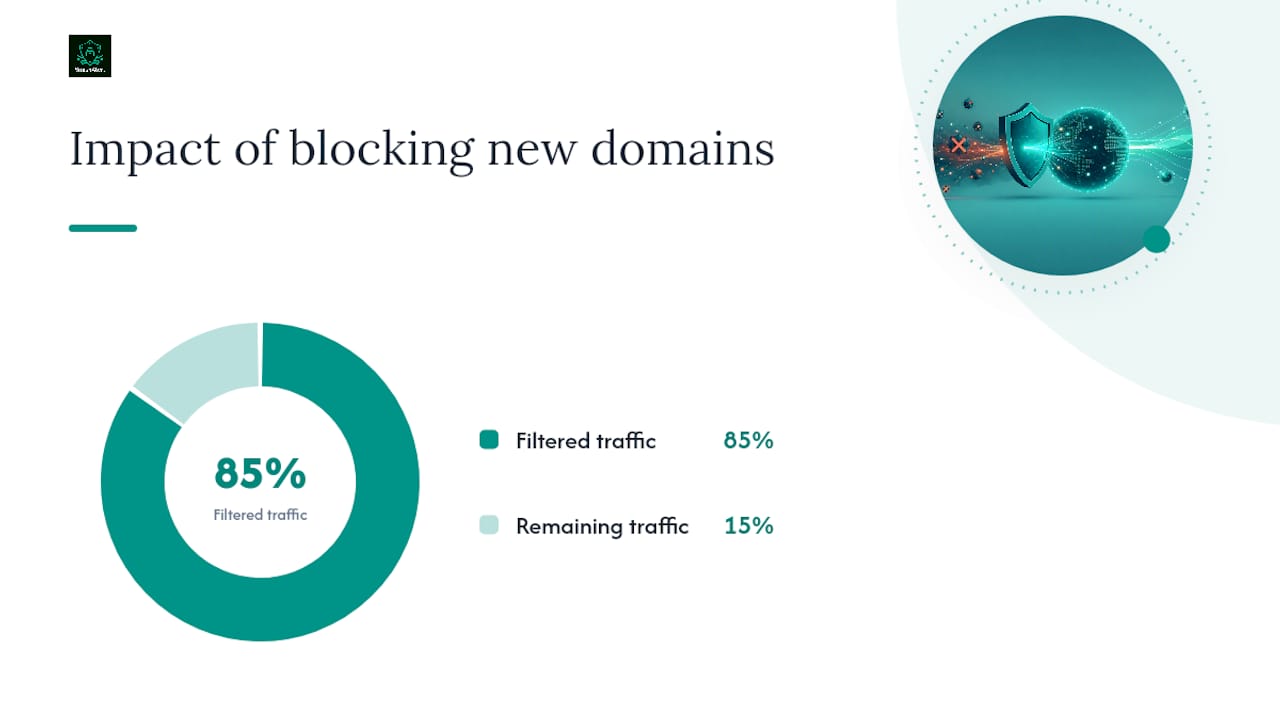
Domain infrastructure is the weakest link in most smishing operations, and it is also the fastest lever a SOC has to pull. Unit42 telemetry recorded sharp spikes in newly registered domains tied to active smishing campaigns, and found that blocking newly registered domains for roughly a month filtered out about 85% of smishing traffic in the campaigns observed.
Attackers also lean on link obfuscation to defeat basic lexical filters. A common tactic inserts a trusted brand name before an “@” symbol in a URL, banking on the fact that browsers and many filters treat everything after “@” as the actual host while a distracted human reads only what comes before it. Any detection logic that trusts the string preceding “@” instead of the resolved host is broken by design.
Group-text renaming is a subtler trick: some campaigns rename a group thread to display a short-code-style label, mimicking a legitimate alert channel. Watch for:
- Domains registered in the last 30 days serving SMS-linked landing pages
- URLs containing “@” where the pre-@ segment names a trusted brand
- Rapid certificate issuance patterns visible in certificate transparency logs tied to lookalike domains
- Sudden bursts of outbound SMS from a single delivery vendor account
Blocking newly registered domains, even for a short defensive window, is one of the highest-leverage single controls available against smishing infrastructure, precisely because attackers cannot easily reuse aged, reputable domains for a throwaway campaign.
How to Escalate Smishing Reports to Carriers and Partners
Escalation only works when the evidence package is complete before you send it. Carriers and registrars typically want the original screenshot, the forwarded message body, exact timestamps, and enough recipient metadata to confirm the report is legitimate rather than a false positive.
When sharing with APWG or an information sharing community, redact personally identifiable information that isn’t operationally necessary, following your organization’s data-sharing mapping rather than sending raw customer records. Loop in legal, customer support, and fraud teams whenever a campaign touches financial credentials, payroll data, or executive impersonation; executive protection teams should be looped in the moment a smishing lure names a specific officer by title or name.
During an active campaign, a daily IOC digest keeps partner teams synchronized; once the campaign cools, a short weekly postmortem captures what worked and what the next campaign will probably try differently.
Legal and Privacy Considerations When Sharing Smishing Data
Sharing smishing intelligence almost always means handling personal data: phone numbers, message content, and sometimes credentials a victim mistakenly entered. Before intel leaves your organization, decide what actually needs to travel with it. A registrar abuse report needs the malicious URL and evidence of delivery; it rarely needs the recipient’s full phone number or employer.
Internal policy should define a redaction standard applied consistently, not judged case by case under time pressure. Strip direct identifiers where the receiving party doesn’t need them to act, and keep an internal audit log mapping the redacted report back to the original in case law enforcement or a regulator later requests the full record.
Cross-border sharing raises its own questions. A multinational enterprise correlating smishing reports across regions may be moving personal data across jurisdictions with different consent and retention rules. Legal counsel should weigh in early on any recurring sharing arrangement with a carrier, ISAC, or partner organization, not after the first exchange has already happened.
Retention deserves the same discipline. Threat intelligence has a shelf life. A domain or number tied to a resolved campaign doesn’t need to sit in a live sharing feed indefinitely; archive it, keep it searchable for future correlation, but don’t keep exporting stale PII into every new report just because the format template has a field for it.
Best Practices for Sharing Smishing Intelligence Securely
The biggest security teams increasingly treat internal and external threat sharing as two different problems that happen to share a data source.
Internally, the goal is speed and completeness. Analysts across shifts need a shared workspace, whether that’s a SIEM case, a ticketing queue, or a dedicated threat intel platform, so a report filed at 2 a.m. doesn’t sit unread until the morning shift. Version-controlled IOC lists prevent two analysts from independently rediscovering the same domain hours apart.
Externally, encrypt sensitive artifacts in transit, particularly anything containing message content or metadata tied to identifiable individuals. Use a dedicated, access-controlled channel for partner and carrier communication rather than ad hoc email threads that accumulate screenshots with no retention policy.
Attribution deserves caution too. Phishing-as-a-service kits sometimes contain backdoors that let the kit’s own author siphon credentials or tokens from the criminal operators using it, which means the operator running a campaign against your organization may not even be the party who profits most from it. Share indicators of compromise and infrastructure details rather than confident claims about who’s “behind” an attack; infrastructure holds up under scrutiny, attribution claims often don’t.
Building the Workflow That Turns Reports Into Detections
A smishing report that never reaches your detection stack is a wasted signal. The workflow that works treats every validated IOC as an automatic input to existing controls, not a manual follow-up task someone might get to.
Once an analyst confirms a malicious domain, the pipeline should push it to URL filtering and mobile threat defense without a second approval step for low-risk, high-confidence indicators. Higher-risk actions, like blocking a domain that also serves legitimate traffic on a shared hosting provider, need a human check before the rule goes live.
SIEM correlation rules should watch for repeat visits to newly flagged domains from the corporate network, since a smishing link a user clicked at home can still resolve to a corporate device syncing over Wi-Fi later that day. Feed confirmed sender numbers and short codes into your mobile threat defense policy so a second employee receiving the same lure gets blocked automatically instead of generating a duplicate ticket.
The endpoint of this workflow isn’t a closed ticket. It’s an updated detection rule, an enriched IOC list, and, ideally, a submission to APWG or a carrier so the next organization targeted by the same infrastructure has a head start.
What to Do With Confirmed Smishing Intelligence
Confirmed intelligence is only valuable if it changes what happens next for the people it affects, not just the indicators in your SIEM.
For any user who clicked a credential-harvesting link and entered information, force a password reset and an MFA re-enrollment immediately, and check for suspicious login activity on the affected account going back to the click timestamp. For payroll or executive impersonation lures, notify HR and finance directly rather than treating it as a purely technical incident, since these campaigns often target a specific approval workflow rather than a random employee.
At the infrastructure level, push the confirmed domain and sender number into your blocklists across email, web proxy, and mobile threat defense simultaneously; a domain blocked only in one control still reaches users through another channel. If the campaign impersonates your own brand, coordinate a takedown request with the hosting provider or registrar directly, citing the evidence package you assembled during triage.
Finally, brief the workforce, but specifically, not generically. A short internal alert describing the exact lure text and sender pattern generates far more reports in the following 48 hours than a generic “watch out for smishing” reminder ever will.
Which Collaboration Frameworks Support Smishing Intel Sharing?
Information Sharing and Analysis Centers, or ISACs, exist precisely because no single organization sees enough of a campaign to understand its full shape. Financial services, healthcare, and other regulated sectors run sector-specific ISACs where members share sanitized indicators, and a smishing campaign hitting one regional bank’s customers often shows up at three others within days.
Beyond ISACs, APWG functions as a broader industry clearinghouse that accepts malicious SMS and landing page submissions from any reporting organization, not just members of a specific sector. That openness matters for smishing specifically, since attackers rarely limit a campaign to a single industry vertical.
Vendor and partner communities add another layer. Cybersecurity vendors that publish IOC feeds, like the kind referenced throughout campaign tracking work from firms studying smishing-as-a-service operations, extend the reach of any single SOC’s visibility well beyond its own reported traffic.
The practical takeaway for a SOC building this into its operating rhythm: join at least one relevant ISAC if your sector has one, submit confirmed IOCs to APWG as a matter of routine, and treat vendor threat feeds as a supplement to internal reports, never a replacement for them.
How SmishAlert Closes the Mobile Reporting Gap
Everything above describes what a mature SOC does once a smishing report reaches the right inbox. The harder problem for most enterprises is getting the report there in the first place: email security platforms have no visibility once an attacker moves the conversation to SMS, iMessage, or WhatsApp, and that blind spot is exactly where executive impersonation, payroll fraud, and credential-harvesting texts thrive.
SmishAlert gives employees, customers, members, and students a frictionless way to report suspicious messages, then automatically correlates those reports across your user population to surface coordinated campaigns rather than isolated complaints. Confirmed threats and IOCs flow into your existing stack through SIEM and API integration, with audit-ready incident reporting built for compliance-sensitive sectors like financial services, healthcare, and higher education.
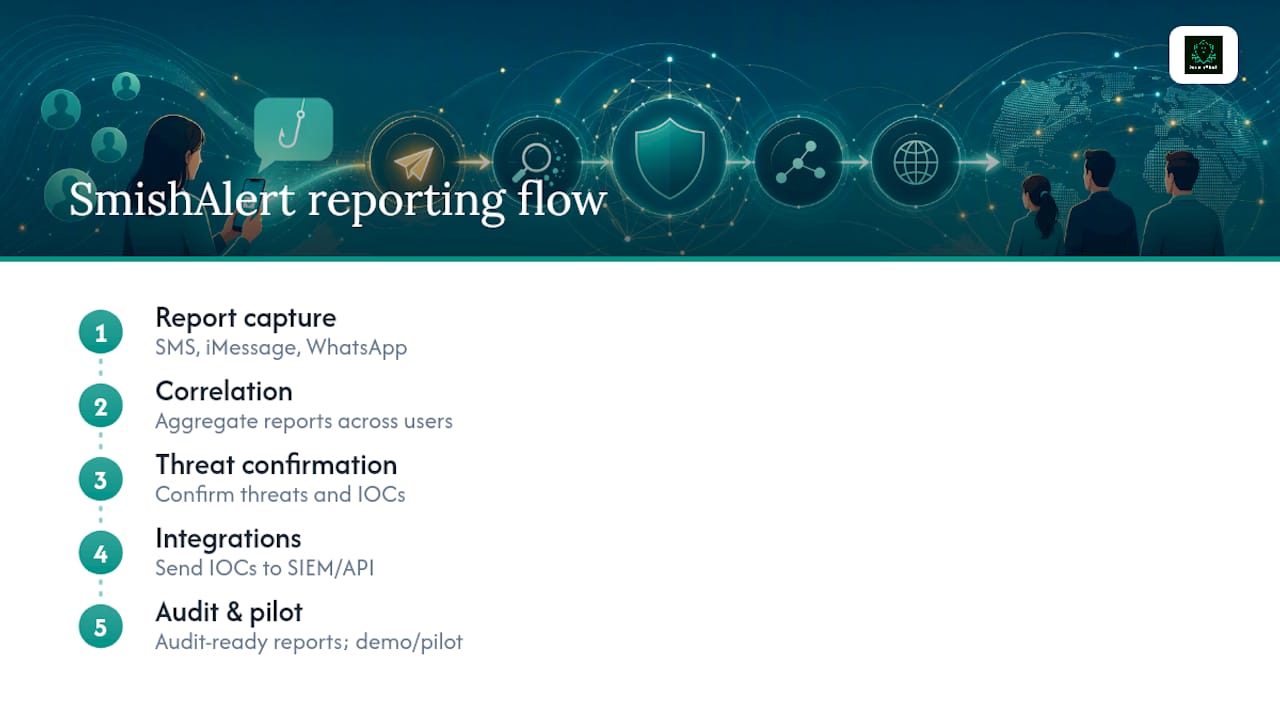
SOCs, CISOs, and MSSPs use it to fill exactly the gap this playbook describes: turning scattered mobile threat reports into the kind of campaign-level intelligence carriers, APWG, and internal detection systems can actually act on. If financial institutions are your primary exposure point, the customer scam reporting deployment is worth a look, and for organizations focused on employee-targeted attacks like executive impersonation over text, a pilot engagement is the fastest way to see correlated campaign data against your own reported traffic. Start with a demo request at SmishAlert to see what a pilot deployment surfaces in your environment.
Sources
- APWG: Upload a malicious SMS/text message
- Unit42 timely threat intel — smishing activity update (IOCs)
FAQ
Why Am I Getting Smishing Texts?
Attackers obtain phone numbers through data breaches, scraped directories, or automated number generation, then send lures at scale because SMS lacks the spam filtering maturity of email. Getting a smishing text usually means your number appeared in a leaked dataset or was targeted as part of a broader area-code sweep.
What Are the Signs of a Smishing Text?
Common signs include urgency (“your account will be locked”), a shortened or unfamiliar URL, a sender number that doesn’t match the brand it claims to represent, and requests to click a link or reply with sensitive information. Messages injected into an existing legitimate thread, or referencing a real recent transaction, deserve extra scrutiny since they exploit inherited trust.
What Is Smishing, Exactly?
Smishing is phishing conducted through SMS or messaging apps rather than email, and it typically uses a malicious link or a request for sensitive information to compromise the recipient. It’s one specific vector within the broader category of messaging-based social engineering, which also spans platforms like iMessage and WhatsApp.
How Do You Spot a Social Engineering Attack Over Text?
Look for pressure tactics, unusual sender behavior, and requests that bypass normal verification, such as a “CEO” asking for a gift card purchase over text. Verifying the request through a separate, known channel, like calling the person directly rather than replying to the message, is the single most reliable check.
Where Should Enterprises Send Confirmed Smishing Intelligence?
Forward the sample to 7726, submit it to APWG for cross-industry tracking, and file with the FTC or IC3 when the incident involves financial fraud. Organizations can route correlated campaign data directly into their SIEM through API integration for faster internal action.