
MDR for Smishing: 6 Signals to Detect and Contain Attacks

MDR cannot stop a malicious text from reaching an employee’s phone, but properly instrumented MDR programs detect the aftermath fast and contain identity-based damage before it spreads. The real value sits in correlating post-click signals: mobile telemetry, authentication logs, and cross-user campaign patterns. Mobile threat defense integration, auth-log correlation, and rapid containment workflows do the heavy lifting. A messaging-layer visibility tool adds coverage that most MDR stacks are missing entirely.
TL;DR:
- Most MDR programs detect smishing after identity-related activity occurs rather than intercepting malicious messages directly.
- Telemetry sources like authentication logs, mobile device activity, and user reports are essential for correlating suspicious sequences indicative of smishing attacks.
- Cross-user campaign detection is crucial to identify coordinated smishing campaigns that involve multiple employees or departments.
- Containment steps include immediate identity access revocation, reissuing MFA, and collecting detailed evidence before attacker activity disappears.
- Integrating messaging-layer telemetry via tools like SmishAlert closes the gap MDR networks have in detecting and responding to SMS-based threats efficiently.
Table of Contents
- What Smishing Looks Like Now and Why Email Controls Miss It
- How MDR Detects Smishing: Telemetry, Signals, and Correlation
- Operational Playbook: Investigate and Contain a Smishing Incident
- Prevention and Hardening: Policies, MTD, and Reporting Workflows
- How SmishAlert Complements MDR and Closes the Messaging Visibility Gap
- Ready to Close the Smishing Blind Spot in Your MDR Program?
- Sources
- FAQ
What Smishing Looks Like Now and Why Email Controls Miss It
Smishing has moved well past the “your package is delayed” template. Current campaigns impersonate executives asking finance staff to approve urgent wire transfers, HR systems requesting W-2 confirmations, payroll platforms flagging “direct deposit changes,” and vendors disputing invoice payment details. The IRS has documented a significant increase in texting scams that use government branding to pressure targets into fast, unverified action, and enterprise attackers borrow the same urgency playbook.
The technical reason SMS bypasses your existing controls is straightforward: DMARC, SPF, and DKIM validate email headers, not carrier delivery paths. URL sandboxing inspects links clicked from a corporate mail client, not from a personal messaging app on an unmanaged phone. Attackers exploit A2P grey routes and spoofed sender IDs to land messages directly on a device your security stack never sees. Carrier-level filtering and short-code registration cut down on commodity spam, but they routinely fail against targeted campaigns using SIM-controlled delivery paths built to evade detection.
The consequences land squarely on identity infrastructure:
- Credential harvesting through fake SSO or benefits portals
- MFA fatigue attacks that push repeated approval prompts until a user taps “yes”
- Account takeover following a single successful credential capture
- Unauthorized payments initiated after a spoofed executive text
Email security stacks provide close to no coverage for SMS-delivered attacks, which is why the detection burden shifts almost entirely to identity and endpoint telemetry.
How MDR Detects Smishing: Telemetry, Signals, and Correlation
MDR programs don’t “see” a text message. They see what happens after someone acts on it, and that’s where detection actually lives. The telemetry sources that matter most:
- Authentication logs from your identity provider, showing login attempts, MFA approvals, and password reset requests
- Endpoint and mobile telemetry, including device posture and app-level activity on managed phones
- Mobile Threat Defense (MTD) feeds that flag malicious URLs or suspicious app behavior on enrolled devices
- Network logs capturing outbound connections to newly registered or low-reputation domains
- SaaS access logs from platforms like Microsoft 365 or Google Workspace, showing anomalous session behavior
- User-reported messages, which remain the single fastest way to get a messaging-layer trigger into the SOC’s queue
Individually, each of these signals is ambiguous. A new login location could be a business trip. A single MFA approval could be a legitimate device swap. The pattern that actually indicates smishing-driven compromise is repetition and sequence: multiple MFA push approvals in a short window, a new OAuth grant that persists after the session ends, or a login from an unfamiliar geography that follows within minutes of a user clicking a link sent by text. HHS guidance on multi-factor authentication specifically calls out MFA flows as a smishing target, which is why analysts weight MFA anomalies heavily when triaging.
Pro Tip: If your SOC only investigates MFA fatigue alerts in isolation, you’re missing the correlation. Cross-reference the timestamp against any messaging report filed in the same hour. That link is often the only thing separating a false positive from a live account-takeover attempt.
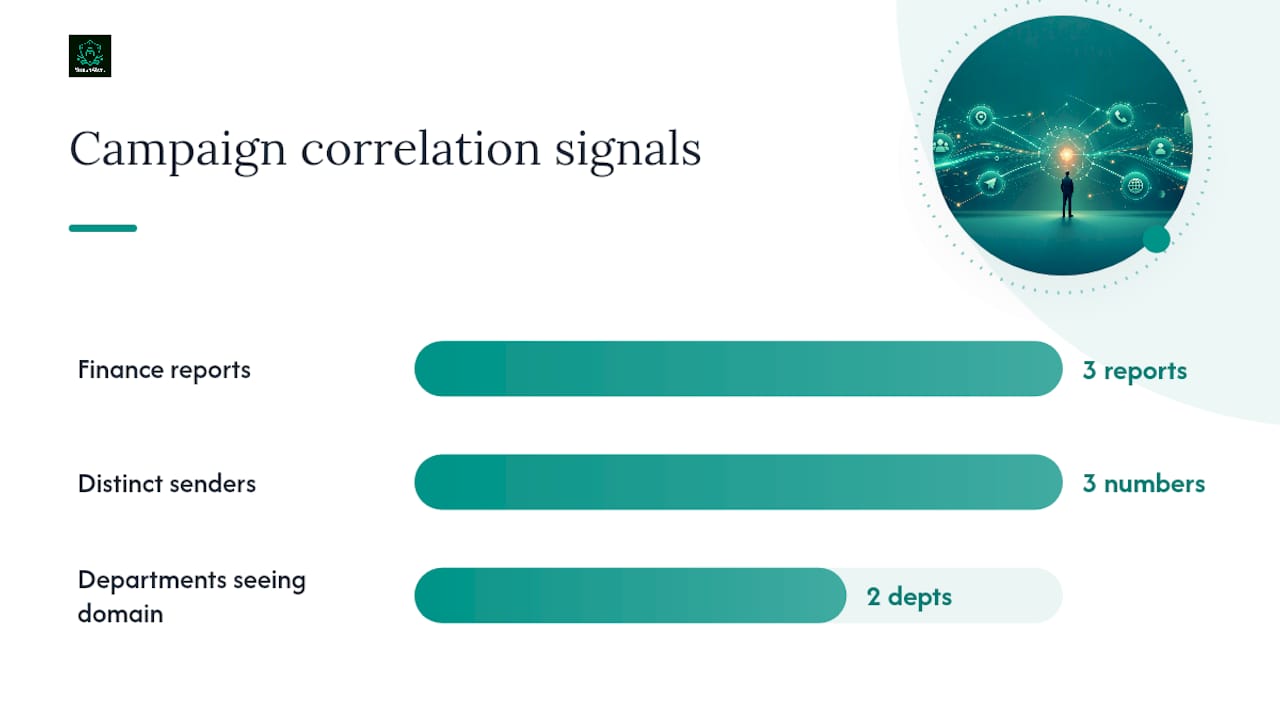
Cross-user campaign correlation is what turns a single confusing alert into an actionable incident. When three employees in finance report near-identical texts from different phone numbers referencing the same fake invoice portal, or when the same shortened URL domain shows up in reports from two unrelated departments, that’s a coordinated campaign, not isolated user error. Detection engineering built around identity telemetry alone will flag account anomalies without ever knowing a text message triggered them, which is precisely the blind spot that messaging-layer reporting is designed to close.
Operational Playbook: Investigate and Contain a Smishing Incident
Once a smishing report or a suspicious authentication event lands in the queue, the order of operations matters more than the tooling. Enterprise response playbooks consistently prioritize identity containment first, investigation second, because SMS interactions often bypass the telemetry your SIEM already trusts.
- Contain identity access immediately. Force a password reset, revoke active sessions, and pull any OAuth tokens or app passwords issued around the incident window.
- Revoke and reissue MFA. Don’t just reset the password; assume the MFA method itself may be compromised and force re-enrollment.
- Collect evidence before it disappears. Get a screenshot of the message, the sender number or short code, any URL involved, and the exact time the user interacted with it.
- Pull authentication artifacts. Cross-reference login timestamps, IP geolocation, and device fingerprints against the reported interaction time.
- Run a cross-user search. Query for the same sender number, domain, or message template across your reporting channel and mailbox logs to size the campaign.
- Escalate when money or sensitive data moved. Loop in finance, legal, and fraud teams the moment a payment was authorized or PII was submitted.
A structured threat-hunting approach to smishing logs makes step five far faster, letting analysts search across message metadata the same way they’d pivot on an IOC in a SIEM query. That’s the integration point: smishing containment steps should feed directly into existing XDR case management, not live in a separate spreadsheet nobody checks after the first 24 hours.
Pro Tip: Preserve the raw message metadata, not just a screenshot. Sender ID, timestamp, and delivery path often matter more for campaign correlation than the message body itself, and screenshots alone strip that data out.
Prevention and Hardening: Policies, MTD, and Reporting Workflows
Detection and response only work as fast as the reporting pipeline feeding them. The strongest smishing prevention programs combine three layers: policy, technical controls, and a reporting culture people actually use.
On policy, ban sensitive workflows from ever running over SMS. Password resets, wire approvals, and benefits changes should never legitimately arrive by text, so tell employees that plainly. Register and verify official short codes for any legitimate business texting you do run, and shift security prompts to in-app push notifications instead of SMS one-time codes wherever possible.
On the technical side, deploy Mobile Threat Defense on every managed device, enforce OS and app patching on a fixed schedule, and turn on URL reputation checks in the mobile browser. Frictionless reporting paired with MTD on enrolled devices closes a large share of enterprise exposure, even when BYOD limits how deeply you can inspect personal phones.
On the operational side, give employees one obvious reporting route, not three competing ones, and don’t punish people for reporting something that turns out to be benign. Training built around real SMS examples, rather than generic phishing modules, measurably reduces click-through rates because people recognize the specific format they’re likely to see. The FCC recommends never clicking links or replying to suspicious texts and reporting them to the FCC and FTC, guidance worth building directly into your internal reporting instructions.
| Control layer | Action | Primary benefit |
|---|---|---|
| Policy | Ban sensitive tasks via SMS | Removes the pretext attackers rely on |
| Technical | Deploy MTD on managed devices | Flags malicious URLs before a click completes |
| Technical | Enforce mobile patching cadence | Closes exploit paths tied to older OS versions |
| Operational | Single, frictionless reporting route | Cuts time between click and SOC visibility |
| Operational | Reward early reporting | Increases report volume, improves campaign detection |
How SmishAlert Complements MDR and Closes the Messaging Visibility Gap
MDR programs are built to correlate identity and endpoint telemetry, but most have no native channel for the thing that started the incident: the text message itself. That’s the gap SmishAlert is built to close, sitting alongside your MDR provider rather than replacing it.
Some platforms collect and analyze reported messages from employees and separately from customers, members, or students, potentially without requiring an app install for that reporting population. These platforms can correlate reports across users to surface coordinated campaigns, flag patterns like executive impersonation or payroll fraud, and generate audit-ready incident records that SOCs can hand to compliance or legal teams without extra formatting work. On managed and enrolled executive devices, on-device filtering can add another detection layer before a message reaches the inbox.
Organizations typically start with a pilot phase before moving to an annual subscription, and the deployment questions worth asking any messaging-focused vendor apply here too:
- What telemetry sources does it ingest, and how does that data reach the SIEM?
- Does it support API integration into existing XDR case management?
- What does the pilot actually measure, and over what window?
- What evidence gets delivered to the SOC during a live incident?
Pro Tip: Ask any vendor, SmishAlert included, to show you a real correlated campaign example before you sign anything. If they can’t produce one, the “correlation” claim is probably aspirational.
Ready to Close the Smishing Blind Spot in Your MDR Program?
A pilot program should demonstrate measurable campaign detections that provide new SOC visibility, seamless integration into existing workflows without additional unmanaged processes, and reduced time-to-contain on identity-related incidents triggered by messaging. If a pilot can’t show those three, it isn’t worth extending.
SmishAlert is built specifically for the visibility gap this article describes: the space between “email security stops working” and “your MDR provider sees an identity anomaly with no idea what triggered it.” Unlike a generic awareness platform, SmishAlert combines frictionless reporting, mobile threat protection, automated message analysis, and cross-user campaign correlation, so your SOC gets the messaging-layer trigger, not just the downstream account anomaly. You can review real detected campaigns on the SmishAlert threat intelligence page, explore how the platform maps to enterprise, financial services, and MSP deployments on the product overview, and evaluate specific attack coverage, including executive impersonation, on the solutions page. If payroll fraud or executive spoofing is your team’s top concern, start with how to protect employees from executive impersonation via text and bring that framework into your next pilot conversation.
Sources
- Avoid temptation—smishing scams
- HHS multi-factor authentication and smishing guidance
- IRS reports significant increase in texting scams
FAQ
What Is MDR in Security?
MDR, or Managed Detection and Response, is an outsourced service that monitors telemetry across endpoints, identity systems, and networks to detect threats and actively contain them, rather than just alerting on them. For smishing specifically, MDR’s value comes from correlating identity and endpoint signals with a messaging-layer trigger, since SMS delivery itself typically sits outside the telemetry MDR providers normally ingest.
Who Are the Top MDR Providers?
There’s no single authoritative ranking of MDR providers, and capabilities vary widely by industry vertical and telemetry coverage. The more useful question for smishing specifically is whether a given MDR provider ingests mobile and messaging-layer signals at all, since most legacy MDR stacks were built around endpoint and network telemetry, not SMS.
Is MDR Worth the Cost for Smishing Defense?
MDR is worth the investment when it’s paired with visibility into the messaging channel that triggers most smishing-driven incidents in the first place. Without that messaging-layer input, MDR still catches downstream account anomalies, but analysts lose the context needed to distinguish a coordinated campaign from an isolated user mistake.
What Does MDR Stand For?
MDR stands for Managed Detection and Response, a service model combining continuous monitoring with active incident containment rather than passive alerting alone.
Where Should Employees Report a Suspicious Text?
Employees should have one clear internal reporting route that feeds directly into SOC triage, and organizations can supplement that with reporting to the FCC and FTC for broader threat tracking. Platforms like SmishAlert are built to make that internal reporting step frictionless for both employees and, separately, for customers or members reporting suspicious messages.