
4 Telemetry Sources SOCs Need to Run Sigma Rules for Smishing

Sigma rules can detect smishing, but only against ingested telemetry, not on the device itself. If you have no message-reporting feed or mobile threat defense (MTD) alert stream flowing into your SIEM, a Sigma rule has nothing to evaluate. The first three moves for any detection engineer: confirm what mobile messaging telemetry actually reaches your log platform, map those fields to a normalized schema, and start with simple keyword and field-based selections before layering complexity.
TL;DR:
- Sigma rules require mobile messaging telemetry such as SMS logs, user reports, or MTD alerts to effectively detect smishing campaigns.
- Detection rules typically rely on normalized fields like sender ID, message content, URL domain, and timestamp, which must be standardized across your ingestion pipeline.
- Combining keyword-based patterns with field-based indicators, including URL domain age or shortener usage, enhances detection accuracy while minimizing false positives.
- Conversion of Sigma rules into SIEM queries demands careful field mapping and appropriate deployment strategies, either scheduled or real-time, for timely alerts.
- Maximizing detection coverage involves enriching telemetry with threat intelligence, implementing user reporting workflows, and correlating reports across multiple recipients.
Table of Contents
- Understanding Sigma Rules for Smishing Detection
- What Telemetry Do You Need to Run Sigma Rules for Smishing?
- Example Sigma Rule Patterns for Detecting Smishing
- Converting and Deploying Sigma Rules in Your SIEM
- Testing and Tuning Your Smishing Detection Rules
- The Mobile Visibility Gap and Program Best Practices
- Where SmishAlert Fits Alongside Sigma-Based Detection
- Sources
- FAQ
Understanding Sigma Rules for Smishing Detection
Sigma is a portable, YAML-based detection format built for server-side log analysis. It was designed to let detection engineers write a rule once and translate it into the query syntax of nearly any SIEM, using conversion tools like pySigma or the Sigma command-line interface. That portability is why Sigma has become the closest thing security operations has to a common language for detections.
A Sigma rule for smishing follows the same anatomy as any other Sigma rule. According to the Sigma detection format documentation, every rule needs:
- Metadata — title, description, author, date, and a unique rule ID
- Logsource — the category, product, and service the rule expects (for smishing, this is typically a custom category tied to your MTD or reporting feed)
- Detection — one or more named selections plus a condition that ties them together
- Falsepositives — documented benign scenarios that could trigger the rule
- Level — the severity assigned when the condition matches
The constraint that trips up teams new to mobile threat detection is straightforward: Sigma rules do not execute on a phone. They run against indexed, searchable logs. If your organization has no pipeline delivering SMS metadata, MTD alerts, or user-reported message content into a SIEM, Sigma’s own specification confirms there is nothing for the rule to query. Sigma is an analysis layer, not a mobile agent. Get the telemetry question wrong and everything downstream, no matter how well written the rule, produces zero coverage.
What Telemetry Do You Need to Run Sigma Rules for Smishing?
Detection coverage for smishing depends entirely on which signal sources you route into searchable storage. Four categories matter most:
- MTD platforms — Lookout and comparable mobile threat defense tools generate alert events with severity and classification fields already attached
- User-reported messages — text or screenshots forwarded by employees, customers, or students through a reporting workflow
- Carrier and gateway logs — SMS gateway or telecom provider logs, where available, covering delivery metadata
- Web-proxy and URL telemetry — outbound requests triggered when a recipient taps a link from a text message
Once those sources are flowing, you need consistent field names to write reusable selections. A practical minimum schema looks like this:
| Field | Purpose |
|---|---|
| sender_id | Originating number, short code, or sender name |
| recipient_number | Recipient identifier or hashed equivalent |
| message_body | Raw or normalized text content |
| url_domain | Extracted domain from any embedded link |
| url_shortener_indicator | Flag for known shortener services |
| device_platform | iOS, Android, or other |
| user_id | Internal identity tied to the recipient |
| timestamp | Message or alert receipt time |
For ingestion, most teams pull MTD alerts through vendor APIs, route reporting-tool submissions through a webhook or connector into the SIEM, and normalize everything at the parser layer before enrichment. Enrichment matters as much as collection: WHOIS lookups, domain age checks, and URL reputation scoring turn a raw url_domain field into something a Sigma condition can actually act on with confidence.
Example Sigma Rule Patterns for Detecting Smishing
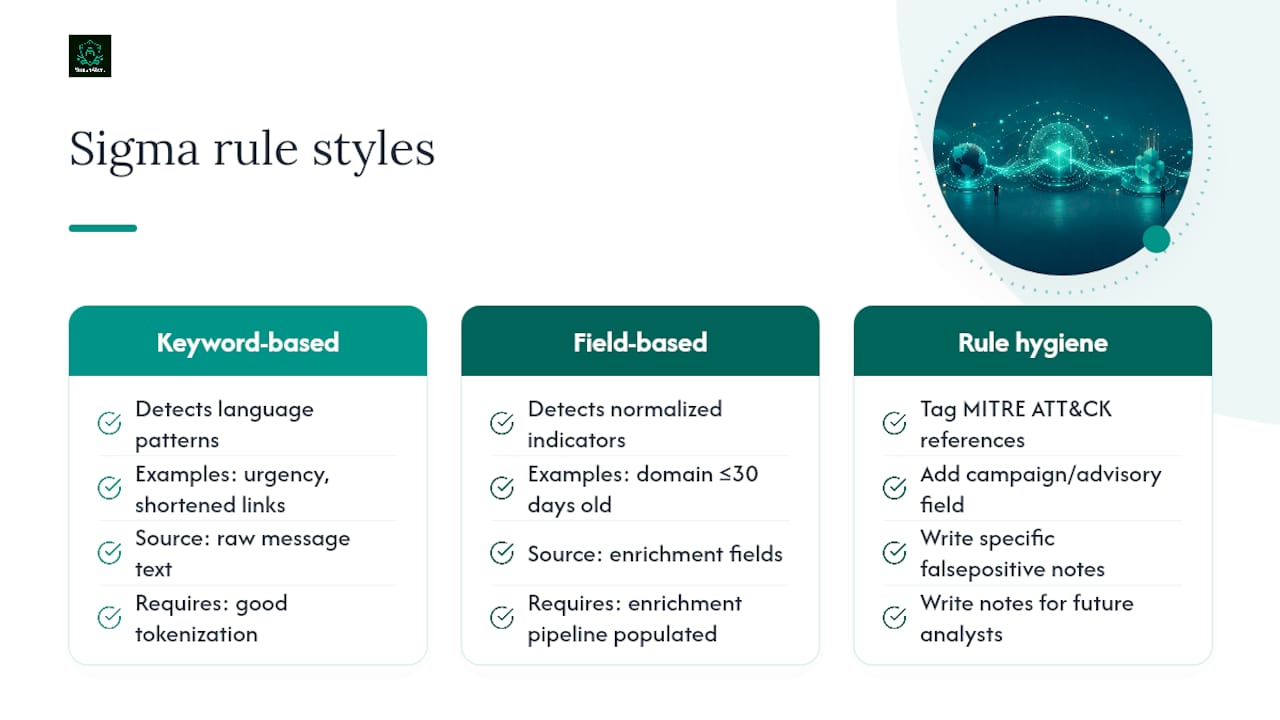
Two rule styles cover most practical smishing detection needs: keyword-based and field-based.
Keyword-based selections catch the language patterns that show up across smishing campaigns: urgency phrasing, shortened links, and brand impersonation strings.
title: Suspicious SMS Content - Urgency and Shortener Combination
id: 8f2a1c9d-4e3b-4a7f-9c1d-2b6e8f4a5c11
status: experimental
description: Detects text messages combining urgency language with known URL shortener domains
author: SOC Detection Engineering
date: 2026-01-15
logsource:
  category: sms_gateway
  product: mobile_messaging
detection:
  selection_urgency:
    message_body|contains:
      - 'verify your account'
      - 'suspended'
      - 'act now'
      - 'confirm your identity'
  selection_shortener:
    url_shortener_indicator: true
  condition: selection_urgency and selection_shortener
falsepositives:
  - Legitimate two-factor authentication reminders using shortened links

level: medium
tags:
  - attack.initial_access
  - attack.t1660
Field-based selections work off normalized indicators rather than raw text, such as flagging any message where url_domain matches a domain registered within the last 30 days, a field your enrichment pipeline should populate before the rule ever runs.
Always tag rules with MITRE ATT&CK references, add a references field pointing to the campaign or advisory that prompted the rule, and write specific falsepositive notes. A rule with no documented false positives is a rule nobody trusts enough to leave enabled.
Pro Tip: Write your falsepositives field as if a different analyst will inherit this rule in six months with no context. Vague notes like “may cause noise” get rules disabled during the next tuning pass; specific notes like “matches legitimate delivery notifications from [carrier] during peak shipping season” get rules kept and refined.
Converting and Deploying Sigma Rules in Your SIEM
Getting a Sigma rule from YAML file to live detection takes three steps.
- Convert with the right backend. Use pySigma or the Sigma CLI with a backend plugin matched to your SIEM’s query language. Field mapping is the part teams underestimate. Your
message_bodyfield in Sigma has to map correctly to whatever field name your SIEM’s parser assigned it, and a mismatch here silently breaks the rule without an error. - Choose scheduled or streaming deployment. Aggregated indicators, like a spike in messages referencing the same shortened domain, suit scheduled analytic rules running every 5 to 15 minutes. High-priority signals, like an MTD alert flagged as critical severity, warrant streaming detection with near-real-time alerting.
- Wire the output into response workflows. A converted Sigma rule becomes valuable only when it feeds an analytic rule that triggers a SOAR playbook or enriches an incident ticket automatically with sender history and prior reports tied to the same domain.
Vendor analytic rule examples help close the field-mapping gap. The Lookout to Microsoft Sentinel analytic rule shows exactly how fields like SmishingAlertSeverity and SmishingAlertType arrive from an MTD vendor, which gives you a concrete template for mapping equivalent fields into your own Sigma logsource definitions.
Testing and Tuning Your Smishing Detection Rules
A rule that has never seen real traffic is a guess, not a detection. Build a test corpus from historical smishing reports your organization has already collected, then supplement it with synthetic messages that mimic current tactics, obfuscated links, brand impersonation, payroll-themed lures.
Simulated campaign injection, replaying historical or synthetic smishing messages against your pipeline before production rollout, gives you a measurable way to validate detection coverage) and estimate triage time ahead of a real incident.
From there, tune using Sigma’s native filter mechanism to suppress known benign patterns, apply thresholding so a single stray keyword match doesn’t fire an alert, and iterate with the analysts who will actually triage the output.
- Track false-positive rate per rule, not just in aggregate
- Measure average triage time from alert to disposition
- Track detection coverage against your test corpus, not just live traffic volume
Statistic Callout: Regulatory guidance from the FCC points to user reporting, forwarding suspected smishing to 7726, as one of the most effective defenses available today, precisely because it generates the recipient-side data that keyword and field-based Sigma selections need to work against.
The Mobile Visibility Gap and Program Best Practices
Sigma rules cannot solve the core structural problem with smishing: text messages land directly on a device, bypassing the centralized mail flow that email security gateways were built to inspect. There is no equivalent chokepoint for SMS, iMessage, or WhatsApp traffic, which means Sigma’s usefulness depends entirely on what telemetry reaches your SIEM in the first place.
Three practices close that gap in practice rather than in theory:
- Instrument frictionless user reporting so recipients can flag suspicious messages without needing IT support
- Correlate reports across users rather than triaging each one in isolation. A single obfuscated link reported by one employee is noise; the same link reported by twelve employees across three departments is a campaign
- Enrich sender numbers and URL domains with threat intelligence, including WHOIS and domain-age data, before they hit a Sigma condition
Pro Tip: Retain message artifacts, not just alert metadata, for at least as long as your incident response policy requires for email. A body of text and its embedded link are often the only evidence you have once a shortened URL redirects somewhere new or gets taken down.
Shifting focus from blocking individual links to correlating reports across recipients catches campaign structure that link-by-link blocking misses entirely, particularly against attackers who rotate domains faster than any single Sigma rule can track them.
Where SmishAlert Fits Alongside Sigma-Based Detection
Sigma rules give you the query logic. SmishAlert gives you the reporting pipeline and correlation layer that feeds it. The platform collects reported messages from employees, customers, members, and students, then analyzes senders and message content for patterns like executive impersonation, payroll fraud, credential harvesting, and brand impersonation, the same categories your Sigma selections are built to catch, but sourced from actual recipient reports rather than a single feed.
Correlation is where SmishAlert adds the most operational value. A report from one employee is a data point; the same sender or domain reported across a dozen users, correlated automatically, is a campaign your team can act on before it spreads further.
Deployment fits several organizational models:
- Employee protection with mobile threat visibility for high-risk and executive users
- Customer and member scam reporting for banks, credit unions, and other regulated institutions, detailed on SmishAlert’s customer protection resources for financial services
- Threat intelligence feeds built from correlated reports, viewable in SmishAlert’s live campaign examples
- Managed security providers extending mobile messaging visibility across client environments
Teams evaluating how this fits into an existing detection stack can review SmishAlert’s product overview for messaging phishing visibility or explore how organizations are protecting employees from executive impersonation delivered via text. Pricing details for SmishAlert’s offerings are available through direct engagement with the company.
Sources
Start with the SigmaHQ repository, the canonical source for rule syntax and community-contributed detections, and the Sigma detection format documentation for field-level specifics. For consumer-facing guidance to fold into your reporting program, the FCC’s smishing guidance and Verizon’s smishing protection page both reinforce the 7726 reporting channel. For field-mapping examples, review the Lookout to Sentinel analytic rule alongside domain and impersonation detection logic from resources like 121 Groups email deliverability guidance, which covers spoofing indicators relevant to sender enrichment.
- SigmaHQ/sigma: Main Sigma Rule Repository
- Rules | Sigma Detection Format
- Avoid temptation - Smishing scams (FCC guidance)
FAQ
What Does a Sigma Rule Example Look Like?
A Sigma rule is a YAML file with metadata (title, author, date), a logsource defining what data it queries, a detection block with named selections and a condition, and a level indicating severity. The example keyword-based rule above shows this structure applied to a smishing use case combining urgency language with shortened URLs.
What Is the Difference Between Sigma and YARA Rules?
Sigma rules detect patterns in log data, like SIEM events, authentication records, or message telemetry, using a portable YAML format that converts to different query languages. YARA rules identify patterns in files and binaries, making them suited for malware analysis rather than log-based detection, which is why smishing detection relies on Sigma rather than YARA.
What Are Sigma Detection Rules Used For?
Sigma detection rules express conditions that identify suspicious activity in searchable log data, then convert into native queries for whatever SIEM a team runs. For smishing specifically, that means matching message content, sender attributes, or MTD alert fields against known attack patterns once that telemetry reaches the SIEM.
What Is “Sigma Rule 7” and Does It Apply to Smishing?
There is no standardized numbered “Sigma rule 7” in the official Sigma specification or repository; this likely refers to a specific community rule ID or a misremembered reference. Analysts should search the SigmaHQ repository by category or MITRE ATT&CK tag rather than by number to find relevant smishing-related detections.