
6-Step SOAR Smishing Playbook for SOCs: Map Email Logic to Mobile

A SOAR smishing playbook is an automated workflow that ingests a reported or detected SMS phishing message, enriches its indicators, and drives containment without waiting on a full manual investigation. Run correctly, it cuts triage time from hours to minutes, revokes compromised sessions before an attacker pivots to lateral movement, and correlates the report against other campaigns already hitting the organization. Feeding it clean telemetry, from a source like Smishalert, is what makes those outcomes real rather than theoretical.
TL;DR:
- Smishing playbooks rely on real-time telecom and mobile telemetry, not email headers, to trigger automated responses from multiple sources.
- Enrichment actions such as URL expansion, sandbox detonation, and domain reputation scoring are central to reducing analyst workload.
- Key automation steps include URL blocking, sender revocation, and domain takedown, with human review required for ambiguous or high-risk cases.
- Telemetry must be captured quickly and durably, including snapshots of landing pages, shortlink chains, and sender metadata, to maintain evidence integrity.
- Regular testing, version control, and phased deployment are essential to prevent automation rot and ensure effective response, especially given rapid threat landscape changes.
Table of Contents
- Why Smishing Playbooks Look Different From Email Playbooks
- The Integrations a Smishing Playbook Can’t Work Without
- A Step-by-Step Smishing Playbook You Can Map Into Any SOAR Canvas
- Turning Ephemeral SMS Artifacts Into Durable Evidence
- Why Smishing Playbooks Break (and How to Test Them)
- Rolling Out a Smishing Playbook Without Breaking Production
- How SmishAlert Feeds SOAR Playbooks With Usable Telemetry
- The Strategic Value and Limits of Smishing Automation
- Evaluating SmishAlert for Your SOAR Rollout
- Sources
Why Smishing Playbooks Look Different From Email Playbooks
Most SOCs already run mature email phishing playbooks. Porting that logic to SMS without adjustment is the most common design mistake teams make, because smishing breaks several assumptions email automation depends on.
A smishing playbook typically triggers on one of three events: a user forwarding a suspicious text, a mobile threat defense (MTD) agent flagging a malicious URL, or an authentication anomaly appearing shortly after an SMS event, such as an MFA approval from an unfamiliar device. None of these triggers behave like an email header.
SMS messages are ephemeral. Users delete them, carriers don’t retain full content the way mail servers retain headers, and the “attachment” is usually a shortlink that expands somewhere the SOC has never queried before. Telemetry lives on the device, not a mail gateway, so the playbook has to pull from an MTD source or a reporting app instead of Exchange logs.
The playbook’s job is to produce concrete outputs, not just an alert closure:
- Session and MFA-token revocation before credential abuse spreads
- Takedown requests against the malicious domain or shortlink
- A campaign correlation record so the next ten reports resolve in seconds, not from scratch
The Integrations a Smishing Playbook Can’t Work Without
Automation is only as good as what it can query. A smishing playbook that can’t reach identity, threat intel, and mobile telemetry in real time is a flowchart, not a defense.
The baseline integration stack looks like this:
- SIEM/XDR and ticketing for case creation, evidence storage, and audit trails
- Mobile Threat Defense for on-device signal, including which handset opened the link and when
- URL and phone-number reputation services to score the sender and any embedded link
- Identity provider APIs (Okta, Entra ID, or equivalent) to check recent MFA events and revoke sessions
- User and device reporting channels, ideally consolidated across SMS, iMessage, and WhatsApp rather than siloed by carrier
Enrichment is where most of the analyst time savings happen. A well-built playbook automatically expands the shortlink, detonates the resulting URL in a sandbox, pulls WHOIS and domain-age data, and checks whether the sending number has appeared in prior campaigns. Unit 42’s research on large-scale smishing operations found extensive domain churn across campaigns, which is exactly why automated correlation matters more here than in a typical email phish: the same kit gets relaunched under a new domain within days.
Not every action belongs on autopilot. Human-in-the-loop gates should sit in front of any step that touches identity, such as forcing a password reset or disabling an account, while low-risk actions, like blocking a shortlink with a confirmed malicious detonation result, can run automatically.
Pro Tip: Set your auto-block threshold using detonation confidence, not reputation score alone. A brand-new domain with a clean reputation but a credential-harvesting page in the sandbox is a stronger auto-block signal than an aged domain with a mediocre reputation score.
A Step-by-Step Smishing Playbook You Can Map Into Any SOAR Canvas
This sequence mirrors the sub-playbook structure used in phishing investigation references like Cortex XSOAR’s phishing playbook, adapted for SMS-specific inputs and constraints.
- Trigger and capture. Log the full message text, sender number, timestamp, recipient device ID, and reporting channel. Missing any of these fields early makes downstream correlation unreliable.
- Automated enrichment. Expand any shortlink, detonate the resolved URL, pull domain WHOIS and registration age, score the sender number against reputation feeds, and check the recipient’s identity provider for recent MFA approvals or new OAuth grants.
- Campaign correlation. Compare indicators against prior cases. A shared C2 domain pattern, sender-number block, or landing-page template usually means this report belongs to an active campaign, not an isolated incident.
- Decision branch. If detonation confirms credential harvesting and reputation scores are unambiguous, auto-block the URL and sender at the network perimeter using an AutoBlockIndicators-style toggle. If results are ambiguous, route to analyst review with a SearchAndDelete-equivalent action queued for approval.
- Containment. Reset affected credentials, revoke active sessions and refresh tokens, block the sender and domain, file a takedown request with the registrar or hosting provider, and notify affected users directly.
- Post-incident hunting. Push confirmed indicators into threat intel feeds, run a retroactive query for other users who received the same sender or URL, and flag training or policy gaps the incident exposed.
Mobile devices are increasingly the primary phishing surface, and click-through rates on SMS links are significantly higher than email for many user populations, which is the core argument for automating steps 2 through 5 rather than working them manually every time.
Containment order matters here. Treating the incident as identity-first, meaning session and credential containment happen before device-level remediation, resolves the exposure faster than waiting on a full device forensic pass.
Turning Ephemeral SMS Artifacts Into Durable Evidence
SMS data disappears in ways email never does. A user deletes the message, the carrier doesn’t retain content, and the shortlink your analyst clicked yesterday may resolve somewhere different today. The playbook’s telemetry layer has to capture evidence before it evaporates.
Useful artifacts to normalize into SIEM events include:
- Sender phone-number metadata, including carrier, country of origin, and any prior campaign association
- A landing-page snapshot taken at detonation time, not just the final URL
- The full shortlink expansion chain, since attackers often stack two or three redirects
- Domain and TLS certificate data for the resolved destination
- Cross-channel traces, since the same social engineering attempt often reappears over voice, RCS, or iMessage days later
Practical playbook implementations, including examples in community phishing playbook repositories, convert these into durable evidence by capturing landing-page snapshots and shortlink expansions into object storage, then attaching them to the SIEM case record for later review. That approach also solves the chain-of-custody problem: if legal or HR needs to review a payroll-fraud smishing case months later, the snapshot exists independent of whether the user still has the original text.
Why Smishing Playbooks Break (and How to Test Them)
Automation rot is real, and smishing playbooks rot faster than most. The threat side of the equation moves quickly: shortlink providers change URL patterns, phishing kits rotate domains every few days, and phone-number spoofing techniques evolve to dodge reputation scoring. On the SOC side, enrichment API changes and identity provider updates quietly break integrations that worked fine last quarter.
A workable maintenance routine includes using AI incident response for SOCs: a practical playbook to confirm the full chain still fires correctly and maintain automation effectiveness.
- Synthetic smishing simulations run on a schedule, not just after an incident, to confirm the full chain still fires correctly.
- Regression testing after any integration or API version change, especially identity provider and reputation feed updates.
- Golden-path and failure-path runs, verifying the playbook handles both a clean confirmed-malicious case and a case where an enrichment source times out.
- Automation hit-rate and false-positive monitoring, tracked monthly rather than reviewed only when something goes wrong.
Security awareness guidance recommends folding SMS into ongoing phishing simulation programs specifically because click rates run higher than email, which makes stale playbook logic a bigger liability here than elsewhere.
Pro Tip: Version-control every playbook change like code, with a named owner and a documented rollback step. The fastest way to lose analyst trust in automation is a silent playbook update that starts auto-blocking legitimate vendor SMS traffic.
Rolling Out a Smishing Playbook Without Breaking Production
Piloting on a narrow scope beats a company-wide launch every time. Start with an executive cohort or a single high-risk department, keep auto-actions limited to clearly low-risk indicators, and expand once the false-positive rate proves acceptable.
Track these during the pilot:
- Mean time to respond (MTTR) before and after automation, measured from report to containment
- Correct automation rate, meaning the percentage of auto-actions that a human reviewer would have made the same call on
- Escalation accuracy, checking whether ambiguous cases actually reached an analyst instead of silently closing
Training matters as much as the automation itself. Analysts need runbook prompts that match what the playbook is doing at each decision branch, plus communication templates ready for notifying affected users and coordinating with help desk on credential resets. Once in production, track SLA adherence by severity tier and revisit thresholds quarterly, since campaign patterns shift and yesterday’s safe auto-action threshold can become too aggressive within a few months. A threat-hunting query framework built for smishing logs makes that quarterly threshold review far faster.
How SmishAlert Feeds SOAR Playbooks With Usable Telemetry
Playbooks are only as strong as the signal feeding them. Smishalert focuses on the layer most SOAR platforms can’t see natively: SMS, iMessage, and WhatsApp activity happening outside the corporate email perimeter.
What matters for SOAR integration specifically:
- Cross-channel user reporting that normalizes SMS, iMessage, and WhatsApp reports into a single case format
- Campaign correlation that flags when a report matches an active pattern rather than starting from zero
- SIEM and API integration so enrichment data lands in the same case object your analysts already work
- On-device iOS filtering that catches credential-harvesting and executive-impersonation attempts before a click even happens
Teams evaluating fit typically start with the SmishAlert self-eval to gauge current visibility gaps before mapping a pilot to specific playbook triggers.
The Strategic Value and Limits of Smishing Automation
Automation earns its place by removing toil, not judgment. It should handle enrichment, correlation, and the mechanical parts of containment reliably every time. It cannot decide whether a highly targeted executive-impersonation attempt is a coincidence or the opening move of a payroll fraud scheme. That call still needs a human who understands the business context.
The teams getting this right treat automation as the fast lane for clear cases and keep analysts fully in the loop for anything ambiguous. They also coordinate playbook design across identity, help desk, and communications teams before deployment, not after the first incident exposes the gap. A playbook that resets credentials automatically but never notifies the help desk creates its own support fire.
— Sophie
Evaluating SmishAlert for Your SOAR Rollout
A 30-day pilot is the fastest way to answer the three questions that actually matter before you commit budget: how much smishing activity you’re currently missing, how cleanly the telemetry maps into your existing SOAR triggers, and how much manual triage time drops once automation takes the first pass.
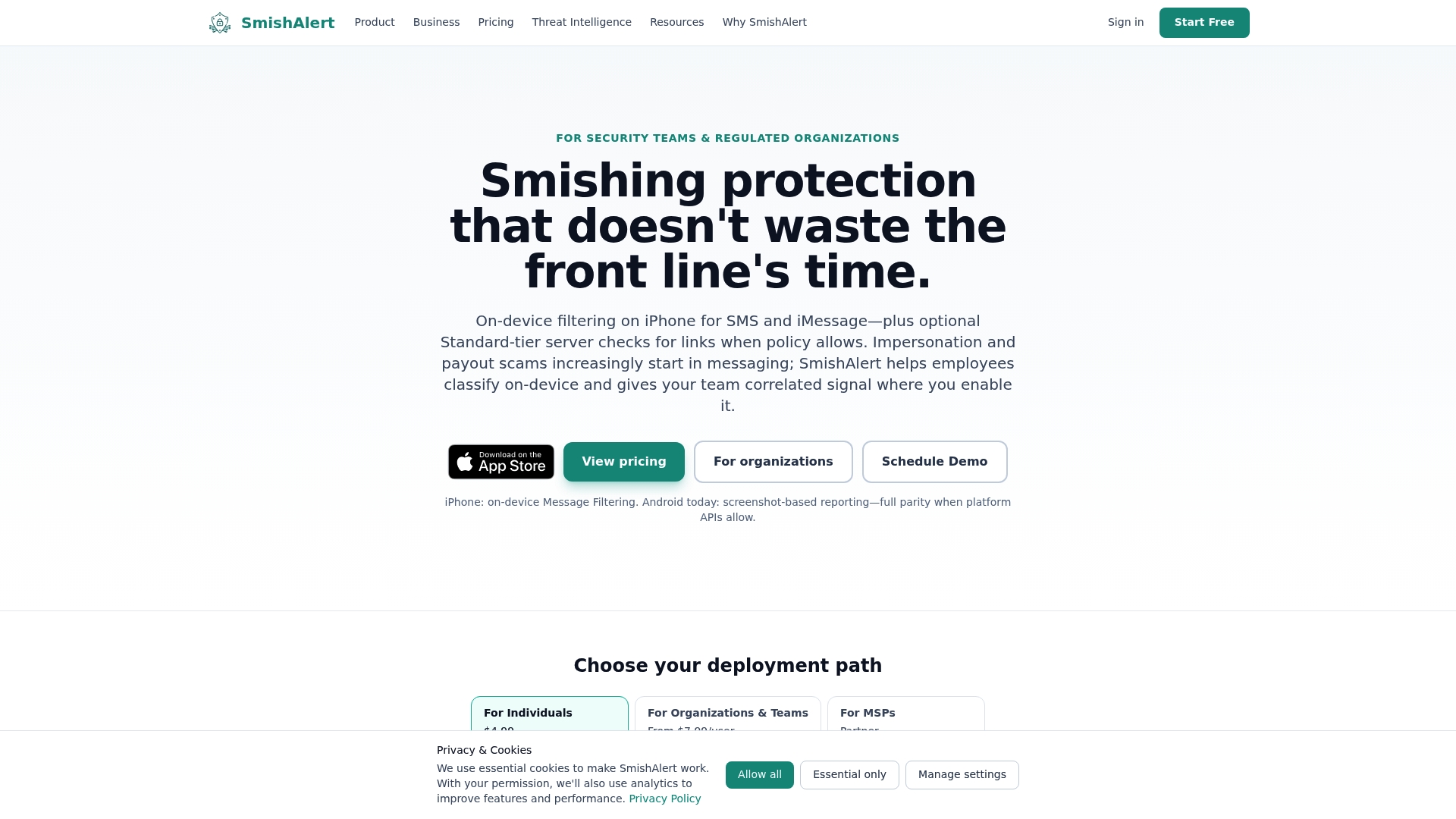
Smishalert gives SOC teams the mobile-native signal that email security platforms were never built to see, correlated across SMS, iMessage, and WhatsApp rather than siloed by channel. Review the platform overview to see how telemetry and integrations map to your stack, check the solution pages for specific attack types like credential harvesting and executive impersonation, or start with the self-eval to scope a pilot against your current playbook gaps.