
6–8 week Mobile Phishing Training Pilot Cuts Detection Time for SOCs

Mobile phishing training, in the enterprise context, means a detection and reporting platform that closes the visibility gap on SMS and messaging-based social engineering. It collects suspicious messages, analyzes threat signals automatically, and correlates campaigns across users. The recommended first move: pilot one in a high-risk business unit this quarter, feed the resulting telemetry into your SIEM, and use NIST SP 800-124r2 and a documented messaging-attack case study to justify the scope to leadership. SmishAlert is one option built specifically for this operational model.
TL;DR:
- Deploy a mobile phishing detection platform gradually, focusing on high-risk units, and measure enrollment, false positives, and threat detection speed during a six-to-eight-week pilot.
- Cross-channel campaign correlation and behavioral detection are critical, as attacks often rely on message sequences or attachments rather than malicious links alone.
- Managed devices support deeper telemetry, but BYOD devices can utilize work-profile or container enrollment methods to balance security with user privacy.
- Integrating with SIEM and MDM requires capturing metadata such as sender, recipient, device attestation, and timestamps, especially on encrypted channels where payload inspection is impossible.
- Post-deployment, continuous analyst training, detailed documentation, and vendor support are essential to maintain detection accuracy and respond effectively to smishing incidents.
- ✓Collect suspicious mobile messages
- ✓Analyze threats and senders
- ✓Correlate reports across users
- ✓Identify coordinated campaigns
Table of Contents
- What Capabilities Does a Mobile Phishing Detection Platform Need?
- How Do You Integrate Mobile Phishing Defense With MDM and SIEM?
- What Should a 6-to-8-Week Mobile Phishing Pilot Measure?
- How Should Security Teams Respond to a Reported Smishing Message?
- What Does Enterprise Mobile Phishing Detection Cost?
- How Long Does Rollout Take From Pilot to Full Deployment?
- What Training and Support Do Security Teams Need Post-Deployment?
- Why SmishAlert Fits the Pilot Criteria Above
- Further Reading and Primary Sources
- Sources
- FAQ
What Capabilities Does a Mobile Phishing Detection Platform Need?
Email security tools inspect a gateway. Messaging security tools have no equivalent choke point, which means the platform itself has to do the work a gateway used to do: collect, analyze, and connect the dots across a population of users.
Reporting has to be frictionless or it fails outright. If employees need to screenshot a text, open a ticket, and email IT, most will just delete the message and move on. In-app reporting, native forwarding, and web-based submission for constituents who don’t have a corporate app all matter, because adoption determines whether a platform ever sees the messages that matter.
Automated analysis is where signature-based thinking breaks down. A case study on a WhatsApp-delivered social engineering attack against an insurance company showed the attacker never needed a malicious link. The compromise ran through file attachments and a conversation sequence that conventional scanning tools were never built to flag. Behavioral detection, which looks at sender reputation, message sequence, and interaction patterns rather than a static blocklist, catches what signature matching misses.
Campaign correlation turns isolated reports into intelligence. If three employees in finance report similar payroll-fraud texts within an hour, that’s not three incidents. It’s one campaign, and the platform should surface it that way automatically, ideally across SMS, iMessage, and WhatsApp rather than one channel at a time.
Core capabilities to evaluate:
- Multi-channel reporting (in-app, native forwarding, web submission for non-employees)
- Behavioral and sequence-based analysis, not just link and hash matching
- Cross-user and cross-channel campaign correlation
- Mobile Threat Defense (MTD) signal ingestion where devices are managed
- Metadata-first analysis for end-to-end encrypted channels where payload inspection isn’t possible
Pro Tip: Test campaign correlation with a real internal exercise before you buy. Send a lookalike smishing message to a small, consented group and see how quickly the platform links the resulting reports into a single incident rather than a pile of duplicates.
How Do You Integrate Mobile Phishing Defense With MDM and SIEM?
Deployment decisions hinge on device ownership. Managed devices support deeper telemetry; BYOD devices require a work-profile approach that keeps personal data untouched while still surfacing threat signals from the managed side.
- Choose an enrollment model. Work profiles or managed app containers on BYOD devices, full MDM enrollment on corporate-owned hardware. NIST SP 1800-22 documents example BYOD architectures that combine EMM, MTD, and app vetting without requiring full device control.
- Wire up MDM/EMM and MTD. Runtime detection on the device should feed conditional access decisions and support automated quarantine when a threat is confirmed, a pattern NIST SP 800-124r2 describes in detail.
- Define your telemetry schema before rollout. Capture sender and recipient metadata, attachment hashes, device attestation state, enrollment status, and timestamps. This is the dataset your SIEM correlates against other endpoint and identity signals.
- Connect DLP and CASB controls for attachment and content policy enforcement on managed channels.
- Default to metadata-first analysis on E2EE channels. WhatsApp and iMessage encryption blocks central payload inspection; attestation tokens and message metadata are what you have to work with, and enterprise messaging security guidance recommends building analytics around that constraint rather than around decryption.
- Set retention and channel policy. Decide which messaging channels are sanctioned, what attestation gates apply to RCS traffic, and how long reported-message data is retained for legal and compliance purposes.
Pro Tip: If your organization has a large BYOD population in a regulated vertical, a work-profile deployment pattern deserves its own review pass. Our BYOD-specific guidance walks through enrollment tradeoffs in more depth than a general checklist can.
What Should a 6-to-8-Week Mobile Phishing Pilot Measure?
A pilot exists to answer one question: does this platform surface real threats faster than what you have now, without breaking the user experience? A pilot duration of several weeks, typically conducted within a small number of business units with a varied set of managed and BYOD devices, is generally sufficient to obtain a defensible answer.
Staged rollout guidance built around MDM, MTD, and DLP integration recommends starting narrow, measuring specific operational metrics, then tuning before any expansion. The KPIs worth tracking:
- Enrollment or reporting-channel adoption rate across the pilot cohort
- Raw report volume and the ratio of reports that require analyst triage
- False-positive rate on automated analysis
- Time-to-detect and time-to-remediate for confirmed threats
- Number of distinct campaigns correlated from otherwise isolated reports
Low enrollment after the first two weeks is a signal to fix the reporting UX before judging detection accuracy. A high report volume paired with a high false-positive rate points to tuning work, not platform failure. If time-to-remediate barely moves compared to your current process, that’s a stop signal worth investigating before any wider rollout. Coordinate early with your carrier or messaging platform contacts if sender blocking or takedown requests will be part of the workflow. That relationship often takes longer to establish than the technical integration does.
How Should Security Teams Respond to a Reported Smishing Message?
The response clock starts the moment a message lands in your reporting queue, and the first steps determine whether you’re containing one attack or missing a coordinated campaign.
- Triage and classify. Preserve the original message, sender identifier, and any attachments before anything else. Check whether similar reports have already come in, then classify the risk: executive impersonation, credential harvesting, or payroll fraud carry different urgency and different response owners.
- Contain. For managed devices, MDM-driven quarantine can isolate a compromised endpoint quickly. Revoke any tokens or credentials the target may have entered, block the sending number or account where the channel allows it, and notify anyone else likely to receive the same campaign. GSA guidance on securing mobile applications and devices describes exactly this kind of MDM and MTD alerting workflow feeding directly into SOC escalation.
- Preserve forensics. Metadata, file hashes, device posture at time of report, and a documented chain of custody all matter if the incident ends up supporting a legal or regulatory response, particularly in payroll fraud cases involving actual funds transfer.
- Run the after-action. Feed confirmed indicators of compromise back into your detection rules, update DLP policy if the attack exploited a gap, and document what worked in the reporting-to-containment timeline for the next incident.
Pro Tip: Behavioral indicators tend to outlive a specific attack. The same WhatsApp-based social engineering case that bypassed signature detection also showed a repeatable interaction pattern. Attackers changed the payload but not the sequence, which is exactly what campaign correlation is built to catch on the next attempt.
What Does Enterprise Mobile Phishing Detection Cost?
Pricing in this category runs almost entirely on per-user annual licensing, and the number that matters most to your budget conversation is total protected population, not seat count in the traditional software-license sense. Vendors typically segment pricing by deployment model: coverage for employees and managed devices, a separate tier for customer or member-facing scam reporting, and often a distinct tier for organizations that want raw threat intelligence and campaign data without full platform deployment.
Most vendors in this space, SmishAlert included, structure the buying process around a paid pilot engagement before a full annual contract. That upfront cost usually gets credited toward the first year of the subscription if you move forward, which changes the calculus: the pilot isn’t a sunk marketing cost, it’s the first invoice.
Budget conversations should also account for integration effort. A platform that ingests cleanly into your existing SIEM and MDM stack costs less in engineering hours than one requiring custom middleware, even if the license price looks identical on paper. Executive-level coverage, where a small population of high-risk individuals gets deeper monitoring or dedicated analyst attention, is frequently scoped and priced separately from the general employee population. Ask about that split early rather than discovering it during contract negotiation.
How Long Does Rollout Take From Pilot to Full Deployment?
A realistic timeline runs in three phases, and skipping the middle one is the most common reason full rollouts stall.
Phase one is the pilot itself: six to eight weeks, as covered above, scoped to one or two business units. Phase two is a tuning window, typically another four to six weeks, where analysts adjust detection thresholds based on pilot false-positive data, finalize the SIEM integration built during the pilot, and extend enrollment to additional business units in stages rather than all at once. This is also when policy decisions around retention, allowed channels, and RCS attestation get formalized rather than left as pilot defaults.
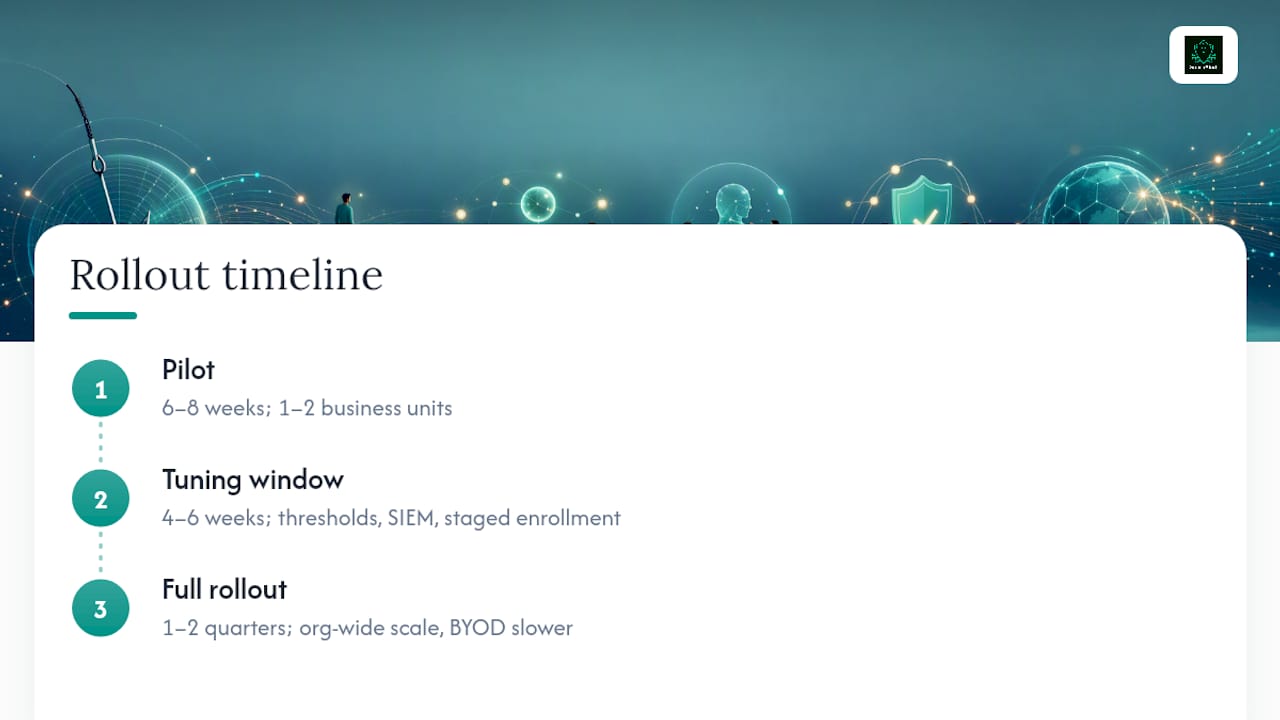
Phase three is full-scale rollout, which for a mid-to-large organization usually spans one to two quarters depending on how many business units, geographies, and device ownership models are involved. Organizations with a large BYOD population tend to move slower here because work-profile enrollment requires more individual user action than a centrally pushed MDM policy.
The single biggest predictor of a smooth phase three is whether the SIEM and MDM integrations were built correctly during the pilot rather than treated as a later project. Retrofitting telemetry pipelines after you’ve already scaled enrollment creates a backlog of unanalyzed reports, which undermines the platform’s core value proposition right when leadership is watching the numbers most closely.
What Training and Support Do Security Teams Need Post-Deployment?
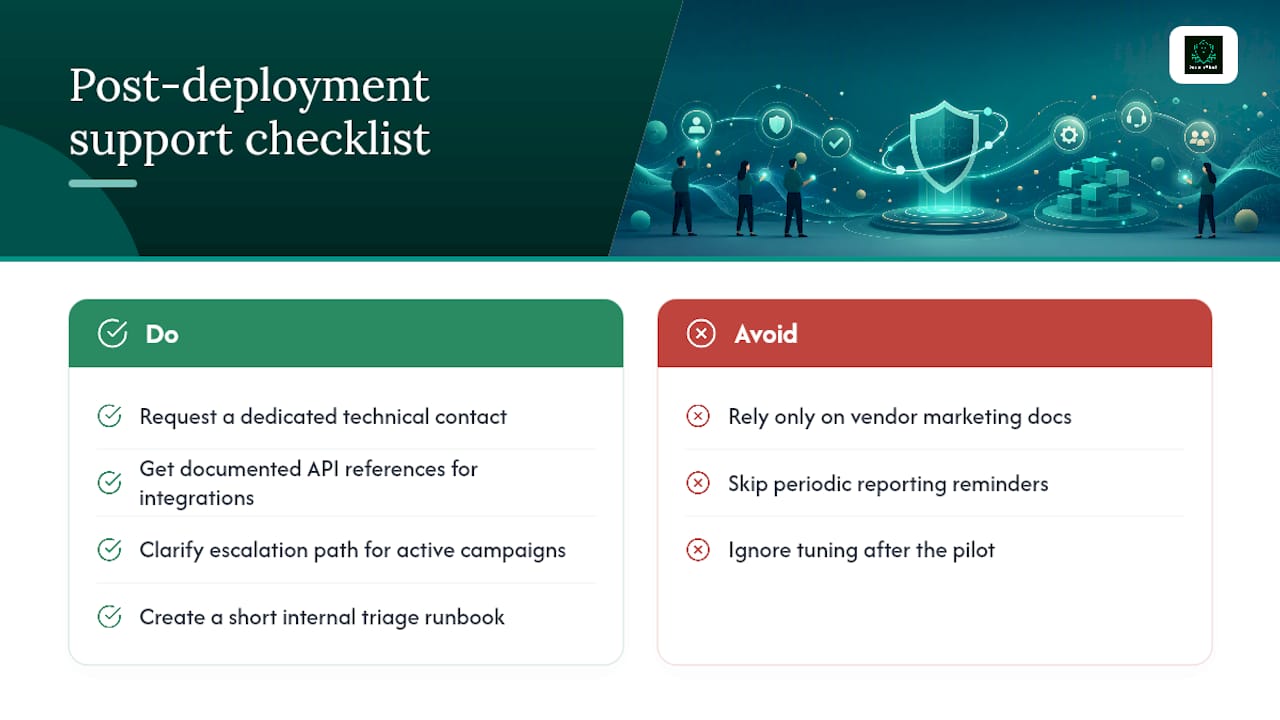
The platform is only as good as the analyst workflow around it. Most vendor onboarding covers initial configuration, but the ongoing work, tuning correlation rules, interpreting new campaign patterns, adjusting DLP integration, is where teams either get real value or let the tool decay into an unmonitored inbox.
Security teams should expect and request analyst-facing documentation on how correlation logic works, not just a marketing overview of the feature. Understanding why the platform grouped five reports into one campaign matters when you’re explaining an incident to leadership or regulators. Vendor support tiers worth clarifying up front include access to a dedicated technical contact during the pilot and tuning phases, documented API references for SIEM and MDM integration work your own engineers will maintain, and a clear escalation path for confirmed active campaigns versus routine false-positive tuning requests.
Internal training matters just as much as vendor support. The employees and constituents reporting messages need periodic reminders about how to report, not why smishing is dangerous, since that’s a security awareness function distinct from this platform. IT and SOC staff need a short internal runbook, built from your own pilot findings, that documents your specific triage and escalation steps rather than relying on generic vendor documentation during a live incident.
Why SmishAlert Fits the Pilot Criteria Above
Every checklist item in this guide, frictionless reporting, automated threat analysis, cross-user campaign correlation, maps directly to what SmishAlert is built to do. SmishAlert gives security teams a way to collect suspicious messages from employees and from customers, members, or students, analyze threats, and correlate reports across a user population to surface coordinated campaigns before they spread further. That includes detection tuned for executive impersonation, credential phishing, and payroll fraud, the exact threat categories this guide’s incident response runbook is built around.
If you’re running the 6-to-8-week pilot described above, validate these specifics with any vendor, SmishAlert included: reporting UX friction for both employees and non-employee constituents, how campaign correlation performs against a controlled test, how cleanly report data ingests into your existing SIEM, coverage quality across BYOD and managed devices, and whether executive-level workflows get differentiated handling. SmishAlert’s product overview details how collection, analysis, and correlation work together, and the executive impersonation protection page is a useful starting point if that threat category is your highest near-term risk. Start there, scope your pilot cohort, and get the SIEM integration built before you expand past your first business unit.
Further Reading and Primary Sources
For technical depth beyond this guide, NIST SP 800-124r2 covers MTD and EMM integration patterns in full. NIST SP 1800-22 walks through example BYOD architectures. SmishAlert’s own SMS phishing prevention guide and answers library cover common operational questions in more depth.
Sources
- Social Engineering via WhatsApp: Insurance cyber attack case study
- NIST SP 800-124 Revision 2: Enterprise Mobility Management guidance
- NIST SP 1800-22: Mobile device security (BYOD example solution)
- GSA guidance on securing mobile applications and devices
FAQ
What Is a Mobile Phishing Training Platform?
It’s an enterprise detection and reporting system that collects suspicious SMS, iMessage, and WhatsApp messages, analyzes them for threats, and correlates reports across users to surface coordinated campaigns, distinct from consumer awareness training.
How Long Should a Mobile Phishing Detection Pilot Run?
Six to eight weeks against one or two business units is typically enough to measure enrollment, report volume, false-positive rate, and time-to-remediate before deciding whether to expand.
Does This Require Full MDM Enrollment for BYOD Devices?
No. Work-profile or managed-app container approaches, described in NIST SP 1800-22, let organizations gain visibility on BYOD devices without full device control.
What Metadata Should Feed the SIEM From a Messaging Security Platform?
Sender and recipient identifiers, attachment hashes, device attestation state, enrollment status, and timestamps form the core schema most SIEM correlation rules need.
How Does SmishAlert Handle Threats Across Different Messaging Channels?
SmishAlert collects and analyzes reported messages across SMS and mobile messaging channels, correlating reports across users to identify coordinated campaigns like executive impersonation and payroll fraud. Pricing details are available directly through SmishAlert.