
Mobile Phishing Protection for Enterprises Without Full MDM: 30 Day Pilot

The strongest mobile phishing protection layers on-device detection, real-time link and URL analysis, safe browsing enforcement, and conditional access policy on top of a fast user-reporting and triage workflow, and none of it requires full MDM enrollment to start. Security teams should pilot link scanning and reporting on executive and finance groups first, then expand based on measured results.
TL;DR:
- On-device detection, link analysis, and safe browsing are crucial, but starting with high-risk groups like executives and finance minimizes initial noise and risk.
- Mobile phishing often uses speed, obfuscation, and multiple channels, making detection and triage emergency-critical when a breach occurs.
- MFA resistance improves security, especially when moving from SMS codes to phishing-resistant solutions like passkeys and number-matching push notifications.
- Organizations can deploy protections without full MDM enrollment by using app-based filtering, reporting, and conditional access, focusing initially on high-risk user groups.
- Combining multiple channels’ visibility, correlating threats across SMS, voice, and messaging apps, and establishing rapid incident response processes reduces overall mobile phishing risk.
Table of Contents
- What Makes Mobile Phishing a Distinct Enterprise Risk?
- Common Mobile Phishing Techniques Security Teams Must Detect
- How Mobile Threat Defense Tools Detect and Block Phishing
- Practical Controls to Deploy Now
- Triage and Incident Response After a Suspected Mobile Phishing Click
- Gaining Messaging Visibility Without Full MDM
- The Role of Multi-Factor Authentication in Stopping Mobile Phishing
- Secure App Permissions and Update Practices That Reduce Phishing Exposure
- Emerging Mobile Phishing Tactics: Deepfakes and Advanced Social Engineering
- Legal and Compliance Considerations for Mobile Phishing Protection
- Operational Priorities for Security Leaders in 2026
- Try SmishAlert as Your Mobile Phishing Protection Layer
- Sources
What Makes Mobile Phishing a Distinct Enterprise Risk?
A phone screen hides the signals that trained employees catch on a laptop. There is no hover-to-preview a link, sender fields truncate, and a text message carries none of the visual cues that make a fraudulent email header obvious. That gap alone explains why attackers have shifted so much volume toward mobile.
Mobile also expands the attack surface beyond email. SMS, iMessage, WhatsApp, QR codes, and in-app messaging inboxes all deliver phishing payloads, and most of them sit outside the corporate email gateway entirely. Mobile devices already account for the majority of global internet access, and phishing traffic follows the same pattern, landing disproportionately on the device employees check first and scrutinize least.
The stakes rise further because mobile is where authentication lives. SMS-based MFA codes and push approvals arrive on the same device attackers are trying to compromise, so a single successful mobile phish can hand over both a credential and the second factor meant to stop it.
Common Mobile Phishing Techniques Security Teams Must Detect
Attackers targeting mobile devices lean on a handful of proven formats, each with recognizable tells once teams know what to look for.
- Smishing: spoofed delivery or IT-helpdesk senders, shortened or obfuscated links, and urgent language pushing immediate action (“your account will be locked in 1 hour”).
- Quishing: malicious QR codes placed on physical signage, parking meters, or emailed invoices; testing requires scanning in a sandboxed environment or using a URL-decoding tool before trusting the destination.
- In-app and messaging-app phishing: executive or vendor impersonation inside WhatsApp or Teams, often with a malicious link embedded directly in a push notification preview so the user never opens the app to see context.
- Credential harvesting pages: login screens that mimic Microsoft 365 or Okta but load on a domain that doesn’t match, frequently missing the visual polish of the real page or requesting information a legitimate login screen never would.
The common thread across all four is speed. Mobile phishing campaigns are built to be acted on in seconds, before a target has time to check the sender or the domain.
How Mobile Threat Defense Tools Detect and Block Phishing
Mobile Threat Defense (MTD) platforms and app-level protections rely on a mix of detection methods, each with real tradeoffs security teams need to weigh before choosing an architecture.
- On-device machine learning versus cloud reputation lookups. On-device models flag suspicious links with lower latency and less data leaving the device, but they need broader permissions and periodic model updates to stay current against new domains.
- Notification and accessibility-based scanning. Some Android tools scan notification text for malicious links before a tap; Kaspersky’s implementation for Android shows how this catches threats pre-click, though iOS’s sandboxing limits how deeply any app can inspect another app’s notifications.
- Pre-click URL analysis and sandboxing. Safe-browsing integrations detonate or rewrite suspicious links before the destination page ever loads on the device.
- SIEM and EDR integration. Mobile alerts mean little in isolation; correlating them with endpoint and identity telemetry is what turns a single flagged text into a detected campaign.
Analyst summaries of the MTD category consistently list on-device behavioral detection, app vetting, and network protection as the baseline capability set, and current mobile antivirus reviews confirm real-time link scanning and scam alerts are now standard rather than premium features.
Practical Controls to Deploy Now
Enterprise mobile phishing protection works best as a layered rollout, not a single tool purchase. Sequence it this way:
- Turn on what you already have. Enable safe browsing, link scanning, and carrier-level SMS filtering where it exists, today, at no additional procurement cost.
- Set policy guardrails. Define BYOD requirements, conditional access rules that block risky sign-ins from unmanaged devices, and an allow/block list for high-risk app categories.
- Wire alerts into operations. Route mobile phishing alerts into your SIEM with defined thresholds, so a spike in flagged links to one department triggers escalation, not just a log entry.
- Train around the specific threat. Run targeted smishing simulations, not generic phishing awareness, and give executives and finance staff extra hardening given their outsized target profile.
- Build a reporting path. A one-tap “report this message” flow only works if someone reviews it inside your existing SLA.
For architecture, MDM-free deployment is a legitimate path for BYOD-heavy organizations that can’t force enrollment; app-based protections and reporting tools can layer on top of unmanaged devices without waiting for a device management rollout.
Pro Tip: Pilot smishing simulations against executives and payroll staff first. They receive a disproportionate share of targeted mobile phishing, and their click-through data will tell you where policy gaps actually are, not just where you assumed they’d be.
Triage and Incident Response After a Suspected Mobile Phishing Click
Speed matters more on mobile than on any other endpoint because the credential and the MFA approval often live on the same compromised device.
- Contain immediately. Revoke active sessions, force MFA re-enrollment, and restrict the device’s access to corporate resources while investigation proceeds.
- Collect mobile-specific evidence. Preserve screenshots of the message, sender metadata, and device logs before the user’s phone auto-deletes the thread.
- Respond to the credential. Reset and rotate the exposed password, notify any downstream service that shares the credential, and check identity logs for lateral movement.
- Close the loop. Correlate the incident against other reports for the same campaign, notify affected users, and document remediation for audit purposes.
A structured breach response plan built ahead of time turns this from an improvised scramble into a repeatable process, and a documented triage workflow keeps mobile incidents moving at the same pace as email-based ones.
Gaining Messaging Visibility Without Full MDM
Organizations that can’t or won’t enroll every device in MDM still need visibility into SMS, iMessage, and WhatsApp threats hitting employees. The platform captures reported messages, correlates them into campaigns, and applies on-device filtering on iOS without requiring device enrollment.
A typical pilot runs about a month, scoped to executives and high-risk groups like finance and HR, following the pattern security teams already use for phishing simulations: measure reported volume, click rates, and time-to-triage, then decide on wider rollout. Integration with SIEM and audit-ready reporting means results plug into existing SOC workflows rather than sitting in a separate dashboard. Evaluate any pilot against those same three outcomes before scaling.
The Role of Multi-Factor Authentication in Stopping Mobile Phishing
MFA remains one of the most effective controls against credential theft, but mobile phishing has adapted specifically to defeat weaker implementations. SMS-based one-time codes and simple push approvals are both vulnerable to real-time relay: an attacker’s fake login page captures the credential, then immediately requests the MFA code or push approval from the same session, passing it through before the code expires.
Phishing-resistant MFA closes that gap. FIDO2 security keys and passkeys bind the authentication to the specific domain requesting it, so a fake login page simply can’t complete the handshake, regardless of how convincing it looks. Number-matching push notifications, where the user enters a code shown on the login screen rather than tapping a bare “approve” button, raise the bar significantly over legacy push approval alone.
Rollout sequencing matters. Executives, finance, HR, and any role with access to payroll or wire transfer systems should move to phishing-resistant MFA first, since they’re the most frequently targeted for both credential theft and business email compromise variants delivered over SMS. Broader employee populations can follow on a slower timeline, but even an interim move from SMS codes to authenticator-app push with number matching meaningfully reduces exposure.
MFA is not a substitute for detecting the phishing attempt itself. It’s a backstop for when detection fails, and pairing it with link scanning and user reporting closes more of the gap than either control alone.

Secure App Permissions and Update Practices That Reduce Phishing Exposure
Phishing payloads on mobile increasingly rely on malicious or over-permissioned apps rather than a single bad link. A text message might not deliver malware directly. It delivers a link to a sideloaded app or a legitimate-looking update that requests permissions far beyond what its function requires.
Enterprises should enforce app vetting before anything reaches a managed or BYOD device with corporate access: review requested permissions against the app’s stated function, and flag anything requesting SMS read access, accessibility services, or notification access without a clear operational reason. Those three permission categories are exactly what malicious apps request to intercept MFA codes or scan for phishing opportunities in real time.
Patch cadence matters just as much as permission review. Delayed OS and app updates leave known vulnerabilities open longer, and mobile phishing campaigns increasingly chain a credential harvesting page with a follow-up exploit targeting an unpatched browser or messaging app component. Enforce update compliance through whatever management layer is available, whether that’s full MDM, a lighter mobile application management policy, or conditional access rules that block outdated OS versions from reaching corporate resources.
Sideloading control deserves explicit policy attention. Android’s flexibility around installing apps outside the Play Store is a common vector for malicious app delivery following a smishing link, and blocking or restricting sideloading on any device with corporate access closes a path attackers rely on specifically because most consumer security advice doesn’t cover it.
Emerging Mobile Phishing Tactics: Deepfakes and Advanced Social Engineering
The newest wave of mobile phishing doesn’t rely on a bad link at all. It relies on voice. Deepfake audio cloning tools have gotten cheap and fast enough that attackers can generate a convincing clone of an executive’s voice from a few minutes of public speaking footage, then place a call to a finance employee requesting an urgent wire transfer. The mobile phone, again, is the delivery mechanism, and voice carries emotional urgency in a way text never quite matches.
Social engineering has advanced alongside the technology. Attackers now routinely combine channels: a text message referencing a real, recent internal event to establish credibility, followed by a call that appears to come from an internal extension, followed by a WhatsApp message continuing the conversation. Each channel reinforces the others, and few enterprise security programs have a workflow that correlates threats across all three.
QR code phishing has also matured past parking meters and fake delivery notices. Attackers now embed malicious QR codes inside PDF invoices and calendar invites, banking on the fact that most email security scanners don’t render or decode embedded images the way they scan links.
The practical response is correlation, not a single new tool. Executive impersonation attempts increasingly span SMS, voice, and messaging apps in the same campaign, and detecting that pattern requires visibility into all three channels feeding into one place, not three separate silos each catching a third of the picture.
Legal and Compliance Considerations for Mobile Phishing Protection
Mobile phishing sits squarely inside existing regulatory obligations, even though most compliance frameworks were written before SMS and messaging-app phishing became common vectors. Healthcare organizations subject to HIPAA, financial firms under GLBA or SEC cybersecurity rules, and any enterprise handling payment data under PCI DSS all carry breach notification and safeguard requirements that apply regardless of whether the compromised credential came through email or a text message.
The practical exposure shows up in two places. First, breach notification timelines start the moment a compromise is confirmed, not when the root cause is understood, so having a mobile-specific triage process shortens the window between detection and required disclosure. Second, regulators and auditors increasingly ask for evidence of how an organization detects and responds to social engineering across all channels, not just email, which means messaging visibility has become a documentation requirement as much as a security one.
BYOD policy carries its own compliance weight. Employee-owned devices used to access regulated data need a documented policy covering what the organization can and cannot inspect, retention rules for any captured message content, and clear consent language, since privacy expectations on a personal device differ meaningfully from a company-issued one. Legal counsel should review any messaging visibility tool’s data handling before deployment, particularly around what message content is captured, how long it’s retained, and who can access it.
Audit-ready reporting is worth building into the program from day one rather than reconstructing after an incident, since regulators and cyber insurers alike now expect documented proof of both detection capability and response time.

Operational Priorities for Security Leaders in 2026
The highest-return investments next year are visibility into messaging channels, on-device detection that works without full device enrollment, and a scoped pilot before any broad rollout. Email and messaging protection need to reach parity. Attackers already treat SMS, WhatsApp, and voice as one channel; defenders still treat them as three. Watch executive impersonation attempts and payroll or gift-card fraud requests closely. They’re the earliest signal that a targeted campaign has started.
— Sophie
Try SmishAlert as Your Mobile Phishing Protection Layer
SmishAlert gives you a faster starting point than building messaging visibility from scratch or waiting on a full MDM rollout to protect BYOD and executive devices. Where MDM alone leaves SMS, iMessage, and WhatsApp threats unmonitored, SmishAlert captures reported messages, correlates them into campaigns, and applies on-device filtering, without requiring every device to be enrolled first.
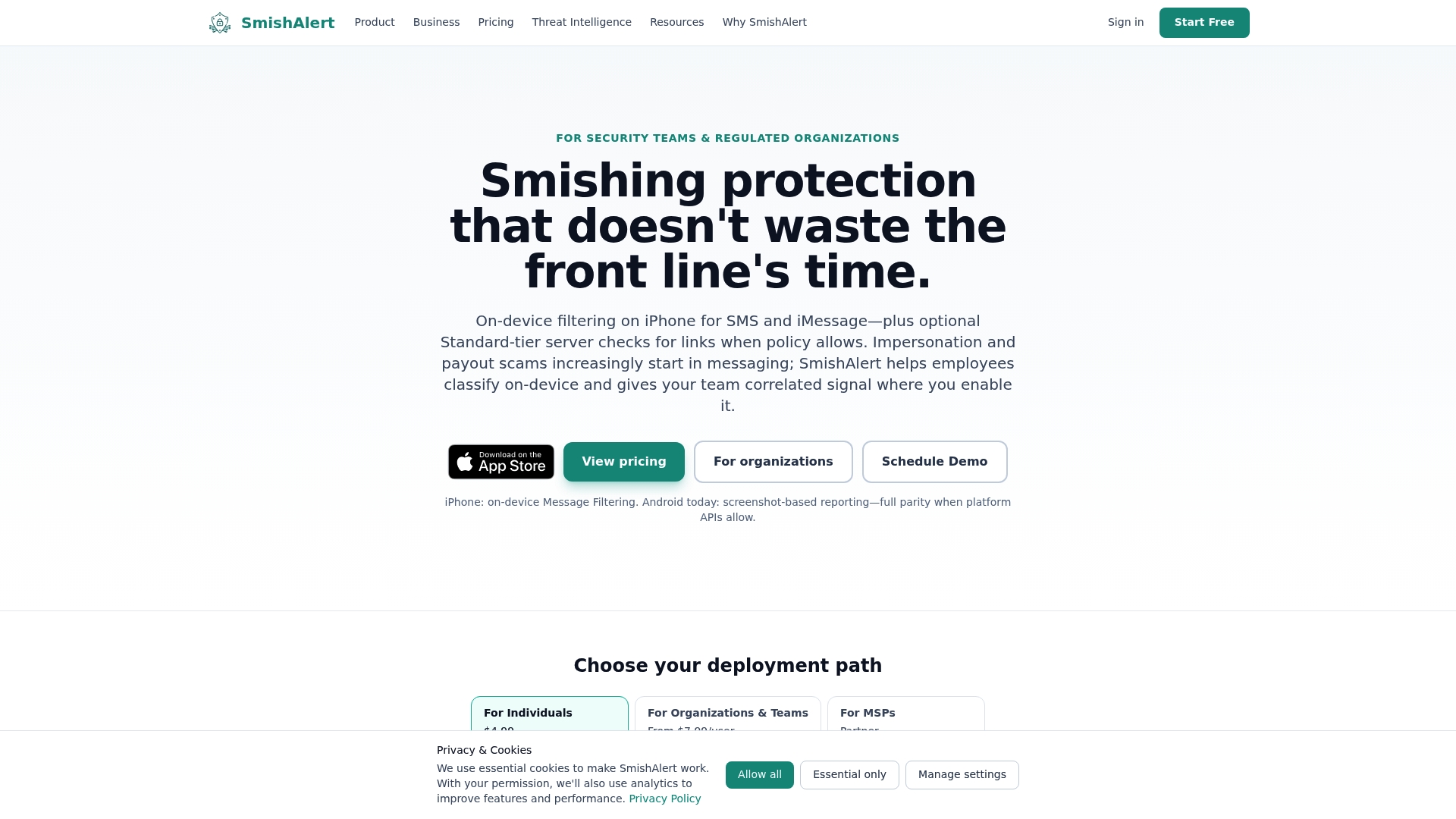
The SmishAlert platform is built for security teams that need messaging-based social engineering visibility fast, whether that’s credential harvesting attempts or executive impersonation campaigns targeting finance and HR staff. A pilot typically scopes to executives and high-risk groups over 30 days, with SIEM integration and audit-ready reporting. If your organization is ready to see what’s hitting employee phones right now, start a pilot and scope it to the groups attackers already target most.