
Why Mobile Phishing Outpaces Desktop Threats: SOC Playbook

Mobile phishing outpaces desktop threats because SMS, iMessage, and WhatsApp operate entirely outside the corporate security perimeter, where traditional email gateways, DLP tools, and EDR telemetry have no reach. The result is a structural blind spot: attackers deliver credential-harvesting lures directly to the device that also receives MFA codes, collapsing the authentication chain in a single interaction. The single highest-impact priority for security teams is restoring visibility into mobile messaging channels before that chain breaks.
- Mobile phishing achieves click-through rates roughly 40% higher than equivalent email lures, per Verizon DBIR analysis.
- Smishalert telemetry consistently shows that the majority of mobile phishing campaigns targeting enterprise employees go unreported to SOC teams because no structured reporting path exists for SMS or messaging apps.
- The top priority: deploy on-device filtering and a structured employee reporting workflow for mobile messaging, then integrate those signals into your SIEM.
Table of Contents
- What the latest data says about mobile phishing risks
- Why mobile messaging evades your existing defenses
- How mobile UX makes users more likely to click
- How AI scales mobile phishing beyond manual SOC capacity
- Common mobile attack types and their business impact
- Why SOCs struggle to detect mobile messaging attacks
- Prioritized mitigation checklist for security leaders
- How Smishalert closes the mobile visibility gap
- 90-day roadmap from pilot to production
- Key Takeaways
- The case for treating mobile visibility as a board-level risk
- Smishalert gives your SOC visibility into mobile messaging threats
- Further reading and source material
What the latest data says about mobile phishing risks
Over 80% of phishing sites are now built specifically for mobile devices, using HTTPS, mobile-optimized redirects, and shortened URLs that obscure destination domains. That figure alone signals a deliberate attacker shift, not a gradual drift.
The Verizon DBIR 2026 data, analyzed by Zimperium, confirms that mobile-first attack strategies are accelerating and that mobile is now the most vulnerable attack surface in the enterprise. Meanwhile, ZDNet’s coverage of the same DBIR data notes that mobile attack vectors are outstripping email threats as organizations improve email defenses, pushing attackers toward channels where detection is weakest.
| Dimension | Desktop / Email | Mobile Messaging |
|---|---|---|
| Phishing site targeting | Broad | 80%+ mobile-optimized |
| Click-rate vs. email baseline | Baseline | significantly higher |
| SOC visibility | High (gateway logs, headers) | Low (no parseable metadata) |
| MFA interception risk | Moderate | High (device is the MFA receiver) |
| Reporting infrastructure | Mature | Largely absent |
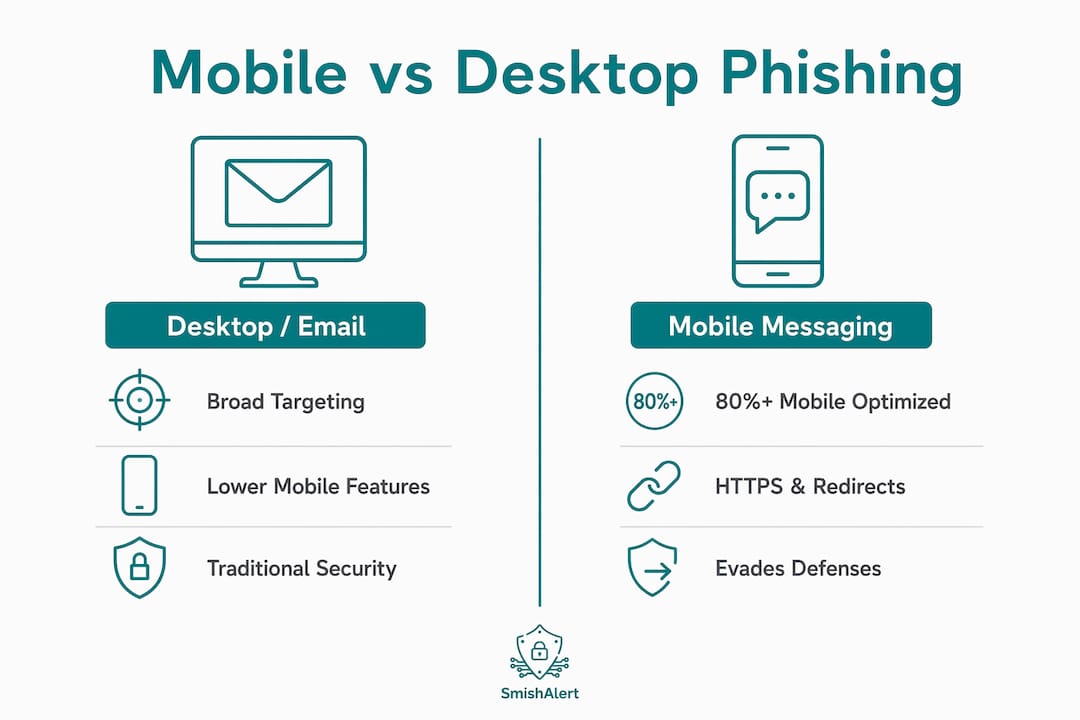
For budget and pilot prioritization, these numbers reframe mobile from a secondary concern to the primary initial-access vector security programs must address in 2026.
Why mobile messaging evades your existing defenses
The core technical problem is the absence of centralized gateways. Email travels through infrastructure your team controls: SMTP relays, spam filters, and gateways that parse headers, apply SPF/DKIM/DMARC checks, and feed logs to your SIEM. SMS, WhatsApp, and iMessage bypass that stack entirely, generating little to no parseable metadata for automated enrichment.
- No transport headers: SMS carries no equivalent of SMTP headers, so there is nothing to parse for sender authentication or routing anomalies.
- Protocol fragmentation: SMS, RCS, iMessage, and WhatsApp each use different protocols and app-layer flows, meaning no single gateway or proxy covers all channels.
- OS fragmentation and patching gaps: Zimperium and the Verizon DBIR report that approximately 50% of enterprise mobile devices run outdated OS versions, and 1 in 4 cannot be upgraded at all, leaving known vulnerabilities permanently open.
- EDR and DLP blind spots: Standard endpoint detection rules written for Windows or macOS processes do not translate to iOS or Android app behaviors, and mobile DLP lacks the hook points available on managed desktops.
Pro Tip: Before scoping a mobile security pilot, audit how many employee devices in your fleet are running OS versions more than two major releases behind. That number is your baseline patching risk and a compelling figure for executive briefings.
For a deeper look at mobile endpoint protection challenges, including app supply-chain risks and third-party library vulnerabilities, the gap between desktop and mobile manageability is wider than most security programs currently account for.

How mobile UX makes users more likely to click
The mobile form factor materially increases social engineering success rates, and the mechanism is concrete. On a desktop, hovering over a hyperlink reveals the destination URL in the browser’s status bar. On mobile, that preview does not exist. Users must perform extra taps to inspect a link destination and rarely do so in rapid messaging flows, particularly when a message creates urgency.
- Truncated URL bars: Mobile browsers frequently hide or shorten the address bar, making look-alike domains nearly invisible to users.
- Contact name spoofing: A message appearing under a saved contact name, or a caller ID displaying a known executive’s number, bypasses the skepticism users apply to unknown senders.
- Padlock myth: The presence of HTTPS on a phishing page signals nothing about legitimacy, yet many users still treat it as a trust indicator.
- Rapid-response behavioral norms: Employees check phones frequently and respond to texts faster than email, often while distracted. AI-generated “Urgent Alert” messages exploit exactly that pattern.
The behavioral consequence for SOC playbooks: user-reported mobile phishing rates are lower than email, not because fewer attacks arrive, but because the UX reduces the friction that would otherwise prompt a user to pause and report.
How AI scales mobile phishing beyond manual SOC capacity
AI has lowered the cost of crafting credible, personalized smishing campaigns to near zero. Vendor analyses confirm that AI now accelerates targeting, message generation, and campaign automation for mobile attacks, enabling attackers to run what amounts to continuous A/B testing across messaging platforms.
- Automated OSINT reconnaissance pulls employee names, roles, and org-chart relationships from LinkedIn and public directories to personalize lures.
- AI voice cloning enables deepfake vishing calls that impersonate known executives, per MITRE ATT&CK technique T1660.
- Rapid template iteration means a high-performing lure can be replicated and distributed across thousands of targets within hours.
The operational consequence for SOC teams is volume-driven noise. When campaigns scale this fast, manual triage cannot keep pace, and false-negative rates climb. The response must also be automated: detection, correlation, and escalation workflows that do not depend on an analyst reviewing each individual report.
Common mobile attack types and their business impact
The attack vectors most likely to affect enterprise employees span several delivery channels, and they frequently chain together.
- Smishing (SMS): The most common entry point. A text impersonating IT, HR, or a financial institution directs the target to a credential-harvesting page.
- WhatsApp and iMessage phishing: Messaging app lures often impersonate vendors or executives and can include malicious attachments or QR codes.
- Vishing: Voice calls, increasingly AI-generated, target executives and help desks for credential resets or wire transfer authorization.
- Quishing (QR-based phishing): QR codes in physical spaces or digital messages redirect users to mobile-optimized phishing pages that bypass link-scanning tools.
A typical campaign timeline runs as follows:
- Initial contact via SMS or WhatsApp impersonating a known sender.
- Target clicks a shortened URL, lands on a mobile-optimized credential page.
- Credentials and SMS-based MFA code are harvested in real time.
- Attacker authenticates to corporate SSO or email within minutes.
- Lateral movement begins: payroll redirect, email rule creation, or data exfiltration.
Mobile phishing frequently targets the authentication chain because the mobile device is the MFA receiver. Credential theft and token interception can happen in a single session, collapsing the time between initial contact and account takeover to under ten minutes.
The business impact ranges from payroll fraud and executive impersonation to full identity takeover and regulatory exposure. For more on real-world mobile threat scenarios and incident timelines, the pattern of initial SMS contact chaining into SSO compromise is now a documented, repeatable playbook on the attacker side.
Why SOCs struggle to detect mobile messaging attacks
The detection gap is structural. SMS, WhatsApp, and iMessage lack the transport headers that make email investigations tractable. There is no equivalent of message-ID, received-from chains, or DMARC alignment data to parse, enrich, or feed into a SIEM correlation rule.
- BYOD and privacy constraints: Many organizations cannot deploy full telemetry on employee-owned devices, limiting forensic access even when an incident is suspected.
- No detonation queues: SOC teams have mature sandboxing workflows for email attachments and URLs. For a URL received via SMS, most teams have no equivalent automated detonation path.
- Cross-channel correlation is manual: A smishing campaign that pivots to a vishing call and then to an email follow-up looks like three unrelated events in three separate queues.
Many SOCs treat mobile phishing reports as dead-end tickets. Without tooling to enrich an SMS-based indicator, analysts close the ticket for lack of actionable data — and the campaign continues.
This is the mobile messaging blind spot that lengthens dwell time and raises the cost of incident response. Mean time to detect for mobile-originated compromises is materially longer than for email-originated ones, precisely because the early signals never reach the SOC.
Pro Tip: Add a dedicated “mobile phishing” category to your ticketing system and track closure reasons. If the dominant closure reason is “insufficient data,” that is a direct measurement of your mobile visibility gap.
Prioritized mitigation checklist for security leaders
Rank controls by impact and implementation effort. Start with visibility; everything else depends on it.
High-impact controls:
- Deploy on-device filtering for iOS (native message filtering API) and a structured reporting workflow for Android and cross-platform messaging apps.
- Implement phishing-resistant MFA (FIDO2/passkeys) for all accounts accessible from mobile devices. SMS-based MFA interception is a documented, exploited risk.
- Integrate mobile phishing reports into your SIEM via API to enable cross-channel correlation.
Mid-tier controls:
- Enforce MDM/MAM policies that require current OS versions and app-layer controls on devices accessing corporate resources.
- Build a dedicated incident response playbook for SMS and messaging-app compromises, including credential reset and session revocation steps.
- Set SLA targets for mobile phishing triage: aim for under four hours from report to disposition.
Low-effort wins:
- Run targeted awareness campaigns that show employees the specific UX pitfalls on mobile: truncated URLs, contact name spoofing, and the absence of hover preview.
- Establish rapid deprovisioning procedures for suspected mobile compromises, including SSO session termination and MFA token revocation.
Pilot metrics to track: reports received per week, average triage time, confirmed malicious link rate, prevented MFA bypass attempts, and time from report to SIEM alert.
For smishing protection best practices that map directly to this checklist, the implementation guidance covers both managed and BYOD device scenarios.
How Smishalert closes the mobile visibility gap
A mobile-first detection platform addresses the structural gaps that email-centric tools cannot reach. Smishalert’s platform capabilities include on-device iOS message filtering, cross-channel reporting for Android and messaging apps, campaign correlation across SMS, WhatsApp, and iMessage, SIEM/API integration, and audit-ready incident reporting.
What the 30-day pilot measures:
- Baseline volume of mobile phishing messages reaching employees.
- Employee reporting rate and average time from receipt to report.
- Campaign correlation: how many individual reports link to a single coordinated attack.
- MFA bypass attempts identified through cross-channel analysis.
- SOC triage time before and after structured mobile reporting is in place.
The pilot fee credits toward the first annual subscription, so the assessment cost does not sit outside the program budget.
Practical example: In a representative deployment, Smishalert’s campaign correlation engine linked 14 individual employee reports across SMS and WhatsApp to a single executive impersonation campaign targeting payroll administrators. Without cross-channel correlation, each report would have closed as an isolated low-priority ticket. With it, the SOC escalated within two hours, revoked the targeted credentials, and blocked the credential-harvesting domain before any payroll redirect completed.
Pro Tip: Use the pilot period to establish your mobile phishing baseline. Without a pre-pilot measurement, you cannot demonstrate program ROI to the board or justify the annual subscription budget.
90-day roadmap from pilot to production
| Phase | Weeks | Key Activities | Owner | KPI |
|---|---|---|---|---|
| Planning | 1–2 | Scope devices, define reporting workflow, brief legal/compliance | Security lead, IT admin, legal | Devices scoped, policy approved |
| Deployment | 3–4 | Deploy on-device filtering, configure SIEM integration, launch employee comms | IT admin, SOC analyst | Filtering active on target fleet |
| Measurement | 5 | Track reports, triage times, campaign correlation, MFA bypass attempts | SOC analyst, security lead | Baseline metrics established |
| Review | 9 | Analyze pilot data, present findings to executive sponsor | Security lead, CISO | Pilot report delivered |
| Production cutover | 11 | Finalize annual subscription, expand to full fleet, update IR playbooks | All roles | Production SLA targets met |
Success criteria for production promotion:
- Mean time to triage mobile phishing reports under four hours.
- At least one coordinated campaign identified through cross-channel correlation during the pilot.
- Zero undetected MFA bypass attempts attributable to mobile phishing after filtering is active.
- Executive sponsor sign-off based on pilot report metrics.
The human element was involved in 62% of all breaches analyzed in recent industry reporting. A 90-day pilot that closes the mobile messaging visibility gap directly addresses that statistic at the human layer.
Key Takeaways
Mobile phishing outpaces desktop threats because it operates outside every traditional security control while targeting the device that holds the authentication chain.
| Point | Details |
|---|---|
| Click-rate differential | Mobile phishing achieves click-through rates roughly 40% higher than equivalent email lures. |
| Attacker site targeting | Over 80% of phishing sites are now built specifically for mobile devices. |
| Authentication chain risk | The mobile device is the MFA receiver; credential theft and token interception can occur in a single session. |
| SOC visibility gap | SMS, WhatsApp, and iMessage lack parseable transport headers, making automated enrichment and correlation nearly impossible without dedicated tooling. |
| Smishalert pilot path | A 30-day paid pilot measures baseline mobile phishing volume, campaign correlation, and MFA bypass attempts, with the fee credited to the annual subscription. |
The case for treating mobile visibility as a board-level risk
The security programs that are furthest behind on mobile are not the ones that ignored the threat. They are the ones that assumed email security investments transferred to mobile channels. They do not. The protocols are different, the metadata is absent, the device is outside the perimeter, and the user is operating in a UX environment designed for speed, not scrutiny.
What changed the calculus for programs that moved early was a single measurement: how many mobile phishing messages reached employees last quarter, and how many were reported? For most organizations, the answer to the second question is a fraction of the first. That gap is the risk. Smishalert’s telemetry makes that gap visible, which is the prerequisite for closing it. Until mobile messaging appears in your threat metrics, it will not appear in your budget, your board reporting, or your incident response playbooks. Make it visible first. Everything else follows.
Smishalert gives your SOC visibility into mobile messaging threats
Security teams that have closed the email phishing gap are now facing a channel where their existing tools have no reach. Smishalert is built specifically for that gap: it surfaces SMS, iMessage, and WhatsApp-based social engineering attacks that never appear in your SIEM, correlates individual employee reports into campaign-level intelligence, and delivers audit-ready incident data your team can act on.
The 30-day paid pilot is scoped to your fleet, measures the metrics that matter to your SOC, and credits the pilot fee toward the first annual subscription. You leave the pilot with a baseline, a campaign correlation report, and the data to justify production deployment to your executive sponsor. Take the 2-minute readiness check to see where your mobile visibility gaps are, or review the full platform capabilities to scope a pilot for your organization.
Further reading and source material
- Zimperium: Critical Takeaways from the 2026 Verizon DBIR — Primary source for mobile click-rate differentials, OS patching gaps, and AI-driven campaign automation. Use for executive briefings and budget justification.
- ZDNet: Mobile Attack Vectors Are Outstripping Email Threats — Mainstream media validation of DBIR findings; useful for non-technical stakeholder communications.
- CSO Online: Over 80% of Phishing Sites Now Target Mobile Devices — Quantifies the attacker shift toward mobile-optimized infrastructure; cite in risk assessments.
- MITRE ATT&CK T1660: Phishing on Mobile — Authoritative technique taxonomy covering smishing, vishing, quishing, and QR-based attacks. Use for SOC playbook development and detection rule mapping.
- PhishSkill: Mobile Phishing Click-Rate Benchmarks — UX research on hover-preview absence and mobile click behavior; supports awareness training design.
- Daylight.ai: Mobile Phishing Risks and Prevention — Covers authentication chain targeting, SOC tooling gaps, and the absence of transport headers in mobile messaging. Useful for technical validation of detection challenges.
- Smishalert Threat Signal: Q2 2026 Smishing Report — Quarterly telemetry on active smishing campaigns, lure types, and campaign correlation data from enterprise deployments.