
Why Mobile Risk Needs Dedicated Ownership in 2026

Dedicated ownership for mobile risk is not optional. Mobile risk crosses endpoint security, IAM, application development, and fraud prevention simultaneously, and only a named owner or accountable cross-functional team can orchestrate consistent controls and fast containment across all four domains. Without that named accountability, organizations experience fragmented assurance, inconsistent user treatment, and delayed incident response — exactly the conditions attackers exploit.
Three immediate takeaways for security and IT leaders:
- Assign a named control owner now. NIST CSF, NIST SP 800-53, and ISO/IEC 27001 all expect clear ownership of access control and incident response. Governance frameworks do not tolerate ambiguity about who can revoke sessions or quarantine devices.
- Tie ownership to business-impact metrics. Reduction in account takeovers, time-to-contain, and fraud dollars prevented are the KPIs that justify the investment to the C-suite — not patch counts or compliance checkboxes.
- Structure authority by control point, not by silo. IT owns device configuration, IAM owns session revocation, and business units own risk-acceptance decisions. Collapsing all three into one team creates bottlenecks; leaving them uncoordinated creates gaps.
Table of Contents
- Why mobile risk is distinct from traditional endpoint or network risk
- How siloed responsibilities cause real security failures
- What dedicated ownership looks like in practice
- What controls and capabilities the owner must manage
- How to measure whether ownership is working
- Step-by-step checklist to establish dedicated ownership
- Common challenges and how to overcome them
- Where messaging-threat visibility fits into the owner’s toolkit
- Key Takeaways
- The case for acting before the next incident
- Smishalert gives mobile risk owners the visibility to act fast
- Authoritative resources and further reading
Why mobile risk is distinct from traditional endpoint or network risk
Mobile devices operate outside the corporate perimeter by design. They carry PII and PHI, connect over untrusted networks, run third-party SDKs, and serve as the primary channel for SMS-based authentication — all at the same time. That combination produces an attack surface no traditional endpoint or network control fully covers.
The attack vectors are specific and often underestimated. Smishing, SIM swap, SMS/OTP fallback abuse, app-based credential-harvesting, runtime hooking via tools like Frida, and SDK data-leakage each exploit a different layer of the mobile stack. A SIM swap, for example, redirects OTP delivery before any endpoint agent can detect it. Fallback abuse exploits the weakest authentication path an organization allows, often SMS, when stronger factors fail or are unavailable.
Third-party SDKs make up a significant portion of mobile app code, according to NowSecure — meaning most enterprises are shipping risk they did not write and cannot fully audit.
Mobile risk also ties device, app, identity, and messaging channels into a single data path. A compromised device can reuse an active session; a stolen OTP can bypass strong device posture. Controls must span enrollment, session and token lifecycle, recovery flows, and messaging channels that fall entirely outside the corporate perimeter. No single existing team — endpoint, IAM, or fraud — owns that full path. That is precisely why mobile security needs focus as a distinct governance domain.
How siloed responsibilities cause real security failures
When ownership is fragmented, the failure modes are predictable. IAM, endpoint security, application security, and fraud each cover a portion of the attack chain — but no single team can revoke the full path quickly when an incident crosses all four.
The practical consequences show up in three patterns:
- Fragmented assurance: Each team applies its own controls to its own layer. An attacker who compromises a device, harvests a token, and then abuses an SMS fallback path has crossed three team boundaries. None of the three teams has the authority or visibility to stop the full chain alone.
- Inconsistent user treatment: Recovery and exception handling differ by product or team. One product team may allow SMS fallback after three failed biometric attempts; another may not. Attackers probe for the weakest path systematically.
- Delayed incident response: Authority disputes slow token and session revocation. A SIM swap that redirects an OTP can result in account takeover within minutes — but if the IAM team needs approval from the fraud team before revoking sessions, that window widens.
“If a single team (e.g., IAM) owns mobile authentication without input from fraud or product security, the organization will suffer uneven user treatment and miss sophisticated attack patterns like SIM swaps and repeated fallback abuse.” — NHIMG
The service gaps between teams are not a people problem. They are a structural problem that only formal ownership resolves.
What dedicated ownership looks like in practice

Three realistic models exist, each with different tradeoffs:
| Model | Structure | Best fit | Key limitation |
|---|---|---|---|
| A: Single named owner | One individual holds delegated authority across device, IAM, app, and fraud controls | Smaller organizations, unified security team | Bottleneck risk; single point of failure |
| B: Cross-functional team with named control owner | Accountable team; one named role holds final authority on escalations | Mid-to-large enterprises with distinct IAM, endpoint, and fraud teams | Requires clear RACI and pre-authorized escalation |
| C: Federated owners with central control plane | Domain owners retain authority; a central policy layer enforces baselines | Large enterprises, complex BYOD or multi-cloud environments | Coordination overhead; slower emergency response without pre-authorization |
NHIMG advises that mobile authentication ownership should be cross-functional — IAM, fraud, and product security together — because single-team ownership consistently misses fraud patterns and recovery edge cases.
Regardless of model, the owning team must hold four minimum authorities: the ability to revoke sessions and tokens, require re-enrollment, trigger step-up authentication, and approve emergency exceptions within the first hour of a confirmed compromise. Without pre-authorization for those four actions, the model is governance theater.
The RACI by control point is straightforward: IT is responsible for device containment and configuration; IAM is responsible for session and token invalidation; business units are accountable for risk-acceptance decisions; and the named control owner is consulted and informed across all three. Coordinating fraud prevention and mobile security teams around these control points — rather than around organizational silos — is what makes the model work.
What controls and capabilities the owner must manage
The owning team’s operational scope divides into three categories.
Telemetry and signals the owner must ingest:
- Device posture scores from mobile threat defense (MTD) tools
- SDK telemetry and third-party library behavior anomalies
- Token and session state from the IAM platform
- Messaging-threat feeds covering smishing, executive impersonation, and credential-harvesting campaigns
- Fraud scores and enrollment anomalies from the fraud platform
Policy and enforcement baselines the owner must set:
- Authentication baselines aligned to NIST SP 800-63 Authenticator Assurance Levels (AAL1, AAL2, AAL3)
- Step-up authentication triggers tied to device posture degradation or fraud score thresholds
- SMS and OTP fallback exception rules, including which user populations may use fallback and under what conditions
- SDK and third-party library approval criteria, including runtime monitoring requirements
Operational tooling the owner must operate or orchestrate:
Centralized session revocation with sub-five-minute SLA for confirmed compromises. Real-time detection pipelines that correlate device posture, IAM events, and messaging-threat signals. Playbooks for containment, recovery, and user communication. Audit trails that capture which control failed, when, and who authorized the response — because that evidence is what regulators and internal reviewers will ask for. Aligning messaging policy with these operational controls closes the perimeter gap that static compliance checklists miss entirely.
How to measure whether ownership is working
| KPI | What it measures | Target direction |
|---|---|---|
| Time-to-detect (mobile incidents) | Minutes from first signal to confirmed alert | Decreasing |
| Time-to-contain (token/session revocation) | Minutes from confirmed incident to revocation | Decreasing; target under one hour |
| Mobile-driven account takeovers | Count per quarter | Decreasing |
| Fraud dollars prevented | Estimated loss avoided via mobile controls | Increasing |
| App inventory coverage | % of apps assessed against business-impact tiers | Increasing toward full coverage |
| Mean time to revoke sessions | Average minutes across all incident types | Decreasing |
| Incident evidence completeness | % of incidents with documented control-failure root cause | Increasing toward full coverage |
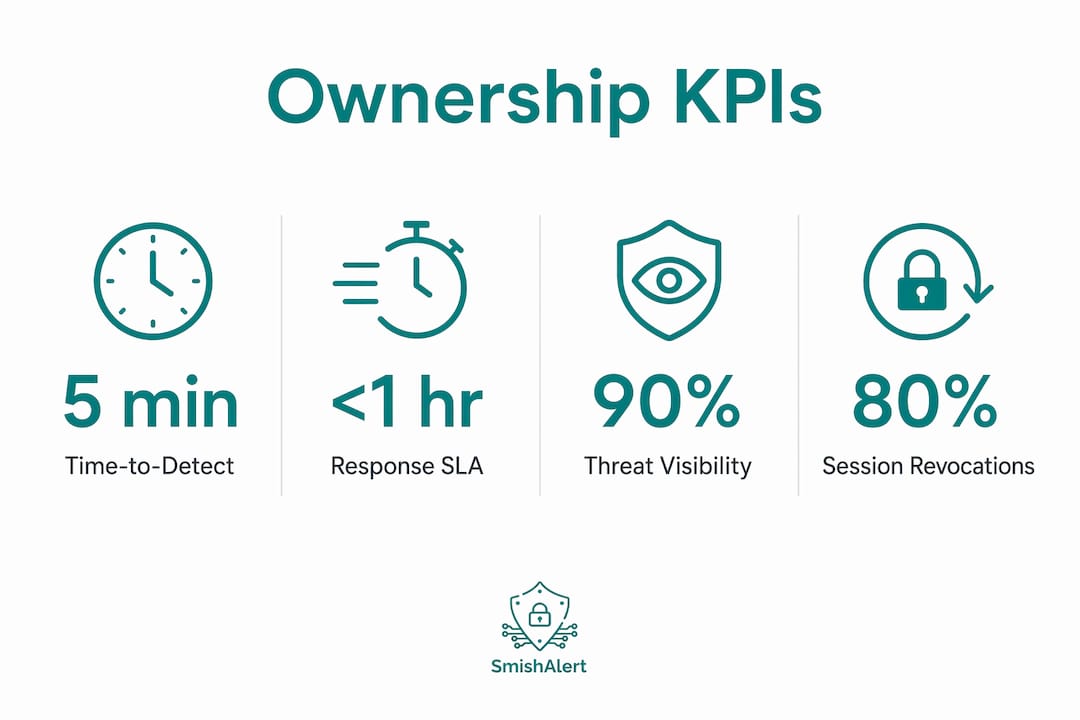
Translating these KPIs into business language matters as much as tracking them. Fewer account takeovers mean lower remediation costs, reduced regulatory exposure under state breach-notification laws, and measurable brand protection. A security leader who can show the CFO that ownership reduced fraud losses by a specific dollar amount in a quarter has a far stronger budget argument than one presenting patch-compliance rates.
Step-by-step checklist to establish dedicated ownership
- Secure executive sponsorship and draft a governance charter. Name the control owner role, define scope, and get sign-off from the CISO and at least one business-unit executive. Without sponsorship, the owner has no authority to enforce cross-team decisions.
- Inventory apps and tier by business impact. Classify each app by the sensitivity of data it handles and the user population it serves. High-impact apps (those handling PII, PHI, or financial transactions) become the pilot scope.
- Nominate the owner and define RACI by control point. Use the three-column model: IT for device, IAM for sessions, business units for risk acceptance. Document it in the charter.
- Integrate telemetry feeds. Connect MTD, IAM, fraud, and messaging-threat signals into a unified detection pipeline. Without correlated telemetry, the owner is operating blind.
- Run a 6–8 week pilot on high-impact apps. Enable detection signals, define containment playbooks, measure baseline KPIs, and run a tabletop incident exercise followed by a live drill. The mobile threat strategy roadmap provides a useful framework for structuring this phase.
- Establish the one-hour escalation matrix. Name, by title, who can revoke tokens, quarantine devices, and approve continuity exceptions in the first hour of a suspected compromise. Pre-authorize those actions so the pilot drill can validate the process under realistic time pressure.
- Review KPIs at pilot close and set scale thresholds. Define the KPI improvement levels that justify expanding ownership to the full app portfolio. Document friction metrics — support ticket volume, user friction reports — alongside security metrics.
- Formalize and scale. Publish the incident escalation matrix, automate detection-to-revocation workflows where possible, and schedule quarterly ownership reviews tied to the business-impact tier reassessment.
Common challenges and how to overcome them
Turf conflicts are the most common obstacle. IAM teams resist ceding session-revocation authority; fraud teams guard their scoring models; product security teams push back on SDK restrictions that slow release cycles. The mitigation is control-point accountability rather than monolithic ownership — each team retains authority within its domain, and the named control owner coordinates escalation, not day-to-day operations.
BYOD ambiguity creates a second friction point. Personally owned devices that store corporate data fall into a governance gray zone, particularly when MDM enrollment is optional. Phased enforcement — starting with corporate-owned devices and extending to BYOD through Mobile Application Management (MAM) policies — reduces resistance while maintaining progress.
Federation and SSO complexity can obscure session state across identity providers. The owner must map every federation trust relationship and confirm that session revocation propagates correctly across all downstream applications. Gaps here are where post-compromise lateral movement occurs.
“A frequent pitfall is missing an exception/escalation matrix; practitioners recommend naming, by title, who can override protocols in the first hour of a compromise to avoid wasted time debating authority.” — NHIMG
Pro Tip: Draft the one-hour emergency authority matrix before the pilot begins, not after the first real incident. List three titles — not names — who can authorize token revocation, device quarantine, and continuity exceptions. Validate it during the tabletop exercise. If the drill reveals ambiguity, fix the matrix before going live.
Where messaging-threat visibility fits into the owner’s toolkit
The mobile owner’s detection pipeline has a structural blind spot: messaging channels. Smishing campaigns, executive impersonation via SMS or WhatsApp, and credential-harvesting links delivered through iMessage all occur outside the corporate perimeter and outside the visibility of MTD or IAM tools. That gap is where attackers increasingly operate.
| Workflow stage | Owner’s need | Messaging-threat signal |
|---|---|---|
| Detection | First alert on active campaign | Real-time smishing or impersonation alert correlated to employee population |
| Prioritization | Which accounts or devices are at risk | Campaign correlation mapping affected users to IAM records |
| Containment | Trigger step-up or revoke session | Enriched fraud score or confirmed credential-harvesting event |
| Recovery | Evidence for incident record | Threat context: message content, sender, campaign pattern |
| Reporting | KPI: time-to-detect, fraud prevented | Aggregated trend data by threat type and business-impact tier |
“Compliance checklists are necessary but insufficient; active, continuous risk management — including runtime monitoring for threats like Frida hooking — is required because mobile devices operate in hostile environments outside the corporate perimeter.” — Approov
Smishalert surfaces exactly these signals. When a smishing campaign targets employees through SMS or WhatsApp, Smishalert detects the campaign, correlates it to affected accounts, and delivers the enriched context the owner needs to trigger containment — step-up authentication, session revocation, or a targeted user alert — before credential-harvesting succeeds. That credential-harvesting detection capability closes the perimeter gap that no MTD or IAM tool alone addresses.
Key Takeaways
Dedicated mobile risk ownership requires a named control owner, control-point RACI, pre-authorized escalation authority, and business-impact KPIs — without all four, governance produces coverage gaps that attackers exploit.
| Point | Details |
|---|---|
| Assign a named control owner | Name a role with pre-authorized authority to revoke sessions, quarantine devices, and approve exceptions within the first hour of compromise. |
| Use control-point RACI | Assign IT to device config, IAM to session revocation, and business units to risk acceptance — coordinate across silos, not within one. |
| Pilot on high-impact apps | Select apps handling PII, PHI, or financial data; measure baseline KPIs over 6–8 weeks before scaling ownership organization-wide. |
| Track business-impact KPIs | Report time-to-contain, account takeovers, and fraud dollars prevented — not patch rates — to justify ownership investment to the C-suite. |
| Smishalert closes the perimeter gap | Messaging-threat telemetry from Smishalert feeds the owner’s detection and containment workflows for threats outside the corporate perimeter. |
The case for acting before the next incident
The pattern is consistent: organizations that assign mobile risk ownership after a major account-takeover incident spend months rebuilding controls that should have been in place. The threat trends driving this urgency — mobile-targeted social engineering, token theft, and SMS-based credential-harvesting — are not slowing. They are accelerating, and they are targeting the messaging channels that most security programs still treat as someone else’s problem.
Smishalert was built specifically to surface these threats: the smishing campaigns, executive impersonation attempts, and credential-harvesting links that arrive through SMS, iMessage, and WhatsApp before any IAM or endpoint tool sees them. The question worth asking now is not whether your organization needs mobile risk ownership. It is whether the person who should own it can actually see what is happening in the messaging layer — and whether they have the authority to act on it before the first hour of a compromise is wasted in an authority debate.
Map who can stop abuse in your organization today. If the answer is unclear, that is the gap the ownership model must close first.
Smishalert gives mobile risk owners the visibility to act fast
Security and IT leaders building a mobile risk ownership program face one consistent gap: no telemetry from the messaging layer. MTD tools cover device posture. IAM platforms cover session state. Neither covers the smishing campaign that harvested credentials before the device was ever flagged.
Smishalert provides real-time messaging-threat visibility — detecting smishing, executive impersonation, payroll fraud attempts, and credential-harvesting campaigns across SMS, iMessage, and WhatsApp. That telemetry feeds directly into the owner’s detection pipeline, enriches IAM and fraud decisions, and reduces time-to-contain by giving the owning team the context to act rather than investigate. Security leaders can explore the platform to see how messaging-threat signals integrate with existing IAM and fraud workflows, or take the two-minute readiness check to identify visibility gaps in the current ownership model before the next incident surfaces them.
Authoritative resources and further reading
- NIST SP 800-124r2 — Guidelines for Managing the Security of Mobile Devices in the Enterprise: The primary NIST reference for mobile device threat modeling, lifecycle management, and control selection — foundational for building a governance charter.
- NIST SP 1800-21 — Mobile Device Security: COPE: Reference architecture for corporate-owned device deployments; useful for defining enrollment, MDM, and MTD control baselines in the pilot.
- NIST SP 1800-22 — Mobile Device Security: BYOD: Companion guide covering BYOD-specific risks and MAM-based controls — essential for organizations with mixed device ownership.
- NHIMG — Who should own mobile authentication decisions?: Operational guidance on cross-functional ownership for mobile authentication; directly applicable to RACI design and escalation matrix drafting.
- NHIMG — Who is accountable when mobile exploit activity leads to account theft?: Covers accountability frameworks and the one-hour escalation matrix recommendation — use this when drafting the governance charter’s incident response section.
- NowSecure — What is mobile app risk management and why your enterprise needs it?: Alan Snyder’s framing of MARM as a structured, continuous program; useful for connecting app security to business-impact tiers in the pilot design.
- Approov — Mobile Application Risk Management (MARM) Framework: Detailed technical guidance on runtime monitoring, SDK telemetry, and Frida-hooking detection — supports the controls and capabilities section of the ownership charter.
- Smishalert — Align mobile threat policy with industry standards: Practical guidance on mapping mobile security policies to NIST and ISO controls — useful when formalizing the ownership model’s policy baselines.