
Mobile Security in Compliance Programs: A CISO Guide

Mobile security in compliance programs means the detection, blocking, reporting, and incident response controls that defend organizations against messaging-based social engineering (smishing) delivered via SMS, iMessage, WhatsApp, and other mobile channels. This definition explicitly excludes MDM/EMM device configuration. Per CISA, NIST, and FBI/HHS guidance, auditors now expect five core controls:
- Visibility and telemetry across all messaging channels with evidence retention
- Phishing-resistant MFA (FIDO/WebAuthn) enrolled for high-value users
- SMS fallback removal per account after authenticator enrollment
- Campaign correlation linking message artifacts to session and account telemetry
- Audit-ready reporting integrated with SIEM for compliance evidence
For executive leadership: smishing is no longer a user-awareness problem. It is a program-level control gap with direct exposure under HIPAA, SEC recordkeeping rules, and CISA guidance.
Table of Contents
- Why does smishing create a compliance risk for US organizations?
- What controls does a compliance-aligned messaging security program require?
- How do these controls map to U.S. compliance frameworks?
- How do you implement a mobile messaging security program?
- What KPIs and audit artifacts prove program effectiveness?
- What does incident response look like for a message-driven compromise?
- Where does Smishalert fit in a compliance-aligned program?
- Key Takeaways
- The compliance gap most security teams are not measuring
- Smishalert’s 30-day pilot: measure your smishing exposure before the next audit
- Useful sources and further reading
Why does smishing create a compliance risk for US organizations?
The FBI and HHS joint advisory documents exactly how this attack chain operates: threat actors register lookalike domains, impersonate executives (including CFOs), use harvested PII to bypass help-desk verification, trigger unauthorized password resets, and divert ACH payments. The entire sequence from initial smishing message to fraudulent wire transfer can complete in minutes, faster than most SOC alert queues.
The compliance exposure runs across multiple frameworks:
- HIPAA/OCR: HHS OCR’s October 2024 cybersecurity newsletter classifies smishing as a social-engineering vector requiring technical controls, including machine-learning-based threat detection and role-based access controls, for covered entities.
- SEC/FINRA recordkeeping: Off-channel communications on WhatsApp and personal SMS fall outside corporate archiving systems, creating regulatory gaps that have resulted in significant enforcement actions.
- CISA critical infrastructure guidance: CISA’s Mobile Communications Best Practice Guidance explicitly frames SMS as unencrypted and non-phishing-resistant, placing organizations relying on SMS MFA at measurable risk.
The downstream impact of a single successful smishing event, credential theft leading to MFA bypass and ACH diversion, is what elevates this from a security concern to a compliance program requirement.
What controls does a compliance-aligned messaging security program require?
Visibility and detection
Security teams need telemetry across SMS, iMessage, WhatsApp, and other channels. That means on-device filtering or user-reporting mechanisms, server-side campaign correlation to identify coordinated attack waves, and real-time alerting into the SOC or SIEM. NIST SP 800-124r2 describes Mobile Threat Defense (MTD) agents that detect malicious URL navigation and phishing attempts, then trigger automated remediation through EMM integration. Treating MTD alerts as primary IR triggers, not secondary signals, closes the detection-to-containment loop.

Evidence retention matters equally. Message artifacts, sender indicators, timestamps, and correlated session logs must be preserved with enough fidelity to support forensic investigation and regulatory production.
Authentication hardening
CISA’s phishing-resistant MFA fact sheet classifies SMS and voice MFA as last-resort options vulnerable to SS7 exploitation. The path forward is FIDO/WebAuthn enrollment for all high-value users, with number-matching as an interim control where full FIDO rollout is not yet complete.
Pro Tip: After enrolling users in authenticator-based MFA, run automated per-account checks to confirm SMS is disabled. CISA explicitly notes that authenticator enrollment often does not automatically unenroll existing SMS, leaving an exploitable fallback that attackers can abuse via account-recovery flows.
Process controls
Help-desk verification hardening is non-negotiable. The FBI/HHS advisory shows attackers using harvested PII to impersonate employees and trigger password resets. Verification protocols must require out-of-band confirmation that cannot be satisfied by information a smishing attacker already holds. High-risk transactions, payroll changes, ACH instructions, and vendor banking updates, require secondary verification independent of the messaging channel that initiated the request.
For enterprise smishing protection, executive and payroll staff warrant dedicated coverage given their disproportionate targeting by impersonation campaigns.
How do these controls map to U.S. compliance frameworks?
| Control | Authoritative Citation | Sample Audit Artifact |
|---|---|---|
| Visibility and telemetry across messaging channels | CISA Mobile Communications Guidance; NIST SP 800-124r2 | SIEM ingestion logs, channel coverage report |
| Phishing-resistant MFA enrollment | CISA Phishing-Resistant MFA Fact Sheet | Per-account MFA enrollment proof, configuration screenshot |
| SMS fallback disabled per account | CISA Mobile Communications Guidance | Automated per-account audit report showing SMS disabled |
| Campaign correlation and evidence retention | FBI/HHS Joint Advisory | Correlation report linking message artifacts to session logs |
| Help-desk verification hardening | FBI/HHS Joint Advisory | Updated verification procedure, call log samples |
| Technical anti-phishing controls | HHS OCR October 2024 Newsletter | ML/behavioral detection configuration, incident tickets |
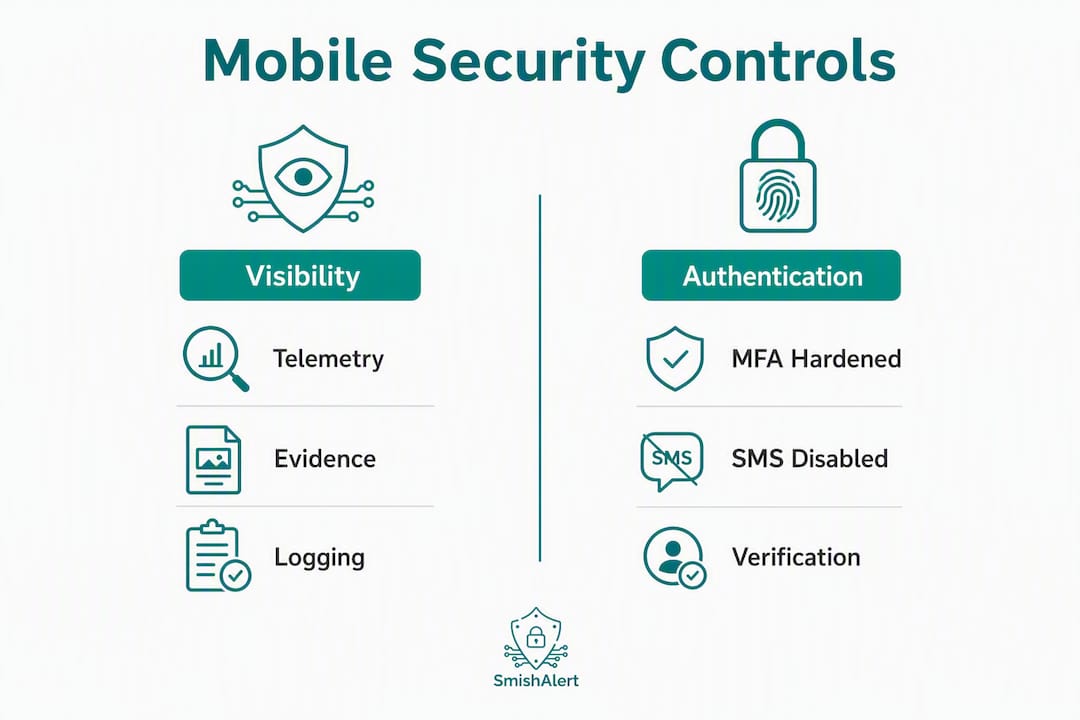
CISA’s guidance supports visibility and logging controls as foundational to Zero Trust posture. NIST SP 800-124r2 provides the MTD-to-EMM integration model that justifies automated remediation as a compliance control. The FBI/HHS advisory grounds help-desk hardening and transaction verification in documented attack patterns. HHS OCR establishes the HIPAA obligation for technical controls in regulated-data environments.
How do you implement a mobile messaging security program?
A phased approach reduces deployment risk and produces pilot evidence auditors can review.
- Pilot execution (weeks 3–6): — Deploy on-device filtering or reporting. Validate SIEM ingestion. Confirm SMS fallback is disabled per account. Test help-desk verification procedures against simulated social-engineering attempts aligned to MITRE ATT&CK techniques, as the FBI/HHS advisory recommends.
Cost considerations include per-user annual licensing (typically structured as pilot-to-subscription with pilot fees credited toward the first year), SOC rule development, and SIEM/API integration effort. Deploying mobile phishing protection without MDM is achievable for BYOD environments, which reduces integration complexity for many mid-sized organizations.
For MFA rollout planning, a practical MFA implementation guide can supplement CISA and NIST recommendations during the pilot phase.
What KPIs and audit artifacts prove program effectiveness?
Compliance reviewers want measurable evidence, not policy documents. Collect and track:
- Time-to-detect — from message delivery to SOC alert
- Phishing-resistant MFA coverage — as a percentage of high-value users enrolled
Audit artifacts should include: SIEM correlation reports linking message artifacts to account activity, per-account MFA enrollment proofs, configuration screenshots showing SMS disabled, pilot summary reports with success-criteria outcomes, and playbook execution logs from any declared incidents.
What does incident response look like for a message-driven compromise?
Speed is the controlling variable. Social-engineering workflows can progress in minutes, so the response sequence must be pre-authorized and rehearsed.
- Preserve artifacts immediately: Capture message content, sender indicators, timestamps, and any clicked URLs before the user deletes or the device cycles.
- Correlate to session telemetry: Match message timestamps to authentication logs, VPN sessions, and application access records to identify what the attacker accessed.
- Enforce temporary MFA revocation and session termination: Revoke active tokens for affected accounts and force re-authentication through phishing-resistant MFA only.
- Suspend high-risk transactions: Place a hold on pending ACH instructions, payroll changes, or vendor banking updates initiated within the compromise window.
- Investigate help-desk call logs: Review whether the attacker contacted the help desk to trigger a password reset or MFA bypass, and preserve those call records.
- Execute remediation: Force credential resets, re-enroll affected users in FIDO-based MFA, and initiate ACH reversal procedures where applicable.
- Assess notification obligations: For HIPAA-covered entities, evaluate whether the compromise involved protected health information and whether breach notification thresholds are met.
- Assemble the evidence package: Compile message artifacts, session logs, help-desk records, phone-porting logs, and remediation documentation into a regulator-ready incident report.
The SMS threat triage checklist provides an operational reference for security teams working through the initial containment steps.
Where does Smishalert fit in a compliance-aligned program?
Smishalert maps directly to the controls above. On-device iOS message filtering provides the detection layer without requiring MDM enrollment. Android and cross-channel reporting extends visibility to WhatsApp and other messaging apps. Campaign correlation links individual reports to coordinated attack waves, giving SOC teams the context needed to escalate from a single suspicious message to a declared incident. SIEM and API integration delivers audit-ready telemetry into existing security infrastructure. Incident reporting exports the evidence package compliance teams need for regulatory production.
Procurement teams evaluating messaging-security solutions should ask:
- What are the telemetry retention limits, and can evidence be exported in formats acceptable to regulators?
- Does the platform support FIDO/WebAuthn integration confirmation, or does it only report on SMS-based authentication events?
- How does campaign correlation surface coordinated attacks across users and channels?
- What does the per-user licensing model look like, and how does the pilot fee apply to the annual subscription?
Pro Tip: Scope the initial pilot to executives, payroll staff, and help-desk personnel. These three groups represent the highest-value targets in the FBI/HHS attack patterns and will generate the most meaningful pilot evidence for compliance review.
Smishalert’s 30-day paid pilot is structured to produce audit-ready output: detection telemetry, SIEM ingestion validation, and a pilot summary report that maps findings to compliance controls. The pilot fee credits toward the first annual subscription.
Key Takeaways
Mobile messaging security controls, mapped to CISA, NIST, and FBI/HHS guidance, are now a compliance program requirement for US organizations facing smishing-driven credential theft, MFA bypass, and ACH diversion.
| Point | Details |
|---|---|
| Smishing is a program-level risk | Credential theft and ACH diversion via SMS require detection and response controls, not just user training. |
| Remove SMS MFA fallback per account | CISA confirms authenticator enrollment often leaves SMS active; automated per-account audits are required. |
| Map controls to authoritative guidance | CISA, NIST SP 800-124r2, and FBI/HHS advisory each specify controls that auditors will reference. |
| Pilot with highest-risk users first | Executives, payroll staff, and help-desk personnel generate the most defensible compliance evidence in a 30-day pilot. |
| Smishalert delivers audit-ready output | Campaign correlation, SIEM integration, and incident reporting map directly to the control evidence auditors expect. |
The compliance gap most security teams are not measuring
The conventional framing of mobile security as a device-management problem has left a significant blind spot in most compliance programs. Organizations that have invested heavily in MDM, endpoint detection, and email security often have no visibility into what arrives in an employee’s SMS inbox or WhatsApp thread. That gap is precisely where the FBI/HHS attack patterns begin.
What gets underestimated is the speed of the downstream impact. A smishing message that harvests credentials at 9:00 AM can result in an ACH diversion by 9:45 AM if help-desk verification is weak and SMS MFA fallback is still active. The compliance exposure is not just the initial message; it is the absence of detection, correlation, and containment evidence that regulators will ask for after the fact.
Security leaders who treat smishing detection as a KPI alongside email phishing detection, and who build the evidence retention and SIEM integration to support it, will be in a materially stronger position during audits and incident reviews. Starting with a scoped pilot on the highest-risk user groups is the lowest-friction path to generating that evidence.
Smishalert’s 30-day pilot: measure your smishing exposure before the next audit
Smishing attacks targeting your executives, payroll team, and help desk are already in progress. The question is whether your compliance program has the detection and evidence infrastructure to prove it, contain it, and report on it.
Smishalert’s 30-day paid pilot is scoped to your highest-risk user groups and produces the audit-ready output compliance teams need: detection telemetry by channel, SIEM ingestion validation, campaign correlation reports, and a pilot summary mapped to CISA and NIST controls. The pilot fee credits toward the first annual subscription, so the evaluation pays for itself in compliance evidence.
Before committing to a full pilot, take the 2-minute readiness self-evaluation to identify where your current program has gaps. Then engage the Smishalert team to scope a pilot that fits your environment, whether managed devices, BYOD, or executive-only coverage.
Useful sources and further reading
The following authoritative resources belong in your compliance evidence folder and program documentation:
- CISA Mobile Communications Best Practice Guidance: Primary reference for SMS MFA deprecation, phishing-resistant MFA rollout, and telco PIN controls. Use for MFA policy documentation and auditor briefings.
- CISA Implementing Phishing-Resistant MFA Fact Sheet: Detailed guidance on SS7 vulnerabilities, FIDO/WebAuthn enrollment, and SMS/voice MFA classification as last-resort options. Use for MFA configuration evidence.
- NIST SP 800-124r2: Guidelines for Managing the Security of Mobile Devices in the Enterprise: MTD detection capabilities, EMM integration patterns, and automated remediation guidance. Use for detection control mapping and SIEM integration justification.
- FBI/HHS Joint Cybersecurity Advisory on Social Engineering: Documents ACH diversion, help-desk bypass, and executive impersonation attack patterns. Use for incident response playbook grounding and help-desk hardening justification.
- HHS OCR Cybersecurity Newsletter, October 2024: HIPAA-specific smishing guidance including technical control requirements for covered entities. Use for HIPAA compliance mapping.
- Smishalert Solutions Page: Platform capabilities, pilot scoping, and coverage options for managed, BYOD, and executive environments.
- Smishalert Threat Intelligence: Live campaign examples and telemetry useful for validating detection capabilities during pilot evaluation.
- Smishalert Enterprise Answers: Q&A resource covering detection patterns, deployment options, and incident response for enterprise security teams.