
How to Verify SMS Message Authenticity in 2026

Verifying the authenticity of SMS and messaging-based communications targeting your employees requires three simultaneous controls: protocol-level verification (Google Verified SMS, RCS Verified Sender, and Sender ID registries), on-device mobile-native detection with user reporting, and SIEM-integrated telemetry that surfaces message-triggered behavioral anomalies. Where feasible, remove SMS as an authentication factor entirely.
Immediate verification primitives to deploy now:
- Protocol-level identity signals: Register with Google Verified SMS and RCS Verified Sender to give employees a visible trust indicator on Android; enroll in national alphanumeric Sender ID registries where your carriers support them.
- On-device detection and reporting: Deploy a mobile-native agent or filtering app that lets employees flag suspicious messages directly from their device, feeding reports into your SOC queue.
- SIEM alerting for message-triggered behavior: Instrument alerts for credential use, URL clicks, and new device authentications that follow a reported suspicious message within a short time window.
The operational playbook in the sections below walks through each step in sequence.
Table of Contents
- Why SMS authenticity matters for enterprise defenders in 2026
- What protocol-level verification actually covers — and where it stops
- What SMS cannot guarantee and how attackers exploit the gaps
- How to deploy mobile-native protection and where Smishalert fits
- Policy and governance you should mandate internally
- Key Takeaways
- What practitioners get wrong about SMS verification
- Smishalert gives your SOC visibility where email security stops
- Useful sources and further reading
Why SMS authenticity matters for enterprise defenders in 2026
Mobile messaging has become the dominant social engineering surface for enterprise attacks. Unlike email, SMS and iMessage traffic bypasses every gateway, DLP, and email security control your organization has deployed. Employees read texts at far higher rates than email, and on BYOD devices, your security team has no native visibility unless you instrument it deliberately.
The 2026 enterprise smishing threat model confirms that SMS-initiated attacks now commonly chain into credential harvesting, payroll fraud, and executive impersonation, with attackers using AI-generated copy that removes the grammar cues employees were trained to spot. Linkless smishing, QR-code baiting, and SMS-to-vishing handoffs make behavioral detection harder than it was two years ago.
Statistic: The Smishalert 2026 Enterprise Defense Guide identifies mobile as the most targeted enterprise attack surface, with SMS-based social engineering now outpacing email phishing as the initial access vector in a growing share of enterprise compromises.
NIST SP 800-63B and CISA guidance both discourage SMS-based MFA for high-assurance accounts, citing SIM swap and interception risks. Carriers and messaging vendors have responded with protocol-level verification schemes, but those schemes have meaningful limits covered in the next section.
Pro Tip: When a user reports a suspicious message, treat it as a potential active campaign, not a one-off. Immediately query your SIEM for other users who received messages from the same sender range or with similar URL patterns in the prior 48 hours.
What protocol-level verification actually covers — and where it stops
Google Verified SMS and RCS Verified Sender
Google Verified SMS lets registered businesses send messages that display a verified badge, brand logo, and description in Google Messages on Android. The Syniverse integration guide documents the full registration flow: businesses must register a Sender ID, submit branding for approval, and route messages through a verified agent. That process introduces a small verification latency per message, which is acceptable for most A2P use cases but worth accounting for in time-sensitive workflows.
RCS Verified Sender operates through verification authorities that issue digital signatures, as documented in the GSMA RCS Verified Sender report. The client-side UI displays a verification mark when the signature chain validates. Google Messages shows brand details and a verified badge for confirmed businesses, but verification depends on carrier support and is not available for end-to-end encrypted conversations or MMS.
Sender ID registries
National alphanumeric Sender ID registries, as recommended by the CEPT ECC/REC/(25)04 guidance, require applicants to vet their identity before using an alphanumeric sender name. Operators are expected to block unregistered alphanumeric IDs in real time. This directly reduces spoofed sender names — one of the most common smishing vectors against employees who trust a message that appears to come from “HR” or “IT Security.”
Verification coverage at a glance
| Mechanism | Platform reach | User indicator | Verification latency | Known gaps |
|---|---|---|---|---|
| Google Verified SMS | Android (Google Messages) | Verified badge, brand logo | — | Android-only; carrier support required |
| RCS Verified Sender | Android RCS-capable clients | Verification mark, brand info | Varies by operator | Not supported for E2E encrypted or MMS; carrier dependent |
| Alphanumeric Sender ID registry | Carrier-enforced (where adopted) | No visible UI mark | Real-time blocking | Adoption varies by country and carrier |
What SMS cannot guarantee and how attackers exploit the gaps
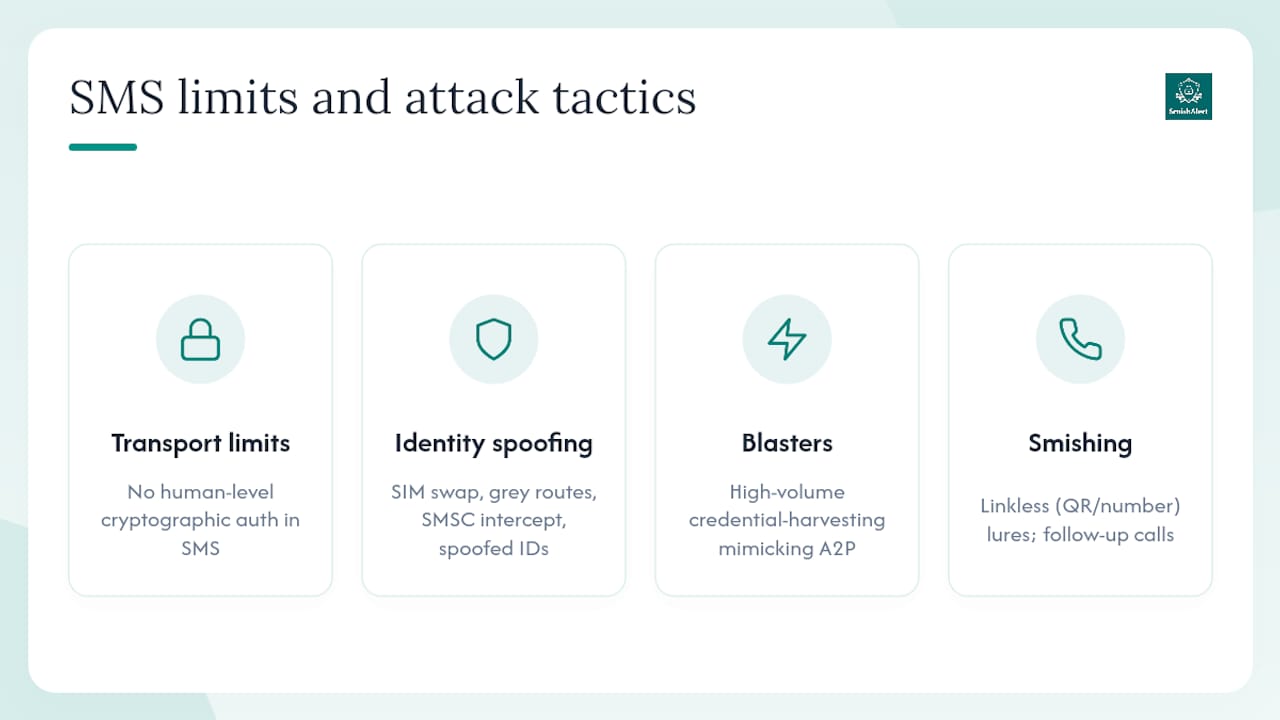
The SMS transport layer was not designed for authenticity. SIM swapping, grey routes, SMSC-level interception, and spoofed alphanumeric Sender IDs all allow attackers to impersonate trusted senders before any verification layer sees the message. True cryptographic authentication of SMS at the human-readable level requires receiver-side verification software — something the standard SMS stack does not provide.
Attackers have adapted accordingly. SMS blasters allow threat actors to deliver high-volume credential-harvesting campaigns that mimic legitimate A2P traffic patterns. Linkless smishing avoids URL-based detection entirely, relying on a phone number or a QR code to move the victim off the SMS channel. Cross-channel attacks, where an SMS primes the target and a follow-up call closes the social engineering loop, are increasingly common against executives and finance teams.
Warning: Protocol verification reduces smishing risk but does not eliminate it. Verified badges apply only to registered business senders on supported clients. A spoofed message arriving via an unregistered sender, a grey route, or a non-RCS client carries no verification signal at all — and employees have no way to distinguish that absence from a legitimate unverified sender.
30-day pilot plan
A focused pilot should cover your 25 highest-risk users plus executive assistants — the group most likely to receive impersonation attempts and most likely to act on them. Deploy on-device reporting in week one. By week two, you should have baseline telemetry flowing into your SIEM. Weeks three and four are for tuning: reduce false positives, validate alert logic, and document time-to-detect for each reported incident. Measure two metrics: reduction in undetected suspicious message delivery and mean time to triage a user report. Pilot fees with Smishalert are credited toward the first annual subscription.
Pro Tip: Start the pilot with executive assistants, not executives. Assistants receive the highest volume of impersonation attempts, are more likely to report consistently, and generate the telemetry you need to tune detection before rolling out to the full executive layer.
How to deploy mobile-native protection and where Smishalert fits
Deployment options split along two lines: managed devices, where an MDM profile can push an on-device agent, and BYOD, where a lightweight app with user consent is the practical path. Deploying mobile phishing protection without MDM is achievable through app-based reporting that requires no device management profile.
Integration checklist:
- SIEM ingestion via webhook or API connector for message report events
- Secure DNS blocking for domains extracted from reported messages
- Help desk ticket automation triggered by high-confidence smishing reports
- MDM/EDR correlation for device posture at the time of a report
Smishalert provides on-device iOS message filtering, Android and cross-channel reporting, campaign correlation across SMS, iMessage, and WhatsApp, and SIEM/webhook integrations. The platform surfaces executive impersonation patterns, payroll fraud attempts, and coordinated multi-channel campaigns that no single-channel tool would catch.
Smishalert pilot outcome: In a documented executive impersonation campaign analysis, Smishalert correlated messages across multiple employees receiving variations of the same impersonation attempt, enabling the security team to identify the campaign scope within hours rather than days. The case study on Chinese actor impersonation of a U.S. leader illustrates how cross-channel correlation surfaces coordinated attacks that appear as isolated incidents without campaign-level visibility.
Policy and governance you should mandate internally
Clear internal policy is what converts detection capability into consistent organizational behavior. At minimum, mandate the following:
- Approved communication channels: — Define which channels security notices, IT alerts, and HR communications may use. SMS should not be on that list for anything requiring a user action on credentials.
Include SMS and RCS smishing scenarios in tabletop exercises at least twice per year. Set a triage SLA of four hours for executive-targeted reports and 24 hours for general employee reports.
Governance note: Analyzing message content at scale raises privacy and regulatory considerations under federal wiretapping statutes and applicable state privacy laws. Rely on metadata, user-submitted content, and privacy-preserving analysis techniques rather than automated interception of message bodies. Consult legal counsel before deploying any capability that reads message content without explicit user consent.
Pro Tip: Frame mobile messaging policy updates as a response to a named threat (executive impersonation campaigns) rather than a generic security initiative. Named threats get executive sign-off faster and drive higher employee reporting rates.
Key Takeaways
Verifying SMS message authenticity requires layered controls: protocol-level verification, mobile-native detection, SIEM telemetry, and removal of SMS as an authentication factor for privileged accounts.
| Point | Details |
|---|---|
| Protocol verification has real limits | Verified SMS and RCS Verified Sender cover registered senders on supported clients only; grey routes and unregistered IDs carry no signal. |
| Remove SMS MFA now | Replace SMS-based OTP with FIDO2/WebAuthn for privileged accounts; this eliminates the most common smishing payoff. |
| Instrument telemetry before an incident | Build SIEM rules for burst delivery, short-lived domain clicks, and new device authentications correlated with message reports. |
| Pilot with your 25 highest-risk users | Start with executive assistants; measure time-to-detect and reduction in undetected delivery over 30 days. |
| Smishalert surfaces campaign-level patterns | Cross-channel correlation across SMS, iMessage, and WhatsApp identifies coordinated impersonation campaigns that appear isolated without platform-level visibility. |
What practitioners get wrong about SMS verification
Most security teams treat protocol-level verification as the primary control and everything else as supplementary. That framing is backward. Verified SMS and RCS Verified Sender are useful trust signals for legitimate business messaging, but they tell you nothing about the messages your employees actually receive from attackers, because attackers do not register their Sender IDs.
The real leverage is on the detection side: instrumenting user behavior after a suspicious message arrives, correlating reports across the organization, and building the telemetry that lets your SOC act in minutes rather than days. Privacy constraints are real, and they push you toward metadata and user-submitted content rather than content scanning. That is not a limitation to work around; it is a design principle that makes your program sustainable and legally defensible.
Executive buy-in for a mobile security pilot is easier to get than most CISOs expect, once you frame it around a named threat. Show one real impersonation example from your industry. The conversation changes immediately.
Smishalert gives your SOC visibility where email security stops
Security teams defending against messaging-based social engineering face a gap that traditional tools cannot close: SMS, iMessage, and WhatsApp traffic is invisible to your email gateway, your EDR, and your MDM unless you instrument it deliberately.
Smishalert fills that gap with on-device reporting, privacy-preserving analysis, and cross-channel campaign correlation that surfaces executive impersonation, payroll fraud, and credential-harvesting attempts before they result in compromise. The platform integrates with your SIEM and ticketing system via webhook and API, and deploys on both managed and BYOD devices without requiring full MDM enrollment.
A 30-day paid pilot is the standard starting point. Pilot fees are credited toward the first annual subscription. Take the 2-minute readiness check to scope your exposure, or review the full platform capabilities to plan your integration.
Useful sources and further reading
- Google Messages support: Identify if your RCS chat is with a verified business
- GSMA RCS Verified Sender report v5
- Enterprise Smishing Defense 2026: SMS Phishing Attack Guide
- Security in Mobile: 2026 Enterprise Defense Guide