
How to Validate Smishing Controls with Red Team Testing

Combining realistic smishing campaigns, hybrid multi-channel playbooks, and CTEM-aligned KPIs is the most reliable way to prove smishing controls work at operational scale. A red-team engagement that targets the SMS channel should follow this sequence:
- Define objectives and success criteria tied to measurable KPIs (time-to-detect, alert fidelity, user-report rate)
- Design hybrid scenarios that chain SMS to credential-harvesting pages, vishing, or internal portals
- Secure rules of engagement and legal signoff before any message is sent
- Run the campaign with full instrumentation using unique tokens, SIEM correlation IDs, and delivery receipts
- Measure detect, escalate, and respond times against pre-set thresholds
- Remediate gaps and retest until CTEM KPIs reach acceptable levels
Smishalert provides the telemetry layer for campaign detection, user-report correlation, and audit-ready reporting throughout this process.
Key Takeaways
Combining CTEM-aligned KPIs, hybrid multi-channel scenarios, and full-stack telemetry is the only approach that produces auditable proof of smishing control effectiveness.
| Point | Details |
|---|---|
| Set KPIs before testing | Define TTD, TTR, alert fidelity, and user-report rate thresholds before any message is sent. |
| Secure ROE and legal signoff | Written authorization covering scope, phone-number sourcing, PII handling, and a kill-switch procedure is mandatory under U.S. law. |
| Run instrumented hybrid campaigns | Assign unique tokens per message and correlate every event to a SIEM alert ID to produce auditable attribution. |
| Carrier filtering leaves gaps | Carrier blocking rates on Smishtank samples range from roughly 25–35%, but some aggressive anti-smishing apps blocked 85–100% of benign messages while blocking more smish; human and SIEM controls are critical because carrier and app blocking alone have limited hit rates and may increase false positives. |
| Smishalert closes the telemetry gap | Smishalert’s campaign correlation and SIEM integration map user-report events to alert IDs for audit-ready red-team reporting. |
Table of Contents
- How does red-team validation of smishing controls differ from a pen test?
- What KPIs prove operational truth for smishing controls?
- What are the rules of engagement and U.S. legal requirements?
- How should you design the smishing test scope and target population?
- Four smishing scenario templates you can run
- Which controls should you test and how do you measure each one?
- Step-by-step runbook for executing and evaluating the campaign
- How do you report findings and integrate them into CTEM dashboards?
- What timeline and resources does a smishing red-team engagement require?
- Why operational truth is the only honest measure of smishing readiness
- Smishalert provides the telemetry layer your red-team engagement needs
- Primary sources and datasets for planning your test
- Sources
How does red-team validation of smishing controls differ from a pen test?
A penetration test assumes a defined scope and often assumes some level of access. A red team assessment operates without assumed access and evaluates whether a skilled attacker can achieve business objectives by testing the combined effectiveness of technical, administrative, and human controls together.
That distinction matters for smishing. A pen test might confirm that a malicious URL resolves or that a carrier filter fires on a known indicator. A red-team engagement asks whether your SOC detects the campaign, whether IAM disables harvested credentials before they are used, and whether the response chain holds under realistic conditions. Those are different questions with different answers.
SMS is a structurally weaker channel than email for defenders. Commercial anti-smishing tools blocked only a portion of threats in aggregated 2025 findings, leaving the majority of malicious messages to reach devices. Metadata is sparse, and traditional security tools miss smishing because they have no visibility into the SMS layer. A realistic attack chain runs: SMS lure → mobile landing page → credential capture → MFA bypass → lateral movement. Validating controls means testing every link in that chain, not just the first one.
What KPIs prove operational truth for smishing controls?
CTEM validation requires demonstrating “operational truth” — that internal teams (SOC, IAM, AppSec) can detect and coordinate a response to simulated attacks, not just that an exploit is theoretically possible. Map each objective to a measurable KPI before the campaign starts:
- Time-to-detect (TTD): elapsed time from first message delivery to a confirmed SIEM alert or analyst triage
- Time-to-respond (TTR): elapsed time from detection to containment action (credential disabled, domain taken down)
- Alert fidelity: true-positive rate and false-positive rate on generated alerts
- User-report rate: percentage of recipients who report the message through the designated channel
- Containment rate: percentage of harvested credentials disabled or phishing domains taken down within the agreed window
- Business impact achieved: whether the red team reached its stated objective (e.g., accessed a target system or exfiltrated a test artifact)
Each KPI requires minimum evidence: SIEM alert IDs with timestamps, delivery receipts tied to message IDs, landing-page token logs, inbox screenshots of user reports, and takedown confirmation receipts. Without that evidence chain, a KPI score is an estimate, not an auditable finding.
What are the rules of engagement and U.S. legal requirements?
Running a lawful smishing test in the United States requires explicit pre-authorization and careful attention to federal and state law. Work through this checklist before any message is sent:
- Obtain written authorization from the CISO, General Counsel, and HR leadership covering scope, target population, and test window.
- Source phone numbers from corporate device lists or explicit employee consent forms — never from personal directories or third-party data brokers.
- Apply a strict no-financial-loss rule: no test message may direct a recipient to a page that processes real payments or captures live banking credentials without an immediate intercept layer.
- Establish a kill-switch procedure: designate one named individual with authority to halt all message delivery within 15 minutes if an unanticipated harm occurs.
- Review TCPA exposure: bulk SMS campaigns to employee devices may trigger Telephone Consumer Protection Act considerations; involve legal counsel to confirm the corporate-device exemption applies in your jurisdiction.
- Define PII handling: any credentials or personal data captured during the test must be hashed, stored in a segregated environment, and deleted per a documented retention schedule.
- Prepare an escalation contact template listing the red-team lead, legal counsel, HR contact, and CISO with 24/7 phone numbers. If a test causes real user harm — financial loss, psychological distress, or a regulatory complaint — stop the campaign immediately, notify the escalation chain, preserve all logs, and engage legal within one hour.
SMS verification risks and SIM-based attack vectors add another layer of exposure worth reviewing with legal before finalizing the ROE.
How should you design the smishing test scope and target population?
Target selection balances realism against safety. Use this audience matrix as a starting point:
Keep pilot campaigns to no more than 20% of the total employee population in a single wave. Channel scope should include SMS as the primary vector, with optional vishing follow-up calls and email threads to emulate realistic hybrid chains. Time windows of two to three business days per wave give the SOC a realistic detection window without compressing the test into an artificial sprint.
Stop-gate triggers that halt the campaign immediately:
- Any unanticipated credential exfiltration reaching a production system
- A recipient reports financial loss or contacts law enforcement
- A test domain or number appears in public threat feeds before the exercise ends
- Legal counsel issues a stop order
SMS blaster dynamics can amplify unintended reach; sampling rules must account for that risk when setting wave sizes.
Four smishing scenario templates you can run
Scenario 1 — Credential harvest via fake SSO landing page. Send an SMS impersonating IT support with a link to a cloned SSO portal. Instrument the landing page with a unique token per recipient. KPIs: TTD from SIEM alert on the domain, user-report rate, and whether IAM detects the credential submission before the token is used. Required evidence: token logs, SIEM alert ID, IAM event log.
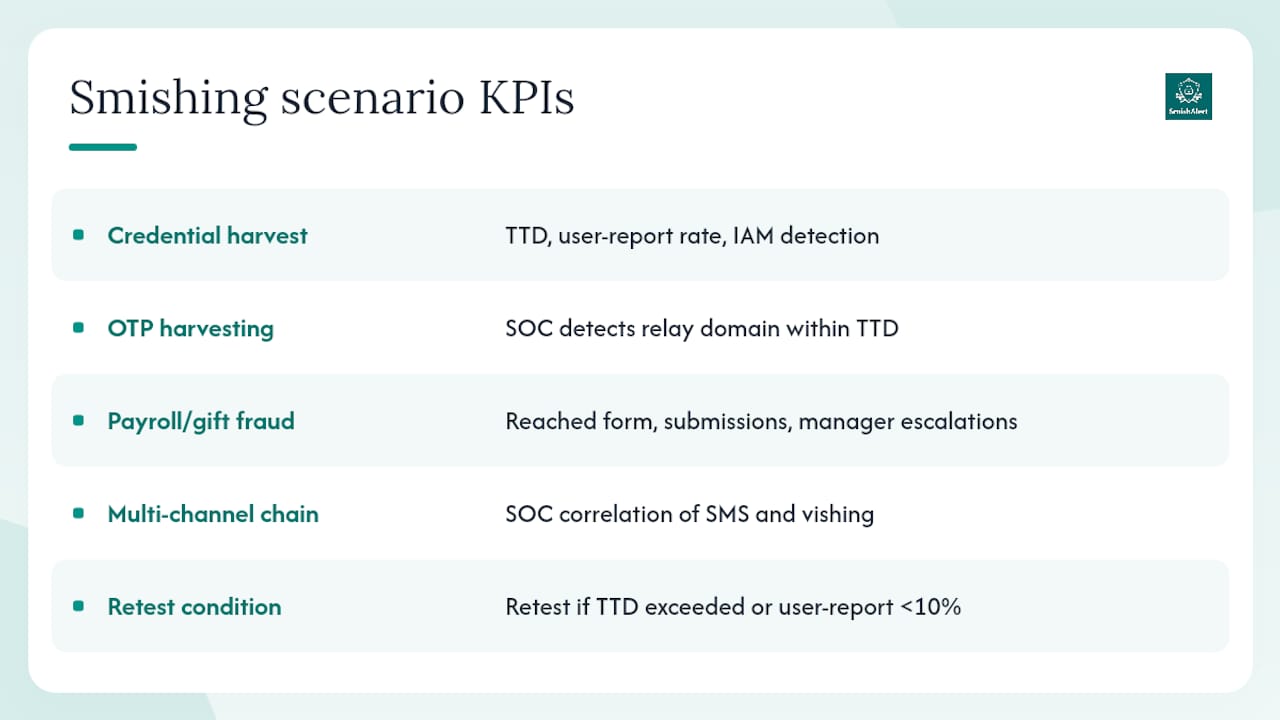
Scenario 2 — OTP harvesting for MFA bypass. Craft a lure that prompts the recipient to enter a one-time passcode on a relay page. Use a test account with no production access. Safe controls: the relay page must not forward the OTP to any live system; log the submission and terminate the session. KPI: whether the SOC detects the relay domain within the TTD threshold.
Scenario 3 — Payroll/gift-card fraud targeting finance roles. Impersonate a senior executive via SMS requesting a gift-card purchase or payroll redirect. The landing page captures intent (a form submission) but processes no real transaction. Instrument for impact metrics: how many recipients reached the form, how many submitted, and whether any escalated to a manager before submitting. This scenario tests human controls as much as technical ones.
Scenario 4 — Multi-channel chain (SMS → vishing → internal portal). An SMS lure is followed 24 hours later by a vishing call from the “IT helpdesk” referencing the earlier message. The call directs the recipient to an internal-looking portal. This chain tests cross-team detection: does the SOC correlate the SMS alert with the vishing report? Red-team instrumentation techniques such as tracking tokens and double-submission logging are critical here to map each interaction back to a specific message instance.
For every scenario: collect message IDs, delivery receipts, landing-page token logs, intercepted credential hashes (stored segregated), and takedown confirmation. Retest any scenario where TTD exceeded the threshold or the user-report rate fell below 10%.
Which controls should you test and how do you measure each one?
Anti-smishing tool evaluations using Smishtank samples found carrier blocking rates in the 25–35% range, with some aggressive apps blocking a high proportion of benign messages. That trade-off between false positives and detection coverage is exactly what your measurement should surface. An ACM study using the same corpus recommended using fresh corpora for realistic testing, which is why seeding your test with current Smishtank samples produces more accurate signal than recycled indicators.
Attribution requires unique infrastructure: assign a distinct landing-page token and tracking parameter to each message instance, then correlate those tokens to SIEM alert IDs. Without that mapping, you cannot distinguish a true detection from a coincidental alert. Contextual phishing warnings on managed devices add another detection layer worth instrumenting separately.
Step-by-step runbook for executing and evaluating the campaign
- Pre-test verification: confirm ROE signatures are in place, test infrastructure (domains, numbers) is clean on VirusTotal, SIEM ingestion is confirmed for test domains, and the kill-switch contact is reachable.
- Controlled send: deploy wave 1 to the smallest target tier; monitor delivery receipts in real time.
- Telemetry ingestion and correlation: ingest landing-page token hits, SIEM alerts, and MDM policy logs; correlate each event to its originating message ID within 30 minutes of send.
- SOC validation: confirm the SOC triaged the alert independently (not prompted by the red team); record TTD and analyst notes.
- Escalate and contain: if the SOC escalates, measure TTR to credential disable or domain takedown; if the SOC does not escalate within the TTD threshold, trigger the red-team stop-gate and log the miss.
- Takedown and remediation: submit test domains for takedown, disable any test credentials, and document all containment actions with timestamps.
- Retest: for any control that missed its KPI threshold, remediate the gap and run a second wave against the same target tier within two weeks.
Evidence checklist per wave: message IDs, delivery receipts, landing-page token logs, SIEM alert IDs with timestamps, intercepted credential hashes (segregated storage), MDM policy hit logs, user-report inbox screenshots, and takedown confirmation receipts.
Pro Tip: Set a “double-submission” trap on the credential-harvest page — a second hidden form field that logs whether the user submitted twice after receiving an error message. This distinguishes users who recognized something was wrong from those who simply moved on, giving you a more accurate user-awareness signal.
Red-team case studies consistently show that containment speed, not detection alone, determines whether a smishing campaign achieves real business impact. Retest cycles should continue until every KPI meets its threshold for two consecutive waves.
How do you report findings and integrate them into CTEM dashboards?
The deliverable has two layers. The executive summary states the verdict (controls passed or failed), lists KPI scores against thresholds, and presents a prioritized remediation roadmap with owners and deadlines. The technical appendix contains the full evidence chain: SIEM export snippets, token logs, takedown receipts, and the red-team playbook for SOC handoff.
Map each finding to a CTEM stage:
- Detect: TTD scores and alert fidelity rates → feed into a TTD histogram widget
- Validate: containment rate and TTR → alert fidelity heatmap by control type
- Remediate: gap list with control owner and target close date
- Harden: retest schedule and updated KPI baselines
Audit-ready deliverables include SIEM export files (JSON or CSV with alert IDs), carrier takedown request confirmations, and the annotated red-team playbook. Enterprise smishing protection best practices provide a useful reference for structuring the remediation roadmap section.
Post-test training should target the specific failure modes the exercise surfaced. If the payroll-fraud scenario had a high submission rate, finance-role training should use that exact pretext, not a generic phishing awareness module.
What timeline and resources does a smishing red-team engagement require?
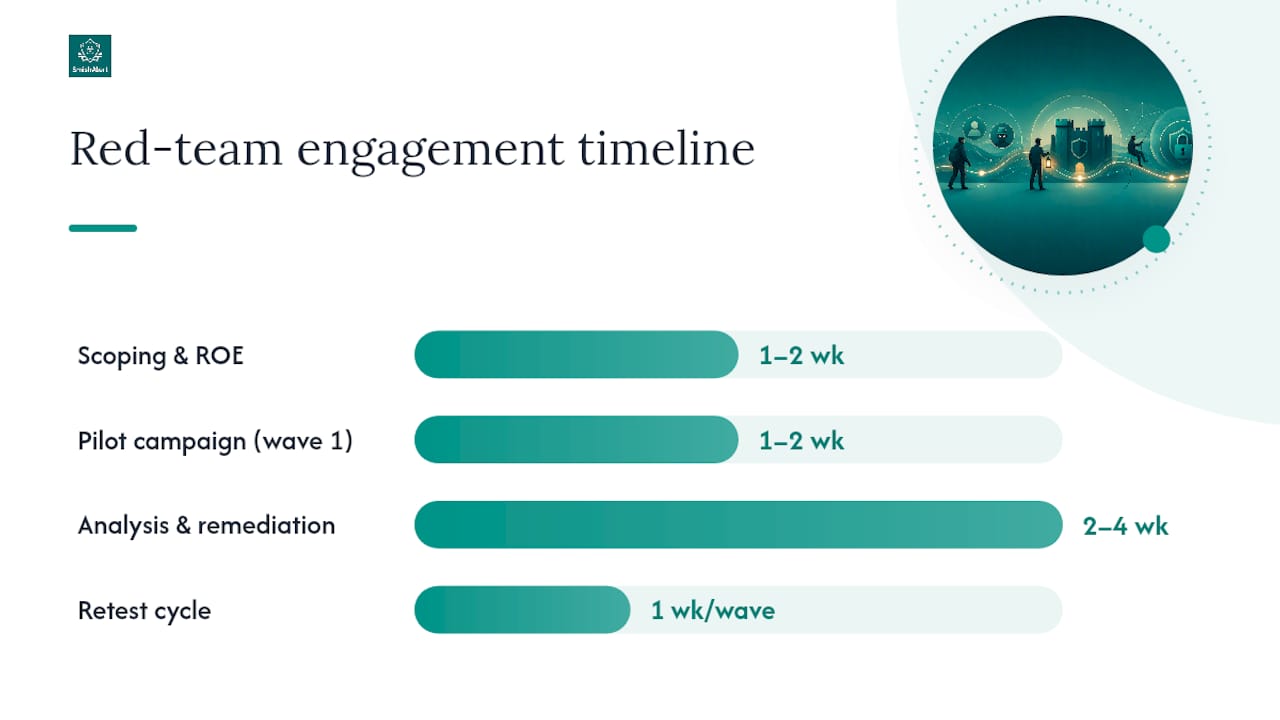
- Scoping and ROE: 1–2 weeks (red-team lead, legal, HR, CISO sign-off)
- Pilot campaign (wave 1): 1–2 weeks including pre-test verification and controlled send
- Analysis and remediation: 2–4 weeks depending on gap severity
- Retest cycle: 1 week per wave
Internal roles required: a red-team lead with mobile social engineering experience, a legal contact available for same-day consultation, an HR liaison for employee communication, and at least one SOC analyst designated as the blind-side validator (not briefed on the test window). Vendor support covers campaign orchestration, telemetry ingestion, and the executive report when internal capacity is limited.
For mid-size organizations (200–500 employees), a minimum sample of 50 recipients per wave produces statistically useful signal on user-report rates. Smaller samples make it difficult to distinguish a genuine control gap from sampling noise. Managed smishing protection options are worth evaluating when internal red-team capacity is constrained.
Why operational truth is the only honest measure of smishing readiness
Most organizations that run phishing simulations stop at the click rate. That number tells you something about user behavior, but it says nothing about whether your SOC detected the campaign, whether IAM responded before credentials were used, or whether the incident response chain held. A smishing simulation without telemetry is closer to a survey than a security test.
The CTEM framing forces a harder question: not “could this attack succeed?” but “would our teams catch it in time?” Those two questions have different answers in most organizations, and the gap between them is where real risk lives. Smishing is a particularly sharp test of that gap because the SMS channel sits outside the corporate perimeter, outside most SIEM ingestion pipelines, and outside the visibility of traditional email security tools. A red-team engagement that instruments every layer — carrier, device, SIEM, and human — and measures TTD and TTR against pre-set thresholds is the only way to produce an honest answer.
Smishalert provides the telemetry layer your red-team engagement needs
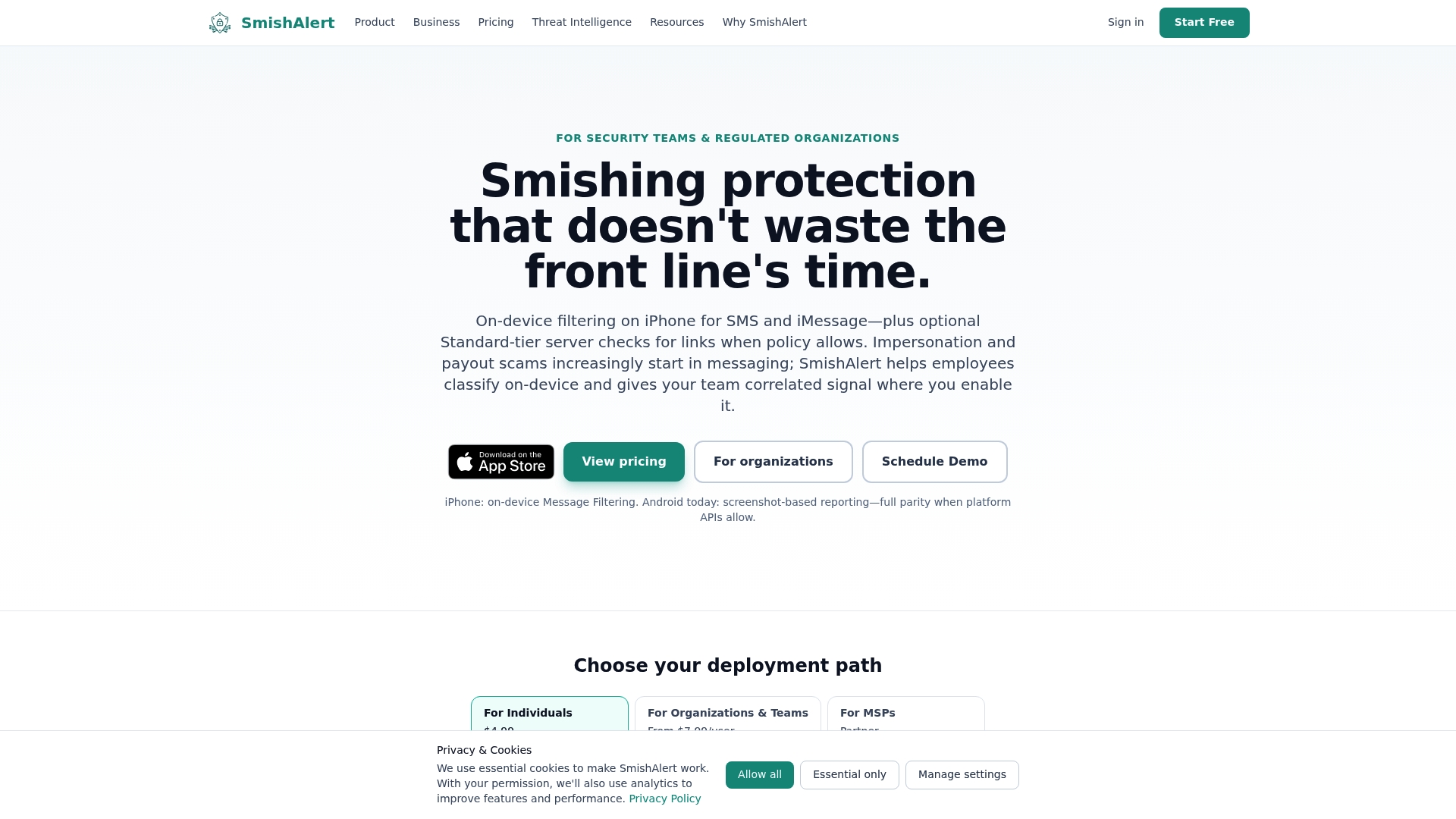
Smishalert gives security teams the visibility that makes smishing red-team results auditable rather than anecdotal. The platform covers on-device iOS message filtering, Android and cross-channel reporting, campaign correlation across SMS, iMessage, and WhatsApp, and SIEM integration that maps user-report events to alert IDs in real time. Every engagement produces audit-ready incident reports that map directly to the KPI framework described in this guide.
A 30-day social engineering exposure assessment includes sample campaign orchestration, SIEM ingestion proof-of-concept, and an executive report with TTD/TTR baselines. The pilot fee is credited toward the first annual subscription. To see where your controls stand before the next red-team cycle, request your assessment or take the 2-minute readiness check to gauge your current exposure.
Primary sources and datasets for planning your test
- Smishalert threat intelligence: live correlated campaign examples to seed test scenarios and validate detection against current pretexts
- Smishtank: open labeled corpus of smishing samples; normalize by recency before use as a test corpus
- XGBoost + LLM dual-layer framework: practical ML baseline for first-layer detection with LLM semantic verification for boundary cases
- CTEM validation documentation: authoritative framing for mapping red-team findings to detect, validate, remediate, and harden stages
- Schellman red-team methodology: reference definition for red-team scope and business-objective framing used throughout this guide
Sources
- Red Team Assessment | Schellman
- CTEM validation
- NDSS poster — anti-smishing tool evaluation (Smishtank)
- Measuring anti-smishing tools with Smishtank (ACM)
- Packetlabs Red: An inside look at our red teaming process
Compound-aware transformer techniques reported F1 scores up to 0.98 on benchmark datasets for obfuscated inputs, which is relevant when test messages use URL shorteners or homoglyph substitution. Limitations to watch: LLM validation adds latency and API cost, and crowdsourced datasets like Smishtank require normalization (remove duplicates, filter by recency) before use as a test corpus. SMS threat detection pipelines describe how these layers integrate in practice.