
Six Board Presentation Types for Messaging Threats

Security leaders who present messaging-based threats to boards need six distinct presentation formats, each matched to a specific risk scenario and decision context. The six types of messaging threat board presentations are: the routine status update, the incident/urgent briefing, the quantified risk and funding ask, the third-party/vendor risk briefing, the scenario/tabletop report, and the metrics/scorecard. The governing rule across all of them: open with a BLUF that connects the threat directly to business impact, then close with a single, specific ask. Boards do not need a technical tutorial. They need to know what is at risk, why it matters to the organization, and what decision they are being asked to make.
Three BLUF templates you can adapt immediately:
- Status update: “Smishing campaigns targeting [department] appear to be increasing over recent months; no confirmed compromise; current controls hold; requesting approval to expand monitoring to executive devices.”},{
- Incident briefing: “A credential-harvesting SMS campaign reached multiple employees recently; some credentials confirmed exposed; containment is underway; requesting funds for immediate remediation.”},{
- Funding ask: “Unmonitored messaging channels expose employees to social engineering risk with potential financial impact; requesting annual investment to close the gap.”},{
The 13 principles of threat intelligence communication frame this precisely: effective threat communications answer three questions — what is the risk, why does it matter to the business, and what are we doing to mitigate it. Every presentation type below is built around that spine.
Key Takeaways
Effective messaging-threat board presentations require the right format for the moment, a BLUF tied to business impact, and a single specific ask that the board can act on in the room.
| Point | Details |
|---|---|
| Six presentation types | Match the format to the scenario: status update, incident briefing, funding ask, vendor risk, tabletop report, or scorecard. |
| BLUF first, always | Every presentation opens with one sentence: threat, business impact, and the single ask. |
| Translate before you present | Swap technical terms for financial and operational equivalents before the deck is built. |
| Metrics need three labels | Every data point on a board slide requires a measurement period, a data source, and a confidence level. |
| Smishalert as evidence source | Smishalert’s live campaign telemetry and audit-ready incident reports supply the credible, specific artifacts boards expect. |
Table of Contents
- What boards actually want to hear about security threats
- The six types of messaging threat board presentations
- How to structure any messaging-threat briefing
- Which metrics and visuals actually persuade a board?
- How vendor risk briefings differ from internal incident reports
- What questions will the board ask, and how should you respond?
- What to avoid when presenting messaging threats to a board
- Evidence and examples for messaging-specific threats
- What actually separates a good board briefing from a forgettable one
- Smishalert gives your board briefings a credible evidence base
- Sources
What boards actually want to hear about security threats
Boards are not a uniform audience. A finance-focused board member is calculating exposure in dollars. An audit or risk committee chair is scanning for regulatory gaps. A technically literate director may probe your detection methodology. Despite these differences, the decision drivers converge: financial exposure, operational continuity, regulatory risk, reputational impact, and whether the security program is keeping pace with the threat environment.
The fastest way to lose a board is to speak in protocol names and CVE identifiers. The fastest way to earn a decision is to translate those terms into the language of business consequence. A few direct translations:
Board presentation guidance for regulated industries recommends a “five slides in 15 minutes” discipline for executive audiences, with ROI framing and a clear ask on every deck. That constraint is a feature, not a limitation. It forces the presenter to decide what actually matters before walking into the room.
Pro Tip: Tailor your opening sentence to the board profile. For a finance-focused board, lead with a dollarized exposure figure. For an audit committee, open with the regulatory citation. For a technically literate chair, you can name the attack vector, but still close with the business consequence before the first slide transition.
Fear-appeal research confirms that high-threat messaging must be paired with clear efficacy — specific, actionable mitigations — to prompt decision-maker action. A board that sees only the threat, with no credible response, is more likely to freeze or deflect than to approve a budget.
The six types of messaging threat board presentations
Each format below serves a distinct purpose. Using the wrong type for the moment — delivering a metrics scorecard when the board needs an incident briefing — signals that the security team does not understand urgency calibration.
1. Routine status update
When to use it: Quarterly or monthly, when there is no active incident and the goal is to demonstrate program health and trend direction.
Slide blueprint (4 slides):
- BLUF: current threat posture in one sentence, with trend direction
- 90-day incident frequency trend (line chart, sourced from SIEM or Smishalert telemetry)
- Control status: what is working, what is pending, any gaps
- Next quarter priorities and resource status
Suggested visuals: Trend line for incident volume, green/amber/red status table for controls, brief KRI summary.
Timing: 8–10 minutes. No deep technical detail. Appendix holds raw metrics.
BLUF template: “Messaging-based social engineering attempts are [up/down/stable] over 90 days; [X] incidents reported; no confirmed compromise; program is on track.”
2. Incident/urgent briefing
When to use it: Immediately after a confirmed or suspected compromise involving SMS, iMessage, WhatsApp, or other messaging channels — or when a credible, active campaign is targeting your organization.
Slide blueprint (5 slides):
- BLUF: what happened, when, confirmed impact to date
- Incident timeline (visual: horizontal timeline with key events)
- Business impact: systems affected, data categories at risk, regulatory exposure
- Containment and remediation status: what is done, what is in progress, who owns it
- Ask: specific budget, headcount, or vendor authorization needed to close the incident
Suggested visuals: Incident timeline, exposure table by data category, containment status tracker.
Timing: 10–15 minutes. The board should leave with a clear decision made.
BLUF template: “On [date], a smishing campaign reached [N] employees; [X] credentials are confirmed compromised; containment is [X]% complete; we are requesting [$Y] to complete remediation by [date].”
3. Quantified risk and funding ask
When to use it: When requesting budget for a new control, tool, or program — particularly for messaging-channel visibility that does not yet exist in the security stack.
Slide blueprint (5 slides):
- BLUF: the gap, the dollarized exposure, the ask
- Exposure quantification: estimated financial impact of a breach via the unmonitored channel (payroll fraud, wire transfer, PII breach cost)
- Current control gap: what is not covered and why
- Proposed solution: what the investment buys, timeline, measurable outcome
- ROI or cost-benefit summary: cost of control vs. cost of breach
Suggested visuals: Exposure table, cost-benefit comparison, before/after control coverage map.
Timing: 12–15 minutes. This is a decision meeting, not an update.
BLUF template: “Unmonitored SMS and messaging channels expose [N] employees to an estimated [$X] in social engineering risk; a [$Y] annual investment in messaging-threat visibility closes this gap.”
4. Third-party/vendor risk briefing
When to use it: When a vendor, partner, or managed service provider is the origin or conduit of a messaging-based threat, or when the board needs to approve vendor risk posture as part of a compliance cycle.
Slide blueprint (4 slides):
- BLUF: which vendor tier is exposed, what the downstream impact is
- Vendor exposure map: critical/high/medium/low tiers with control status
- Contractual and audit status: SLAs, attestations, outstanding remediation items
- Ask: vendor remediation deadline, contract action, or third-party audit authorization
Suggested visuals: Vendor tiering heatmap, SLA compliance table, remediation timeline.
Timing: 10–12 minutes.
BLUF template: “A critical-tier vendor with access to [system] has no SMS-channel controls; downstream exposure includes [business impact]; we are requesting authorization to require attestation by [date].”
5. Scenario/tabletop report
When to use it: After a tabletop exercise, or to present a hypothetical attack scenario to stress-test board understanding of a specific threat vector — particularly useful for messaging-based social engineering, where the attack chain is often invisible to traditional controls.
Slide blueprint (5 slides):
- BLUF: the scenario tested, the key finding
- Attack chain walkthrough: step-by-step from initial SMS to business impact (credential theft, payroll diversion, lateral movement)
- Detection gap analysis: where controls failed or were absent
- Recommended mitigations: specific, costed, with owners and timelines
- Ask: approval for remediation investment or policy change
Suggested visuals: Attack chain flowchart, detection gap heatmap, mitigation cost table.
Timing: 15 minutes. Leave 5 minutes for board questions.
BLUF template: “In our tabletop exercise, a simulated smishing attack reached payroll systems in [X] hours without triggering any alert; we are requesting [$Y] to deploy on-device messaging filters and targeted user training.”
6. Metrics/scorecard
When to use it: As a standing agenda item for audit or risk committees, or when the board has requested a formal security scorecard aligned to a framework such as the NIST Cybersecurity Framework.
Slide blueprint (3 slides):
- BLUF: overall program health, trend direction, any amber/red KRIs
- KRI scorecard: 6–8 metrics with period, source, and trend indicator
- Priority actions: top 2–3 items requiring board awareness or decision
Suggested visuals: KRI table with RAG (red/amber/green) status, trend sparklines, program maturity bar.
Timing: 8 minutes. This is a monitoring session, not a decision meeting — unless a KRI is red.
BLUF template: “The messaging-threat scorecard for [period] shows [X] KRIs in amber and [Y] in red; the highest-priority item is [specific metric]; recommended action is [specific ask].”
Pre-briefing checklist (confirm before every presentation):
- Confirm the audience profile and tailor the BLUF accordingly
- Verify all data sources and measurement periods are labeled on every slide
- Identify the single ask and make sure it appears on slide 1 and the final slide
- Prepare the appendix with raw metrics, IOC lists, and vendor reports
- Rehearse the BLUF and ask with at least one non-technical reviewer
How to structure any messaging-threat briefing
Regardless of which of the six formats you are using, the same five-slide spine applies. Boards respond to consistency. When the structure is predictable, they spend their attention on the content rather than orienting themselves to the deck.
The five-slide template:
- BLUF — one sentence: threat, business impact, ask
- So what — business impact quantified: financial exposure, regulatory risk, operational disruption
- Evidence — one key data visual: trend line, heatmap, or incident timeline
- What we are doing — specific mitigations with owners, timelines, and costs
- Ask and next steps — the decision, the budget, the deadline
Everything else goes in the appendix. IOC lists, raw SIEM exports, vendor attestations, campaign correlation data, and technical architecture diagrams belong there — available on request, not on the main deck.
Single-slide BLUF checklist:
- Audience: who is in the room and what do they need to decide?
- Timeframe: what period does this data cover?
- Data sources: where did the metrics come from, and are they labeled?
- Single ask: is there exactly one decision being requested?
- Owner: who is accountable for the next action?
Pro Tip: Rehearse your BLUF and your ask with two people who are not on the security team — a CFO’s chief of staff or a legal colleague works well. If they cannot restate the risk and the ask after one hearing, the slide needs revision before it goes to the board.
Board presentation guidance recommends sending supporting documents — agenda, background context — ahead of the meeting rather than the slides themselves. This preserves the impact of the visual narrative while giving board members the context they need to engage productively.
Which metrics and visuals actually persuade a board?
The metrics that move boards are the ones that connect directly to financial exposure, regulatory obligation, or operational continuity. Technical metrics — packets inspected, signatures updated, rules deployed — belong in the appendix. The following KPIs belong on the main deck.
| KPI | Best visual | Why it persuades the board |
|---|---|---|
| Dollarized exposure estimate | Exposure table by scenario | Converts abstract risk to budget-comparable cost |
| Incident frequency trend (90/180 days) | Line chart with period labeled | Shows whether the threat environment is improving or worsening |
| Mean time to detect (MTTD) | Single metric with trend arrow | Quantifies the detection gap in business-readable terms |
| Mean time to remediate (MTTR) | Single metric with trend arrow | Shows operational response capability |
| Third-party tier exposure | Heatmap by vendor tier | Maps vendor risk to business systems at a glance |
| Messaging campaign reach | Bar chart by channel (SMS, iMessage, WhatsApp) | Illustrates the scale of the human attack surface |
| Employee reporting rate | Trend line over 90 days | Demonstrates human-layer detection capability |
The NIST Cybersecurity Framework provides a taxonomy for mapping these metrics to the Identify, Protect, Detect, Respond, and Recover functions — a structure boards recognize and auditors expect.
Labeling discipline matters as much as the metric itself. Every data point on a board slide should carry three labels: measurement period, data source, and confidence level (low/medium/high). A metric without a source is an assertion. A metric with a source and a period is evidence.
Visual presentation guidance confirms that executives respond to high-level dashboards, heatmaps, and trend lines — not topology maps or packet-capture summaries. Those belong in the appendix for technical reviewers.
Cost-benefit slide checklist:
- Current annual cost of the unmitigated risk (dollarized, with source)
- Proposed control cost (annual, fully loaded)
- Expected risk reduction (percentage or scenario-based)
- Payback period or break-even point
- Measurement method for validating the reduction
How vendor risk briefings differ from internal incident reports
A third-party/vendor risk briefing is not a scaled-down incident report. The evidence base, the ask, and the visual logic are structurally different. Internal incident briefings focus on what happened inside the perimeter and what the security team is doing to contain it. Vendor risk briefings focus on exposure that exists because of a trusted relationship — and the board’s role is often to authorize contractual or legal action, not just approve a technical control.
The core question in a vendor risk briefing is: which vendors have access to critical systems, and what controls do they have on their own messaging channels? A vendor whose employees receive smishing attacks targeting your organization’s credentials is a threat vector you do not directly control.
Vendor tiering and what to report at each level:
| Vendor tier | Definition | What to report |
|---|---|---|
| Critical | Direct access to production systems or sensitive data | Control status, audit results, SLA compliance, remediation timeline |
| High | Access to internal systems with indirect data exposure | Attestation status, outstanding findings, contractual obligations |
| Medium | Limited system access, no sensitive data | Self-assessment status, next review date |
| Low | No system access, commercial relationship only | Standard contract terms, periodic review schedule |
Sample slide titles for a vendor risk briefing:
- “Critical-tier vendor exposure: [N] vendors with unmonitored messaging access to production systems”
- “Contractual control gaps: [N] vendors missing SMS-channel security attestations”
- “Remediation timeline: vendor attestation deadlines and escalation path”
Recommended appendix items for vendor briefings: vendor attestation documents, SOC 2 or SOC 3 reports, remediation timelines with named owners, and any legal or contractual action items requiring board authorization. For digital asset environments, security and risk management considerations in vendor relationships follow similar tiering logic, with additional emphasis on custody and access controls.
What questions will the board ask, and how should you respond?
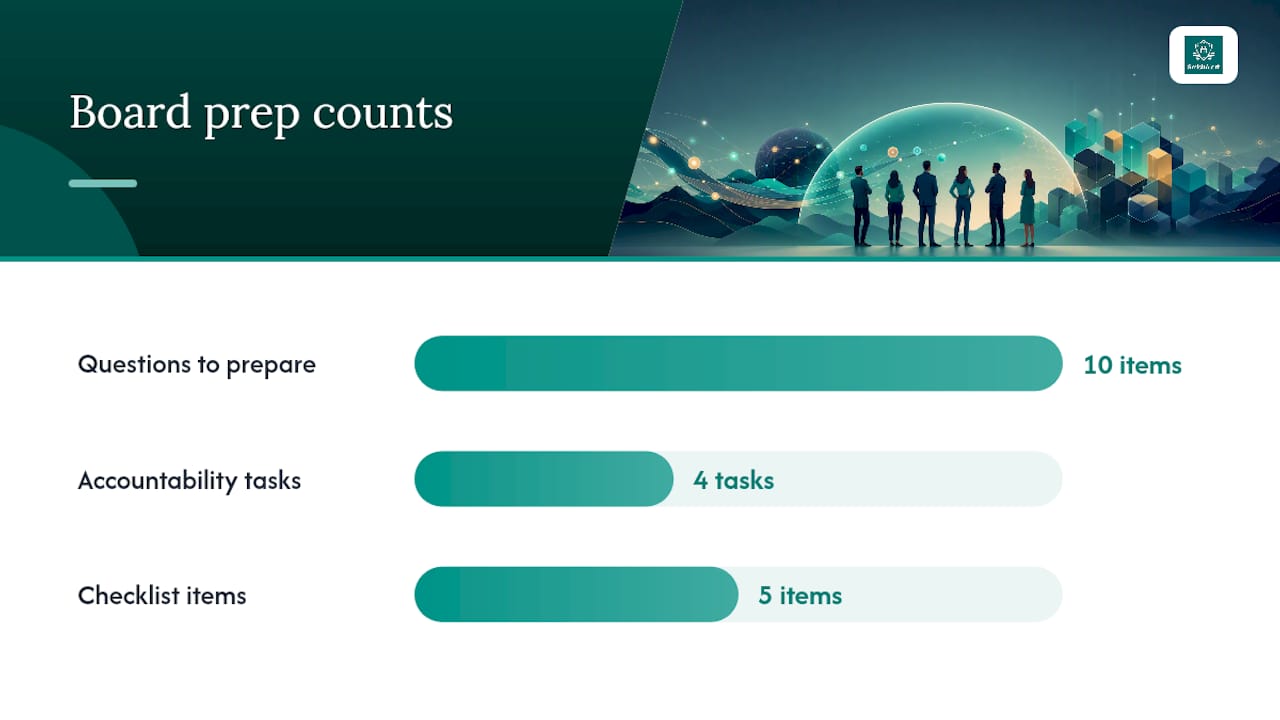
Boards ask predictable questions. Preparing a one-line response to each one before the meeting is the difference between a confident briefing and a follow-up email that undermines your credibility.
The ten questions to prepare for:
- “What is our total financial exposure?” — “Based on [source] and [period], our estimated exposure from unmonitored messaging channels is [$X], primarily through payroll diversion and credential-based fraud.”
- “Are our current controls sufficient?” — “Controls cover email and endpoint; messaging channels — SMS, iMessage, WhatsApp — currently have no monitoring, which is the gap this briefing addresses.”
- “What is our regulatory exposure?” — “Under [applicable regulation], a confirmed breach via messaging channels would trigger notification obligations within [X] days and potential fines of up to [$Y].”
- “How long would it take to detect an attack?” — “Our current MTTD for messaging-based threats is [X] days; industry guidance suggests this window should be under 24 hours for credential-based attacks.”
- “Who else is affected — customers, partners?” — “A payroll diversion attack affects employees directly; a credential-harvesting campaign can extend to any system the compromised account accesses.”
- “How reliable are these metrics?” — “All metrics are sourced from [SIEM/Smishalert telemetry] and cover the [90/180-day] period ending [date]; confidence level is [medium/high].”
- “Is this the vendor’s problem or ours?” — “Contractually, the vendor is responsible for their own controls; operationally, the exposure lands on us if their employees are compromised and use that access against our systems.”
- “What does the investment actually buy?” — “The requested [$Y] funds [specific control] and delivers [measurable outcome] within [X] months.”
- “What is our legal exposure if we do not act?” — “Documented awareness of a control gap without remediation creates potential negligence exposure; legal counsel has reviewed this briefing.”
- “What is the impact on customers?” — “A confirmed breach via messaging channels affecting customer PII would trigger [regulation] notification requirements and reputational exposure in [specific customer segment].”
Simple accountability matrix:
| Question | Owner | Deadline | Required artifact |
|---|---|---|---|
| Financial exposure | CISO / CFO | Before next board meeting | Dollarized exposure model |
| Regulatory exposure | Legal / Compliance | Before next board meeting | Regulatory citation memo |
| Vendor remediation | Vendor Management | [Specific date] | Vendor attestation or audit report |
| Control deployment | Security Engineering | [Specific date] | Deployment confirmation |
Pre-meeting preparation checklist:
- Confirm all data sources are labeled and current
- Rehearse the BLUF and ask with a non-technical reviewer
- Prepare the appendix with IOC lists, raw metrics, and vendor reports
- Brief the CEO or COO on the ask before the meeting, not during it
- Confirm the single decision the board needs to make
What to avoid when presenting messaging threats to a board
The most common failure mode in threat presentations is not a bad slide. It is a structural mismatch between the threat signal and the response signal. Fear-appeal research shows that high-threat messaging without a clear efficacy statement — a specific, credible mitigation — causes decision-makers to disengage rather than act. Boards that feel alarmed but powerless tend to defer, not decide.
The pitfalls that undermine board decisions:
- Fear-only messaging: Presenting threat trends without a paired mitigation plan signals that the security team has identified a problem but not a solution. Every threat slide needs a “what we are doing” counterpart.
- Too much technical detail on the main deck: CVE identifiers, packet captures, and SIEM rule syntax belong in the appendix. A board member who has to decode technical notation is not evaluating the risk — they are trying to understand the vocabulary.
- No single ask: A briefing that ends with “we wanted to make you aware” is not a board presentation. It is a status report. Every board presentation needs one decision on the table.
- Inconsistent metric periods: Comparing a 30-day incident count to a 90-day trend line in the same slide creates confusion and invites questions about data integrity. Pick one period and hold it across the deck.
- Jargon without translation: Terms like “lateral movement,” “IOC,” and “campaign correlation” are precise and useful — but only if the board has been given the translation. Build a one-slide glossary into the appendix.
- Sending slides before context is established: Slides without the verbal narrative are often misread. Send the agenda and background document in advance; deliver the slides in the room.
Pro Tip: Pair every threat with an efficacy statement. The formula is: “The threat is [X]; the control is [Y]; the measurable outcome is [Z] within [timeframe].” A board that sees both the problem and the solution is far more likely to approve the ask than one that sees only the risk.
Pro Tip: Apply strict appendix discipline. The rule is simple: if a board member would not act on it in the room, it goes in the appendix. IOC lists, raw log excerpts, vendor attestation documents, and SIEM export snippets are appendix material. The main deck should contain nothing a non-technical director cannot interpret in 30 seconds.
Evidence and examples for messaging-specific threats
Messaging-based social engineering operates outside the corporate perimeter, which means traditional email security telemetry does not capture it. The FBI’s guidance on “specific” and “credible” threat warnings recommends using observable indicators to distinguish individual incidents from the broader threat environment — a standard that applies directly to board briefings. A claim that “smishing is increasing” is not specific. A claim that “a coordinated smishing campaign targeting payroll staff at organizations in our sector reached [N] employees over 30 days, using executive impersonation via iMessage” is specific and credible.
Anonymized campaign snapshot (illustrative attack flow):
A coordinated smishing campaign begins with an SMS impersonating the organization’s CEO, sent to the payroll manager’s personal mobile number. The message requests an urgent wire transfer or payroll update, citing a time-sensitive business need. The payroll manager, receiving the message outside business hours on a personal device, responds. Within 48 hours, a fraudulent payroll change is processed. No email security tool captures the initial message. No endpoint agent sees the SMS. The first signal appears in the bank’s fraud alert — after the transfer clears.

This attack chain is not hypothetical. It represents a pattern that Smishalert’s live campaign telemetry surfaces regularly across SMS, iMessage, and WhatsApp channels. The business impact is direct: payroll diversion, credential harvesting, and in some cases lateral movement into financial systems once the compromised account is used to authenticate.
Practitioners should consider running a 2-minute readiness self-evaluation before a board briefing to confirm that the organization’s messaging-threat visibility is sufficient to support the claims being made on the slides.
Recommended board actions following this briefing type:
- Commission a 30-day messaging-threat pilot to establish a baseline
- Approve budget for on-device messaging filters for executive and high-risk employee devices
- Require vendor attestations confirming SMS-channel controls for critical-tier vendors
Recommended appendix artifacts:
- IOC list: phone numbers, message templates, and sending infrastructure associated with the campaign
- Campaign correlation data: evidence linking multiple messages to a single threat actor
- SIEM export snippet: log entries showing the absence of detection during the attack window
- Smishalert incident report: audit-ready record of reported messages and analysis
The 13 principles of threat intelligence communication note that practitioners often spend at least 20% of preparation time refining the executive summary or BLUF, because executives recall that section more than any technical detail. That ratio is worth holding to.
What actually separates a good board briefing from a forgettable one
The conventional wisdom in security communications is that boards need to be educated. That framing is usually wrong, and it creates presentations that talk down to experienced executives who have been making high-stakes decisions under uncertainty for decades.
What boards actually need is not education. They need a clear problem, a credible response, and a specific decision. The security leader’s job is not to explain how smishing works. It is to explain what it costs, what the organization is doing about it, and what the board needs to approve to close the gap.
The Harvard PON research on effective threats makes a parallel point: effective threats — and by extension, effective risk communications — are credible, pre-crafted, and allow face-saving exit options. A board ask that leaves no room for a “not yet” answer is likely to generate resistance. Build in a staged option: a pilot before a full deployment, a 90-day review before a multi-year commitment.
Three things that consistently improve board outcomes: a BLUF that is written before the slides are built, a single ask that is agreed internally before the meeting, and an appendix that is complete enough that no follow-up question requires a new document. The security leaders who get budget approved are not the ones with the most alarming data. They are the ones who walk in with a clear problem, a credible solution, and a decision the board can make in the room.
Smishalert gives your board briefings a credible evidence base
Security teams preparing messaging-threat briefings often face the same gap: the threat is real, but the evidence is thin because the attack channel is invisible to existing tools. Smishalert closes that gap by providing live campaign telemetry, audit-ready incident reports, and campaign correlation data that map directly into board slides.
The Smishalert solutions platform surfaces executive impersonation, payroll fraud, credential harvesting, and coordinated multi-channel campaigns across SMS, iMessage, and WhatsApp — the channels that traditional email security does not reach. Every reported message generates an audit-grade record that can go directly into a board appendix or a funding-ask slide. The 2-minute readiness self-evaluation gives security leaders a fast baseline they can reference in the BLUF before walking into the boardroom. To request a threat-intel snapshot or start a 30-day pilot, visit the Smishalert self-evaluation page and begin the assessment.
Sources
The sources below are the primary references used throughout this article. Each one addresses a specific gap that security leaders encounter when preparing board-level threat communications.
- 13 principles of threat intelligence communication
- Fear appeals and persuasion: A review and extension
- The FBI’s use of ‘specific’ and ‘credible’ in threat warning
- The art of the threat
- NIST Cybersecurity Framework