
Can AI Really Pass the Turing Test in 2026?

The Turing Test asks a single behavioral question: can a machine’s text conversation fool a human judge into thinking it’s talking to another person? Under narrow, persona-prompted experimental conditions, the answer is now yes. A preregistered study published in PNAS found that GPT-4.5, when prompted to adopt a humanlike persona, was judged human at rates between 56% and 73%, sometimes outperforming the actual human participants in the study.
That result does not mean the underlying model understands anything. It means the model produces text that hits the stylistic and emotional cues judges rely on when deciding “human or not.” A 2026 study out of UC San Diego found persona-prompted GPT-4.5 was judged human 73% of the time in five-minute conversations, while the same model without a persona prompt scored only 21% to 38%. Strip away the character prompt, and the illusion mostly collapses.
Here’s what the current evidence actually supports:
- Persona prompting, not raw model capability, drives most of the pass rate.
- Judges lean on tone, hesitation, and emotional phrasing, not logical rigor, when making the call.
- Passing a two-party or three-party conversational test says nothing about reasoning, consciousness, or comprehension.
- Test design (time limits, judge expertise, message caps) changes the outcome as much as the model does.
Pro Tip: If a headline says “AI passed the Turing Test,” check whether the AI was prompted with a persona before you take the claim at face value. That single detail explains most of the reported jump in pass rates.
The philosophical caveat matters as much as the numbers. Alan Turing designed the imitation game to sidestep the unanswerable question “can machines think?” Stanford’s Encyclopedia of Philosophy notes he intended it as a thought experiment, not a certification exam for machine minds. Passing it today tells you a model is good at sounding human. It tells you nothing about whether anything resembling understanding sits behind the words.
Key Takeaways
Persona-prompted large language models now pass narrow, controlled Turing Test formulations at rates that rival or exceed human baselines, but this measures perceived humanness, not understanding or consciousness.
| Point | Details |
|---|---|
| Persona prompting drives results | Persona-prompted GPT-4.5 was judged human far more frequently than without a persona, according to UC San Diego research. |
| Format changes the outcome | Two-party and three-party test designs produce different pass rates, so any claim should specify which was used. |
| Style beats substance | Judges rely on stylistic and socio-emotional cues, not logical rigor, when deciding “human or machine.” |
| Passing isn’t proof of thought | Philosophical objections like the Chinese Room argument show indistinguishability doesn’t equal comprehension. |
| Real-world stakes are security, not just theory | Conversationally convincing AI directly raises risks of executive impersonation and credential harvesting over messaging channels. |
Table of Contents
- What Counts as Passing the Turing Test in AI Research?
- How Researchers Actually Run a Turing Test Today
- Turing’s 1950 Paper and the Birth of the Imitation Game
- What the Latest Peer-Reviewed Studies Show About LLM Pass Rates
- Why Philosophers Still Reject the Turing Test as Proof of Intelligence
- Better Benchmarks: Alternatives to the Turing Test
- Why Indistinguishable AI Is a Security Problem, Not Just a Philosophy Problem
- So Did AI Really Pass the Turing Test?
- Why Security Teams Should Read the Turing Test Data Differently
- Frequently Asked Questions
- Sources
What Counts as Passing the Turing Test in AI Research?
Turing’s original imitation game involved three participants: a human interrogator, a human foil, and a machine, with the interrogator trying to identify which respondent was which. Most modern implementations simplify that to a two-party test: one judge, one conversation partner (either human or machine), no side-by-side comparison. That shift sounds minor. It isn’t.
In a three-party design, the judge has a live human baseline to compare against in real time, which raises the bar for the machine. In a two-party setup, the judge is working from memory and general expectations of “how humans write,” which is a softer target. Researchers have gravitated toward two-party formats for controlled studies because they’re easier to run at scale and produce cleaner statistical comparisons, but the tradeoff is that they depart from Turing’s original three-player logic. Any claim about “passing the Turing Test” should specify which version was used, because the two formats aren’t measuring quite the same thing.
The core criterion, regardless of format, is indistinguishability in conversational behavior, not correctness. A machine that confidently states a wrong fact in a very human way can pass. A machine that answers every question with encyclopedic precision but no conversational texture often fails, because flawless recall reads as inhuman. This is the detail most casual explanations miss: the Turing Test measures perceived humanness, not accuracy, intelligence, or knowledge depth.
Several operational variables determine whether a given system passes:
- Judge expertise. Judges familiar with AI writing patterns catch tells that casual users miss entirely.
- Conversation length. Short exchanges favor the machine; longer ones give inconsistencies more room to surface.
- Message controls. Caps on response length or reply speed can mask or expose AI-typical patterns.
- Persona prompting. Explicit instructions to “act like a specific type of person” measurably change how convincingly a model performs.
- Performance threshold. Turing himself proposed a rough benchmark, not a universal pass/fail line, and later researchers have used varying cutoffs to declare a “pass.”
Understanding these variables is the difference between reading a Turing Test headline critically and taking it at face value.
How Researchers Actually Run a Turing Test Today
Modern Turing Test experiments look less like a casual chat and more like a controlled clinical trial. Researchers running peer-reviewed studies typically pre-register their hypotheses and methodology before collecting data, which prevents cherry-picking favorable results after the fact.
A typical modern protocol includes:
- Format selection. Researchers choose two-party or three-party design and disclose it, since the two-party structure has become the default for randomized studies comparing AI and human responses because it simplifies implementation and avoids confounds introduced by a live human foil.
- Time and message caps. Most experiments impose a fixed window, often five minutes, echoing Turing’s own suggested duration, plus limits on message length to prevent giveaway patterns like unnaturally long, structured responses.
- Interface controls. Some setups add artificial typing delays or strip formatting cues (perfect punctuation, instant replies) that would otherwise flag a respondent as a machine.
- Persona assignment. Roughly half of participants in comparative studies get a model instructed to role-play a specific personality, age, or communication style; the other half get the same model with no persona instruction, isolating the prompt’s effect.
- Judgment collection and analysis. Judges rate each conversation as human or machine, and researchers compare rates against pre-registered statistical thresholds rather than eyeballing the results.
The persona variable deserves special attention because it’s the single biggest lever researchers have found to shape AI behavior, as detailed in typed memory in AI. A model instructed to write like a specific, moderately informal young adult consistently outperforms the identical model given a neutral, helpful-assistant instruction. Interrogators in these studies report leaning on stylistic and socio-emotional cues rather than logical probing, which explains why a well-crafted persona prompt does more work than any underlying model upgrade.
Pro Tip: When you see a Turing Test result reported without mentioning persona prompting, assume the number reflects an idealized best case, not typical chatbot behavior in the wild.
Turing’s 1950 Paper and the Birth of the Imitation Game
Alan Turing opened his 1950 paper Computing Machinery and Intelligence by rejecting the question everyone wanted him to answer. “Can machines think?” he argued, was too loaded with ambiguous definitions of “machine” and “think” to be useful. So he replaced it with something testable: the imitation game.
That single sentence became one of the most cited predictions in computing history. Turing wasn’t claiming machines would think by the year 2000. He was setting a specific, falsifiable benchmark: a five-minute conversation window, and a interrogator success rate no better than 70%, meaning the machine fools the judge roughly 30% of the time.
The imitation game itself borrowed its structure from a parlor game where a judge tries to determine the gender of two hidden respondents through written notes alone. Turing swapped one respondent for a machine and asked whether the judge’s success rate would change. If a machine could match a human’s ability to be mistaken for a person, Turing argued, the philosophical question of “real” thought becomes moot for practical purposes. The Stanford Encyclopedia of Philosophy frames this move as an attempt to convert an unanswerable metaphysical question into an empirical, behavioral one.
The 30% figure and five-minute window shaped decades of later benchmarks, contests, and media coverage, even though Turing offered them as a loose prediction rather than a rigid scientific standard. That distinction gets lost almost every time a headline declares a chatbot has “passed the Turing Test,” since most modern studies use thresholds and durations that Turing never specified, and some use none at all.
What the Latest Peer-Reviewed Studies Show About LLM Pass Rates
The strongest recent evidence comes from two independently run, peer-reviewed studies, and both point to the same conclusion from different angles.
The PNAS study ran a standard three-party Turing test and found persona-prompted GPT-4.5 achieved human-judged pass rates between 56% and 73%, depending on the specific experimental condition. Interrogators in this study consistently pointed to stylistic and socio-emotional signals, casual phrasing, apparent uncertainty, emotional reactions, as their reasoning for calling a respondent human, rather than any test of reasoning or factual depth.
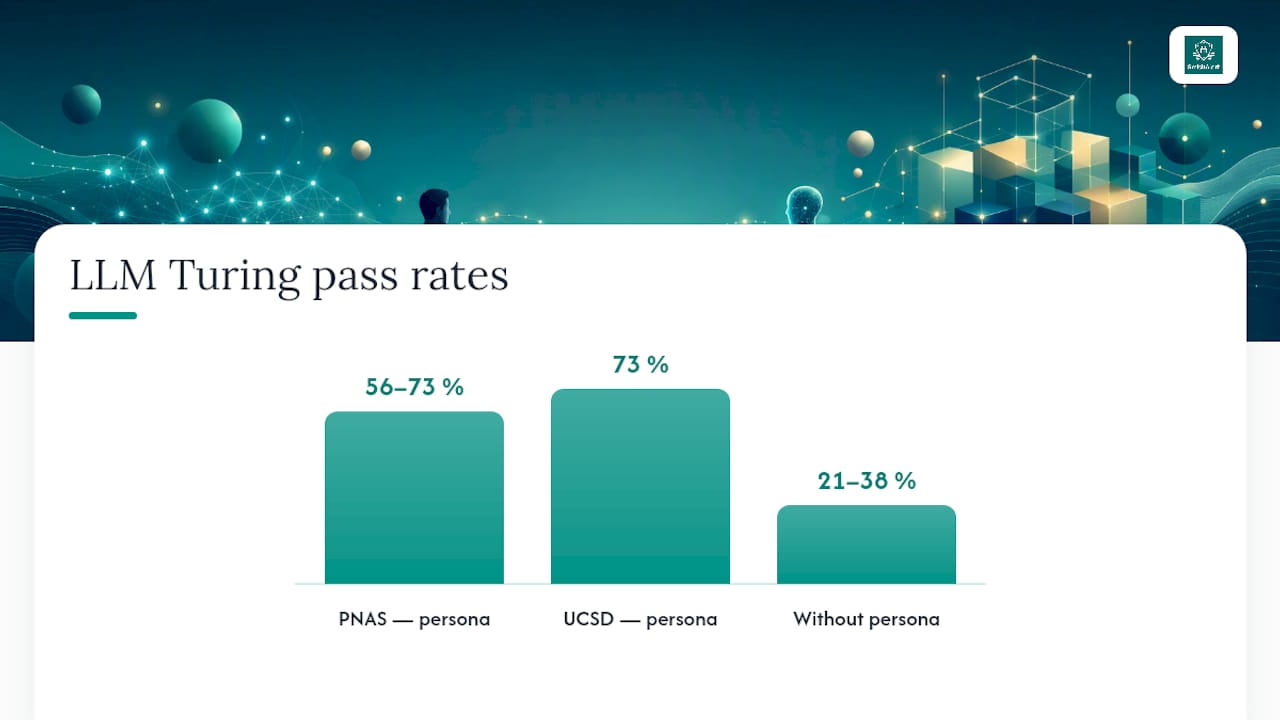
The UC San Diego study ran a two-party version with five-minute conversations and found an even sharper contrast. Persona-prompted GPT-4.5 was judged human 73% of the time, actually exceeding the rate at which real human participants were correctly identified as human. Strip the persona instruction away, and performance dropped to a range of 21% to 38%, a gap wide enough to change the entire narrative around what “AI passing the Turing Test” means.
Read those two numbers side by side and the pattern is unmistakable:
- With persona prompting: pass rates cluster in the mid-50s to mid-70s percent range across both studies.
- Without persona prompting: pass rates fall to the 20s and 30s percent range, a difference of roughly 35 to 40 percentage points.
- Human baseline: in the UC San Diego study, actual human participants were sometimes judged human at a lower rate than the persona-prompted AI, an inversion that says more about judge expectations than about machine cognition.
That inversion is worth sitting with. It suggests judges may hold real humans to an implicit standard of “sounding like a real person,” and that a carefully engineered persona can exceed that standard more easily than an unscripted human typing casually under time pressure.
Several methodological caveats temper how far these results generalize. Participant pools in both studies were recruited through specific platforms, which may not represent the broader population’s conversational habits or skepticism toward AI. Conversation length was capped at five minutes in most trials, a duration that limits how much inconsistency a model has room to reveal; longer conversations, or ones involving specialized knowledge domains, tend to expose model limitations that don’t surface in short exchanges. Interface artifacts, response timing, formatting, even how a chat window renders text, can also nudge judges’ perceptions independent of the content itself.
None of this undermines the finding that persona-prompted models are convincing under these conditions. It does mean the PNAS and UC San Diego results describe a specific, bounded scenario rather than a general statement that “AI thinks like a human now.”
Why Philosophers Still Reject the Turing Test as Proof of Intelligence
Passing a conversational imitation test has never settled the philosophical argument about machine intelligence, and three classic objections explain why.
The Chinese Room argument, proposed by philosopher John Searle, imagines a person locked in a room with a rulebook for manipulating Chinese symbols. The person can produce perfectly correct Chinese responses by following the rules mechanically, without understanding a word of Chinese. Searle’s point: syntactic manipulation, shuffling symbols according to rules, isn’t the same as semantic understanding, grasping what the symbols mean. A large language model, in this view, is an extremely elaborate version of that rulebook: it produces contextually appropriate text through statistical pattern matching, not because it comprehends the conversation.
Lady Lovelace’s objection, which Turing himself addressed in his original paper, comes from Ada Lovelace’s observation that a machine “has no pretensions to originate anything.” It only does what it’s programmed to do. Applied to modern LLMs, the objection becomes: a model’s fluent, seemingly spontaneous responses are still the product of pattern completion over training data, not the machine forming a novel idea or intention of its own. Whether this actually distinguishes machines from humans (who also draw heavily on learned patterns) remains genuinely contested, but the objection has aged better than many critics initially expected.
The argument from consciousness goes further than either of the above: it asks whether a machine could ever have subjective experience at all, regardless of behavioral output. A system can be behaviorally indistinguishable from a person and still, this argument holds, be entirely without inner experience. Since consciousness isn’t directly observable in anyone but yourself, this objection is largely unfalsifiable, but it explains why philosophers treat “the AI passed” as a data point about behavior, not a resolved question about minds.
Beyond the philosophical objections sit practical ones. The Turing Test is gameable in ways that have nothing to do with intelligence:
- Deliberately inserting typos, hesitations, or grammatical slips to seem more “human.”
- Refusing to answer questions instantly to avoid the tell of inhuman speed.
- Exploiting the ELIZA effect, where people readily attribute understanding to a system that simply reflects their own input back with minor variation, named after Joseph Weizenbaum’s 1960s chatbot.
Academic commentary in Science frames these gameable elements as evidence that the Turing Test increasingly measures how well a system exploits human perceptual shortcuts, not how intelligent it is. That’s a useful reframe for anyone tempted to treat a passed test as a verdict on machine minds.
Better Benchmarks: Alternatives to the Turing Test
Researchers dissatisfied with the Turing Test’s vulnerability to stylistic gaming have proposed several alternatives, each targeting a different gap.
- Winograd Schema Challenge: tests common-sense reasoning through carefully constructed sentences with ambiguous pronouns that require real-world knowledge to resolve correctly. It probes reasoning directly rather than conversational style, but it’s narrower in scope than a full conversation.
- Lovelace Test (and its variants): asks whether a system can generate something its own programmers cannot fully explain or predict, targeting the originality objection head-on. It’s harder to standardize than a conversational test, which limits its use in large comparative studies.
- Total Turing Test: extends the original test to include physical and perceptual tasks, requiring a robot-embodied system to interact with objects in the world, not just produce text. It addresses the criticism that pure text tests ignore embodied understanding, at the cost of being far more expensive to run.
- Universal intelligence metrics: attempt to score general problem-solving ability across many task types rather than relying on human judgment of a single conversation, trading intuitive interpretability for broader coverage.
None of these fully replaces the Turing Test, because each measures something narrower or costlier. The practical guidance for readers evaluating any AI capability claim: check whether the claim is about imitation (Turing-style), reasoning (Winograd-style), or originality (Lovelace-style), because these are not interchangeable measures, and a system that excels at one can fail badly at another.
Why Indistinguishable AI Is a Security Problem, Not Just a Philosophy Problem
The same quality that makes persona-prompted models convincing in a lab study, indistinguishability from a human conversational partner, is exactly what makes them dangerous in a phishing message. A judge in a controlled experiment has five minutes and a clear incentive to be skeptical. An employee glancing at a text message from “the CEO” asking for an urgent wire transfer has neither.
That gap between test conditions and real-world attention is where messaging-based social engineering thrives. Security teams have already documented AI-assisted phishing and impersonation growing across SMS, iMessage, and WhatsApp, channels that sit outside traditional email security tools entirely.
- Executive impersonation, where a persona-prompted message mimics a specific leader’s tone closely enough that a finance employee approves a fraudulent payment.
- Credential harvesting, where a conversational AI-generated text convinces a recipient to enter login details on a spoofed page.
- Payroll fraud, where an impersonated HR or vendor contact requests a routine-sounding change to direct deposit details.
- Vendor compromise, where a convincing multi-message exchange builds enough trust to redirect an invoice payment.
AI chatbots are already being used to script and scale phishing attempts at a volume that manual review can’t keep up with, and the persona-prompting effect documented in the PNAS and UC San Diego studies is the same mechanic attackers exploit when they craft a message that sounds like a specific trusted person rather than a generic scam.
Pro Tip: Treat any unexpected, emotionally urgent text from a “known” contact the way a Turing Test judge should treat a suspiciously perfect conversationalist: with more scrutiny, not less.
Effective mitigation looks less like a single filter and more like a layered process: detection across channels, correlation of message patterns into recognizable campaigns, straightforward employee reporting, and pilot testing of suspicious flows before they become full-blown incidents. Reducing mobile impersonation risk specifically means combining technical detection with clear reporting habits, because the fastest-growing attack vector is precisely the one that traditional email security was never built to see.

So Did AI Really Pass the Turing Test?
Under specific, narrow experimental conditions, yes. Persona-prompted GPT-4.5 and similar systems have achieved human-judged pass rates that meet or exceed typical human baselines in peer-reviewed, pre-registered studies. That’s a real, replicated empirical finding, not hype.
What it doesn’t mean is equally clear. Passing a five-minute, persona-prompted conversation test is not evidence of understanding, reasoning, or consciousness. It’s evidence that a well-tuned language model can produce text that hits the stylistic markers judges associate with humanness.
Before accepting the next “AI passed the Turing Test” headline, ask:
- Was the model persona-prompted, or evaluated in its default configuration?
- Was it a two-party or three-party design, and how long did the conversation run?
- Has the result been replicated, or is it a single study?
- Does the claim conflate “sounds human” with “thinks like a human”?
Those four questions separate a genuinely informative result from a headline built to generate clicks.
Why Security Teams Should Read the Turing Test Data Differently
The conventional takeaway from the Turing Test literature is philosophical: can machines think, does passing prove anything, is Searle right about syntax versus semantics. That debate is worth having, but it’s not the most urgent one buried in the PNAS and UC San Diego data.
The urgent finding is that a specific, learnable technique, persona prompting, reliably pushes a model past the threshold of human perception. That’s not an abstract result about machine cognition. It’s a concrete description of how a scripted, socially engineered message gets past a skeptical reader’s guard, because the skeptical reader is running the same heuristics as a Turing Test judge and judges are wrong roughly a quarter to half the time.
Security teams that treat this as a philosophy problem will miss the point. The actionable read is that indistinguishability has a measurable, reproducible cause, and that cause is now cheap and accessible to attackers. Prioritize detection systems built for conversational, persona-driven text over ones built to catch crude, generic scam language. The next convincing message won’t sound like a bot. That’s exactly what the data says to expect.
Frequently Asked Questions
What is the Turing Test in AI, in simple terms? It’s a behavioral test where a human judge holds a text conversation and tries to determine whether they’re talking to a machine or another person. If the judge can’t reliably tell the difference, the machine is said to pass.
Has any AI actually passed the Turing Test? Yes, under specific conditions.
Does passing the Turing Test mean an AI is conscious or truly intelligent? No. Passing shows a model can produce conversationally convincing text. Philosophical objections like the Chinese Room argument point out that producing correct-seeming output doesn’t require genuine understanding.
What’s the difference between a two-party and three-party Turing Test? A three-party test has a judge comparing a human and a machine side by side; a two-party test has a judge evaluating one conversation partner at a time without a live comparison. The formats can produce different pass rates.
Why does persona prompting matter so much? Instructing a model to adopt a specific personality or communication style dramatically increases how “human” it seems, because judges rely on stylistic and emotional cues rather than logical testing.
How does the Turing Test relate to security risks like phishing? The same conversational fluency that fools a Turing Test judge is what makes AI-generated phishing and impersonation messages convincing on SMS, iMessage, and WhatsApp, channels where recipients have far less time and skepticism than a study participant.
Organizations that want to see how these dynamics play out in real attack data can review SmishAlert’s threat intelligence on active messaging campaigns or run a two-minute readiness self-evaluation to see where mobile impersonation risk currently stands.
Sources
- What is the Turing Test? | Stanford HAI
- Large language models pass a standard three-party Turing test
- AI can seem more human than real humans in a classic Turing test study, finds UCSD
- Turing test | Stanford Encyclopedia of Philosophy
- The Turing Test and our shifting conceptions of intelligence | Science
Recommended
- AI, Automation & Cybercrime: Safeguarding Trust with SmishAlert.ai | SmishAlert
- Bypassing MFA: The Rising Threat and How SmishAlert.ai Protects Your Business | SmishAlert
- Tackling the Rising Threat of Malicious URLs with SmishAlert.ai | SmishAlert
- AI Chatbots Aid Phishing Scams: Shield Your Business with SmishAlert.ai | SmishAlert