
SMPP source_addr Checks for SOCs to Stop SMS Sender Spoofing

SMS sender spoofing forges the visible sender ID on a text message so it appears to come from a bank, a delivery service, or a company executive when it does not. The core defender action is protocol-level visibility paired with route validation: you cannot stop what you cannot see at the SMPP and gateway layer, and you cannot fully trust a sender ID without verifying the route it traveled.
TL;DR:
- Many aggregators accept arbitrary
source_addrvalues without validating ownership, enabling easy spoofing of sender IDs.- Spoofing notably targets alphanumeric sender IDs because they are more believable and trusted by recipients.
- Detecting spoofing requires analyzing protocol-level artifacts like SMPP
source_addrfields, route identifiers, and message volume patterns.- The most common spoofing attacks include brand impersonation, executive fraud, SMS blaster campaigns, and multi-channel escalation schemes.
- Implementing sender ID registration, source validation, and user-facing warnings are key measures to prevent spoofing exploits.
Table of Contents
- What Is SMS Sender Spoofing, and How Does It Differ From Smishing?
- How SMS Spoofing Actually Works at the Protocol Level
- What Do Real-World SMS Spoofing Attacks Look Like?
- How Big Is the SMS Spoofing Problem, Really?
- What Forensic Signals Reveal a Spoofed Text Message?
- How Can Organizations Prevent SMS Sender Spoofing?
- What Should You Do When You Discover a Spoofed SMS Attack?
- How Platform Telemetry Closes the Detection Gap
- Can Spoofed Text Messages Actually Be Traced?
- A Practitioner’s Priority Checklist for Defenders
- Get Visibility Into Spoofed Messages Before They Reach Employees
- Sources
What Is SMS Sender Spoofing, and How Does It Differ From Smishing?
Sender ID spoofing is the act of manipulating the “From” field in an SMS header so the message displays a forged identity instead of the actual originating number or account. That header field can carry either a numeric sender (a long code or short code) or an alphanumeric sender ID, a text string like “BANKALERT” instead of a phone number. Both formats can be manipulated to display a forged identity, and that dual capability is exactly what makes the technique so useful for legitimate business and so dangerous in the wrong hands.
Smishing, by contrast, is the attack category, not the mechanism. Smishing is SMS-based phishing: the broader scheme of tricking someone into clicking a link, handing over credentials, or wiring money. Spoofing is one tool inside that scheme, usually the first one. A smishing campaign does not require a spoofed sender, but spoofing dramatically raises the success rate because it borrows the trust a recipient already has in the forged name.
The legitimate side of this matters for context. Application-to-person (A2P) messaging, the bulk of one-time passcodes, shipping alerts, and appointment reminders, runs almost entirely on alphanumeric sender IDs precisely because brands want recognizable names in the inbox instead of a random 10-digit number. Airlines, banks, and pharmacies register these sender strings with aggregators as a customer-experience feature.
Three parties typically touch a message before it lands on a phone:
- Originator: the business or platform sending the message, whether a marketing platform or a fraud operation.
- Aggregator: the intermediary that routes traffic from originators into carrier networks, often across multiple countries.
- Mobile network operator (MNO): the carrier that delivers the final message to the handset.
Spoofing exploits the gap between what the originator claims and what the aggregator or carrier actually verifies at each handoff.
How SMS Spoofing Actually Works at the Protocol Level
SMS sender spoofing largely comes down to one field in one protocol: source_addr inside the SMPP submit_sm PDU. Short Message Peer to Peer (SMPP) is the messaging protocol that carries the bulk of A2P traffic from originators through aggregators into carrier networks, and it lets the sending system declare its own origin address. An academic measurement study confirmed this empirically, demonstrating that SMPP submission can set an arbitrary originating number and verifying spoofability across multiple mobile network operators. That is not a theoretical flaw. It is a protocol design choice from an era when trust between telecom partners was assumed rather than verified.
The real-world exposure depends heavily on who is holding the SMPP account. Aggregators with lax validation, and the “grey routes” that move traffic through under-regulated intermediary carriers to cut costs, routinely accept source_addr values without confirming the sender actually owns that identity. A gateway that checks nothing lets an attacker with API access impersonate any brand string.
Sender type changes the risk profile:
- Short codes (5 to 6 digit numbers) require carrier vetting and are harder, though not impossible, to spoof convincingly.
- Long codes (standard 10-digit numbers) see frequent number-spoofing since they are common and cheap to acquire.
- Alphanumeric sender IDs are the most attractive spoofing target because recipients associate a text brand name with legitimacy, not a number.
SIM-based attacks add a separate vector entirely. A SIM swap that ports a victim’s number to an attacker-controlled device, or malware that compromises a messaging app, lets criminals send from a genuinely legitimate account rather than forging one, which sidesteps sender-ID detection altogether.
The most consequential technical detail for defenders is thread injection. Mobile operating systems group messages into a single conversation thread by matching the visible sender string against prior messages. When a spoofed text uses the same display name as a bank’s legitimate past texts, the phone drops it into that existing thread, and that placement collapses the visual cues people rely on to spot something wrong.
Pro Tip: When evaluating a messaging vendor’s security claims, ask specifically whether they validate source_addr against a registered sender list at the gateway, not just at the marketing dashboard level. Many platforms only enforce sender identity in the UI, which does nothing to stop a spoofed submission at the protocol layer.
What Do Real-World SMS Spoofing Attacks Look Like?
Security teams tend to see the same handful of attack shapes repeated with minor variations. Understanding the flow of each helps prioritize which detection rules to write first.
- Brand impersonation and credential harvesting. A spoofed sender ID mimics a bank or delivery carrier, the message creates urgency (“your package needs a customs fee” or “unusual login detected”), and a short link routes to a cloned login page that captures credentials in real time.
- Executive impersonation and payroll fraud. An attacker spoofs or closely mimics an executive’s number, texts an HR or finance employee directly, and requests an urgent wire transfer or a change to direct-deposit banking details, often timed to when the real executive is traveling.
- Bulk SMS blaster campaigns. Attackers use SIM farms or SMS blaster hardware to seed thousands of spoofed messages carrying malicious short links in a single burst, betting on volume rather than personalization to generate clicks. Smishalert’s analysis of this pattern in SMS blaster campaigns covers how these hardware-driven bursts evade carrier-level filtering.
- Multi-channel escalation. A spoofed text is often just the opening move. It gets followed by a spoofed caller ID phone call reinforcing the same story, or an email from a lookalike domain, so the victim sees three “confirmations” of the same lie across three channels within minutes.
A documented case involving impersonation of a U.S. leader over SMS illustrates how far sender-trust exploitation can scale when the impersonated identity carries enough authority. The trust advantage of SMS, its immediacy and personal framing compared to email, is exactly what makes recipients act fast instead of pausing to verify, and every scenario above depends on that reflex.
How Big Is the SMS Spoofing Problem, Really?
The financial numbers back up what SOC teams have felt anecdotally for years: text-based fraud is not a marginal threat anymore.
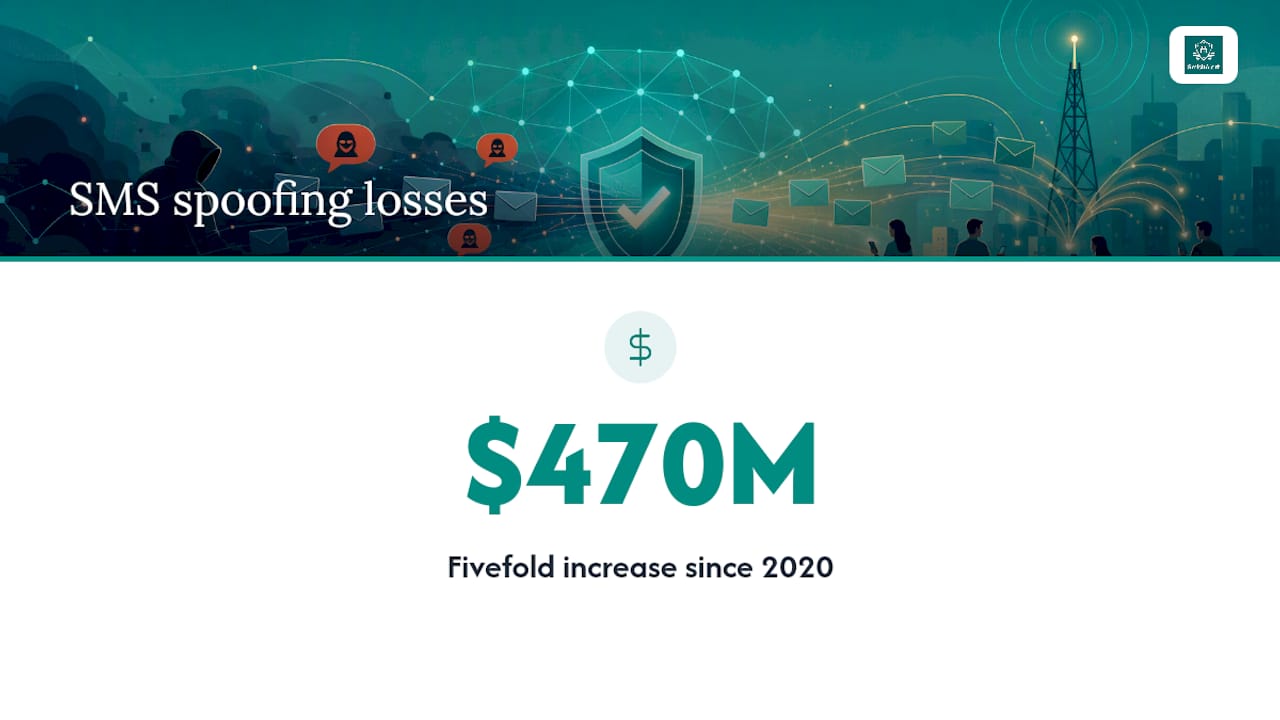
By the numbers: Victims reported roughly $470 million in losses from text scams to the FBI’s IC3 in 2024, a fivefold increase since 2020.
A fivefold jump over four years outpaces almost every other fraud category the IC3 tracks, and it lines up with the protocol-level reality: spoofing has stayed technically trivial while smartphone adoption and mobile-first banking have only grown the attack surface. The academic verification of SMPP spoofability matters here because it removes any ambiguity about mechanism. This is not a patchwork of isolated carrier misconfigurations; it is a structural weakness present across multiple operators tested in the same study.
The operational cost rarely shows up in the headline loss figure. A single successful executive-impersonation payroll fraud can cost a mid-sized company six figures in one wire transfer, and the reputational damage of customers receiving spoofed texts under a company’s brand name compounds separately, often driving support call volume up for weeks after a campaign runs. Brand trust, once a recipient has been burned by a convincing fake, is slow to rebuild.
What Forensic Signals Reveal a Spoofed Text Message?
Detecting spoofing requires looking past the message body and into the metadata layer most phone users never see. SOC teams investigating a suspected spoofing incident should be pulling specific artifacts, not just screenshots.
- PDU-level fields: the
source_addr,source_addr_ton(type of number), andsource_addr_npi(numbering plan indicator) from the SMPP submission, where available from the carrier or aggregator. - Gateway and route identifiers: which SMPP account, aggregator, or grey route the message transited, since legitimate traffic from a registered sender should show a consistent, known path.
- Timestamps and delivery metadata: submission time versus delivery time, and whether the pattern matches known bulk-send bursts.
- Sender-ID anomalies: a brand’s alphanumeric ID suddenly arriving from a different route or country code than its historical baseline.
- Volume spikes: a sudden burst of messages using the same sender string across many recipients in a short window, a classic SMS blaster signature.
On the device side, thread injection produces a specific tell: a spoofed message appears inside an existing, previously legitimate conversation thread rather than starting a new one. That single UX detail is often the strongest signal available to an end user, since it visually mimics continuity with a trusted sender.
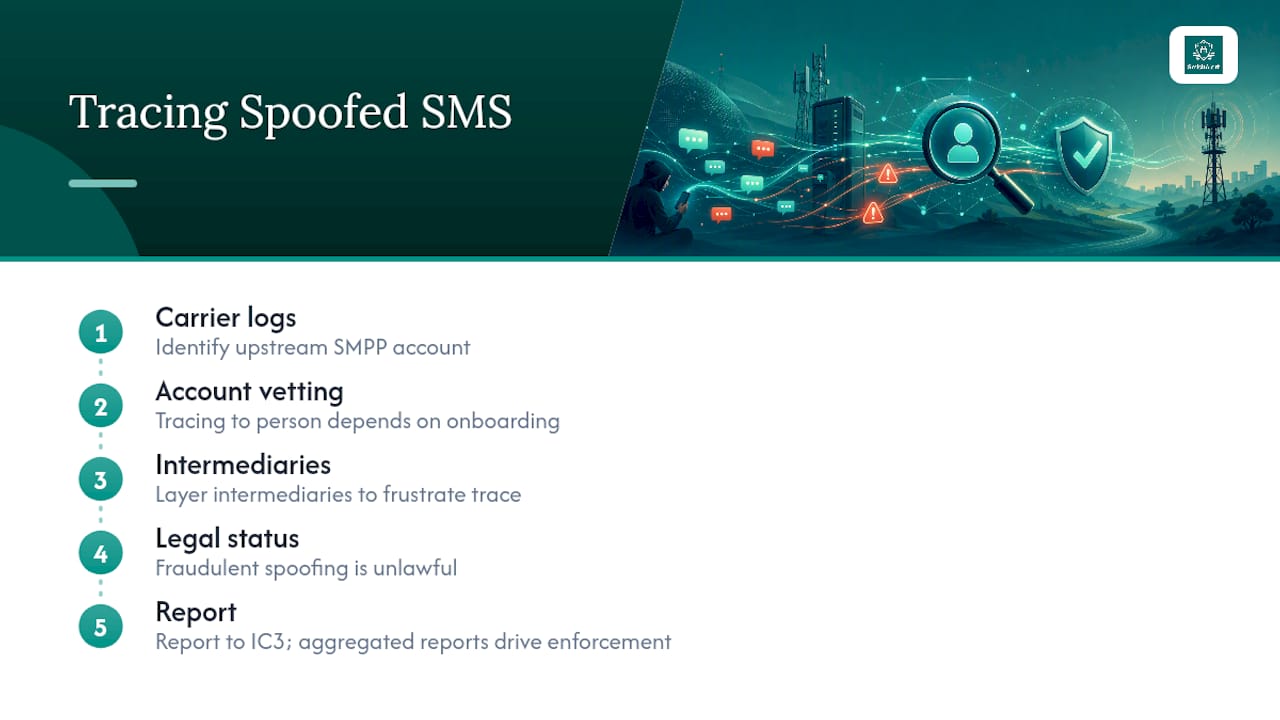
Requesting carrier or aggregator logs after an incident means asking specifically for SMSC (short message service center) records tied to the reported message’s timestamp and sender string, not a general account statement. Aggregators can usually confirm which upstream account submitted the traffic; whether they can name the actual attacker behind that account depends entirely on how well that account was vetted at signup.
Pro Tip: Build a sender-ID baseline for every brand string your organization uses in customer communications, including expected origin routes and typical send volume. Deviations from that baseline are far easier to flag automatically than trying to judge any single message in isolation.
How Can Organizations Prevent SMS Sender Spoofing?
No single control eliminates spoofing outright, but a layered set of technical and policy measures shrinks the window attackers can exploit.
- Register and protect branded sender IDs. Where your carrier or regional regulator supports sender ID registration, lock down your alphanumeric strings so unregistered senders using the same name get flagged or blocked outright.
- Enforce source_addr validation at the gateway. Require aggregators to validate that a submitting account owns the sender identity it claims, and refuse traffic arriving through known grey routes. Industry frameworks increasingly treat this validation step as baseline hygiene rather than an optional add-on.
- Adopt metadata enrichment and attestation where available. Some carrier partnerships now support caller/sender attestation frameworks conceptually similar to STIR/SHAKEN for voice; ask your telecom vendor what’s on their roadmap. Email’s SPF, DKIM, and DMARC stack offers a useful analogy here, since getting sender authentication wrong carries real cost in that channel too, and SMS is heading toward similar accountability structures.
- Deploy contextual warnings at the UX layer. Flagging first-time senders, unusual links, or sender-route mismatches directly in the messaging interface reduces click-through even when the message otherwise looks convincing. Smishalert’s work on contextual phishing warnings covers implementation patterns for this layer specifically.
- Publish a “what we will never ask by SMS” policy. A public, simple statement (your bank will never ask for a one-time passcode by text, your payroll team will never request banking changes over SMS) gives customers and employees a fast mental check, and gives your support team language to point to during a live incident.
Pro Tip: Route hygiene is the highest-leverage single investment on this list. If your organization sends A2P traffic through third-party aggregators, ask for a documented grey-route exclusion policy in writing before renewing that contract. A broader prevention playbook, including detection rule design, is covered in Smishalert’s SMS phishing prevention guide.
What Should You Do When You Discover a Spoofed SMS Attack?
Speed matters in the first hour of a suspected spoofing incident, both for containment and for evidence quality.
- Notify affected customers or employees immediately through a verified channel, explicitly referencing the fraudulent message so recipients can cross-check.
- Preserve evidence before anything else: full screenshots including timestamp and visible sender ID, any SMPP or gateway logs your platform can pull, and the exact short link URL if one was included.
- Escalate to your carrier and aggregator with the preserved evidence, requesting SMSC-level trace records tied to the specific timestamp and sender string.
- File a report with the FBI’s Internet Crime Complaint Center when fraud or financial loss occurred, since IC3 data feeds broader law enforcement pattern analysis.
- After containment, tighten the specific control gap the incident exposed, whether that’s a missing sender-ID registration or an unvalidated aggregator route, and document it for the next audit cycle.
How Platform Telemetry Closes the Detection Gap
Carrier logs answer “what happened at the network layer.” They rarely answer “how many of my employees got this message, and did anyone click.” Smishalert closes that gap through cross-channel correlation across SMS, iMessage, and WhatsApp, surfacing campaign-level patterns that a single carrier record cannot show. User-reported messages feed directly into campaign correlation, and findings route into existing SIEM and API workflows so SOC teams investigate spoofing incidents inside the tools they already use.
Can Spoofed Text Messages Actually Be Traced?
Attribution is possible, but partial, more often than defenders expect. Carriers and aggregators can usually identify the upstream SMPP account or gateway that submitted a spoofed message from their SMSC logs. Whether that traces to an actual person depends on how well that account was vetted at onboarding, and organized fraud operations often layer intermediaries specifically to frustrate that trace. Spoofing for fraud is unlawful regardless of whether the sender is ever identified, and reporting to IC3 remains worthwhile even when attribution stalls, since aggregated reports drive carrier-level enforcement against repeat-offending routes.
A Practitioner’s Priority Checklist for Defenders
Three priorities beat a long feature wish list every time: get visibility into messaging traffic you currently can’t see, fix route hygiene with your aggregators, and give customers a plain-language script for what your brand will never ask by text. Detection-first spending pays off faster than user training alone, because thread injection defeats even alert users. Worth running a quick readiness self-eval before your next budget cycle to see where the gaps actually sit.
— Sophie
Get Visibility Into Spoofed Messages Before They Reach Employees
Carrier logs and user training close part of the gap. Neither one shows a security team what’s actually landing on employee phones across SMS, iMessage, and WhatsApp in real time, and that blind spot is exactly where executive impersonation and payroll fraud campaigns thrive.
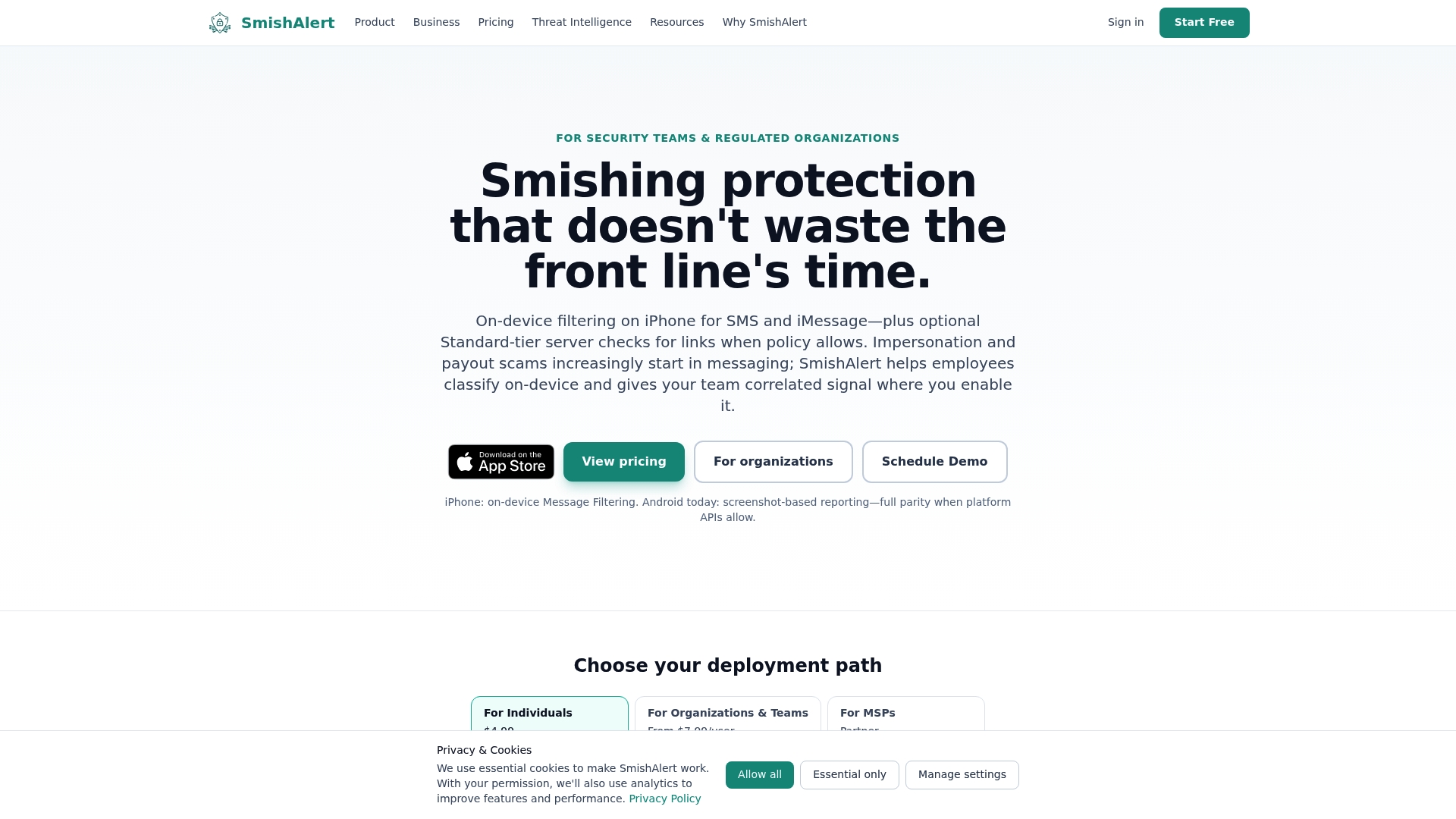
Smishalert gives SOC teams the missing layer: cross-channel campaign correlation, user reporting built into the messaging experience, and audit-ready incident data that plugs into your existing SIEM. It’s built for the exact scenario this article walked through: spoofed sender IDs slipping past carrier-level filters and landing in an employee’s trusted message thread. Rather than waiting on aggregator logs after damage is done, security teams get platform-level visibility into messaging attacks as they happen. Start with the two-minute readiness self-eval to see where your organization’s messaging blind spots actually are.
Sources
For technical depth beyond this guide, the FBI’s IC3 2024 report documents the loss trend in full. The ACM paper on SMPP spoofability is the primary academic source behind the protocol-level claims in this article. DMARC Report’s SMS spoofing explainer covers definitions and mitigation practices in more consumer-facing detail, and the i3forum industry framework outlines where carrier-level cooperation is heading next.
- FBI — IC3 report (2024)
- ACM — Demonstrating spoofability of an originating number when sending an SMS using SMPP
- DMARC Report — SMS spoofing explained
- i3forum — industry framework to combat SMS fraud