
Query-Based Smishing Threat Hunting: A Practical Playbook

Query-based smishing detection works when you hunt on a narrow set of high-signal fields, not the full message corpus: sender ID, message text or hash, embedded URLs, gateway delivery events, and destination metadata. SmishAlert and open-source detection frameworks that watch AWS CloudTrail both rely on volume-anomaly queries to surface bulk phishing campaigns before employees click. Transformer ensemble models that combine text, URL behavior, and page metadata have reported F1 scores as high as 0.98 in controlled testing, which tells you multivariate signals beat text-only classifiers by a wide margin.
Before you write a single query, confirm your logs include these:
- Message text or a hash of it (for privacy-preserving matching)
- Sender ID and recipient identifier (masked or hashed)
- Embedded URLs and resolved domains
- Gateway or delivery-platform events (SNS, Twilio, MNO logs)
- Source IP, user agent, or account credential used to send
Statistic Callout: A recognized anomaly threshold for bulk direct-to-phone abuse in AWS environments is more than 30 successful SNS Publish actions within a 10-second window. Run that query against your last 30 days of CloudTrail data today and you will likely find your first candidate cluster.
Key Takeaways
Effective smishing threat hunting depends on querying multivariate signals (text, URL, gateway, and infrastructure data) together, not any single field in isolation.
| Point | Details |
|---|---|
| Query five fields minimum | Sender ID, message text/hash, URLs, delivery outcome, and account/IP data together, not alone. |
| Deploy the volume threshold | Start with the >30 Publish actions in 10 seconds rule, then tune to your baseline. |
| Enrich in fixed order | Check urlscan.io and VirusTotal before sandboxing to keep triage fast. |
| Build the campaign graph | Map message, URL, domain, and IP nodes to catch infrastructure reuse across campaigns. |
| Automate correlation with SmishAlert | Use SmishAlert to run continuous campaign correlation and produce audit-ready incident reports. |
Table of Contents
- Which Signals Should You Query for Smishing Detection?
- Query Patterns and Thresholds You Can Deploy Today
- How Do You Enrich and Validate a Candidate Smishing Hit?
- Mapping Campaigns With Graph-Based Visualization
- Model Choices and Defending Against Obfuscated Text
- Turning Detections Into a Response Runbook
- Where SmishAlert Fits Into This Playbook
- See Your Smishing Exposure Before It Becomes an Incident
- Sources
Which Signals Should You Query for Smishing Detection?
Smishing hunting fails most often because analysts query the wrong layer. Message text alone misses obfuscated lures; URL data alone misses account abuse; gateway logs alone miss content patterns. Effective queries triangulate across sources.
Pull from five log sources at minimum: SMS gateway or SNS delivery logs, CloudTrail and CloudWatch for API-level activity, mobile network operator (MNO) reports where your carrier relationships allow it, SIEM or ELK traces for correlation, and device telemetry from managed endpoints. Each source answers a different question, and none of them alone tells the full story.
| Field | Why it matters |
|---|---|
| Sender ID / short code | Reveals spoofed or reused identities across campaigns |
| Message body or hash | Enables template clustering without storing raw PII |
| Embedded URL / domain | Anchors enrichment and infrastructure pivoting |
| Delivery result / outcome | Flags bounce patterns tied to bulk sending |
| Account or credential used | Identifies compromised sending accounts |
| Source IP / user agent | Distinguishes automated abuse from legitimate traffic |
Mask phone numbers at ingestion, set retention limits consistent with your data policy, and restrict query access to role-based groups. Smishing logs contain personal communications data, and treating them casually invites both privacy exposure and evidence contamination.
Query Patterns and Thresholds You Can Deploy Today
Three query patterns cover most smishing detection scenarios, and each one is adaptable to Sigma, ES|QL, or a native SIEM query language.
- Direct-to-phone volume spike. The SNS Publish threshold of >30 actions in 10 seconds works as a starting baseline, but tune it against your own account’s normal notification volume before deploying to production alerts.
- Repeated URL across many sender IDs. Query for a single domain or shortened link appearing across more than five distinct sender identities within a rolling 24-hour window. This pattern catches campaigns that rotate sending numbers but reuse infrastructure.
- Rapid domain churn correlated with landing pages. Flag newly registered domains (under 48 hours old via WHOIS) that appear in message URLs within the same window, especially when paired with short page lifetimes.
Tuning matters more than the raw threshold number. Legitimate services (appointment reminders, delivery notifications, two-factor codes) can trip volume alerts, so filter out known service accounts and established delivery partners before the query fires. Start thresholds conservative, then loosen them once you understand your baseline traffic.
One operational catch: CloudTrail and CloudWatch often sanitize or strip phone numbers and message content from event records. A CloudTrail hit tells you that something happened, not always what was sent. Correlate every alert against CloudWatch delivery logs or MNO-side records to reconstruct full context before you escalate.
How Do You Enrich and Validate a Candidate Smishing Hit?
A raw query hit is a lead, not a confirmed incident. Speed here determines whether you catch a campaign in its first hour or its fifth.
Work through enrichment sources in a fixed order: check the URL and domain against Urlscan and passive DNS history first, then cross-reference VirusTotal for known-malicious flags, scrape the landing page title and visible content, and run a sandbox or safe-browsing check if the page is still live.

The pivot sequence typically runs: message template → extracted URL → resolved domain → landing page HTML and title → hosting ASN and IP → passive DNS and WHOIS history → related sender IDs sharing the same infrastructure. Each hop either confirms the campaign or rules out a false positive.
For SOAR automation, run URL reputation checks and domain age lookups synchronously since they return in seconds and gate the triage decision. Push sandbox detonation and deep WHOIS history pulls to asynchronous queues instead. Blocking an analyst’s triage screen on a 90-second sandbox run defeats the purpose of automating it.
Mapping Campaigns With Graph-Based Visualization
Text similarity alone misses campaigns that reuse infrastructure but rewrite every message. That’s the gap graph-based tools close. Systems like SmishViz map relationships between messages, URLs, and web-entity infrastructure, letting you see campaign scale that a flat log table hides.
Build the graph with five node types: message template or hash, extracted URL, resolved domain, hosting IP or ASN, and sender ID. Edges connect a message to its URL, a URL to its domain, and a domain to its hosting infrastructure.
- Degree centrality flags domains or IPs that connect to unusually many message clusters, often the shared infrastructure behind a coordinated operation.
- Connected components show how many distinct campaigns are actually running versus how many appear distinct on the surface.
- Graph density and reuse frequency indicate whether an actor is recycling hosting across waves, which research on smishing infrastructure confirms is common and part of why static blacklists lose effectiveness over time.
Graph pivoting catches low-text-similarity campaigns that share a registrar, a hosting ASN, or a redirect chain, exactly the connections a keyword search will never surface.
Model Choices and Defending Against Obfuscated Text
Detection accuracy on clean text tells you almost nothing about how a model performs against a determined attacker. Adversarial robustness research shows classical lexical models like Random Forest and XGBoost degrade sharply under character-level obfuscation, while multilingual transformer models such as mBERT and XLM-RoBERTa hold up better against the same perturbations.
That gap matters operationally because smishing actors obfuscate constantly: swapping characters for homoglyphs, inserting invisible Unicode, or breaking keywords into fragments a lexical filter won’t reassemble.
Three defenses reduce that exposure. First, add compound-aware decomposition that reconstructs meaningful subwords from fragmented or obfuscated text before classification. Second, normalize characters (homoglyphs, mixed scripts, zero-width characters) in preprocessing rather than trusting the raw string. Third, build ensemble scoring that weighs text classification alongside URL behavior and landing page metadata, so no single obfuscation trick defeats the whole pipeline.
Pro Tip: Retraining a model on more obfuscated examples helps less than fixing the preprocessing pipeline first. Normalize homoglyphs and reassemble compound-obfuscated text before the model ever sees it, and your existing classifier will likely perform better without retraining at all.
Turning Detections Into a Response Runbook
A query hit only matters if your team acts on it consistently. Structure the response as a fixed sequence:
- Triage. Confirm the alert against your baseline, check for known service accounts, and assign a severity based on volume and URL reputation.
- Enrich. Run the pivot sequence from URL to infrastructure, documenting each hop.
- Contain. Block confirmed malicious domains at the gateway or DNS layer, sinkhole where feasible, and report to the MNO or a centralized cross-sector reporting portal if your carrier relationship supports it.
- Escalate. Route to incident response when the campaign targets executives, payroll systems, or credential harvesting at scale.
Track these metrics to know if the program is working:
- Time-to-triage and time-to-block, measured from first alert
- Percentage of enriched indicators that match a confirmed environment hit
- False-positive rate against your tuned thresholds
Mask PII in every log you retain for investigation, and loop in legal or compliance before notifying regulators or MNOs on any case involving customer or employee data.
Where SmishAlert Fits Into This Playbook
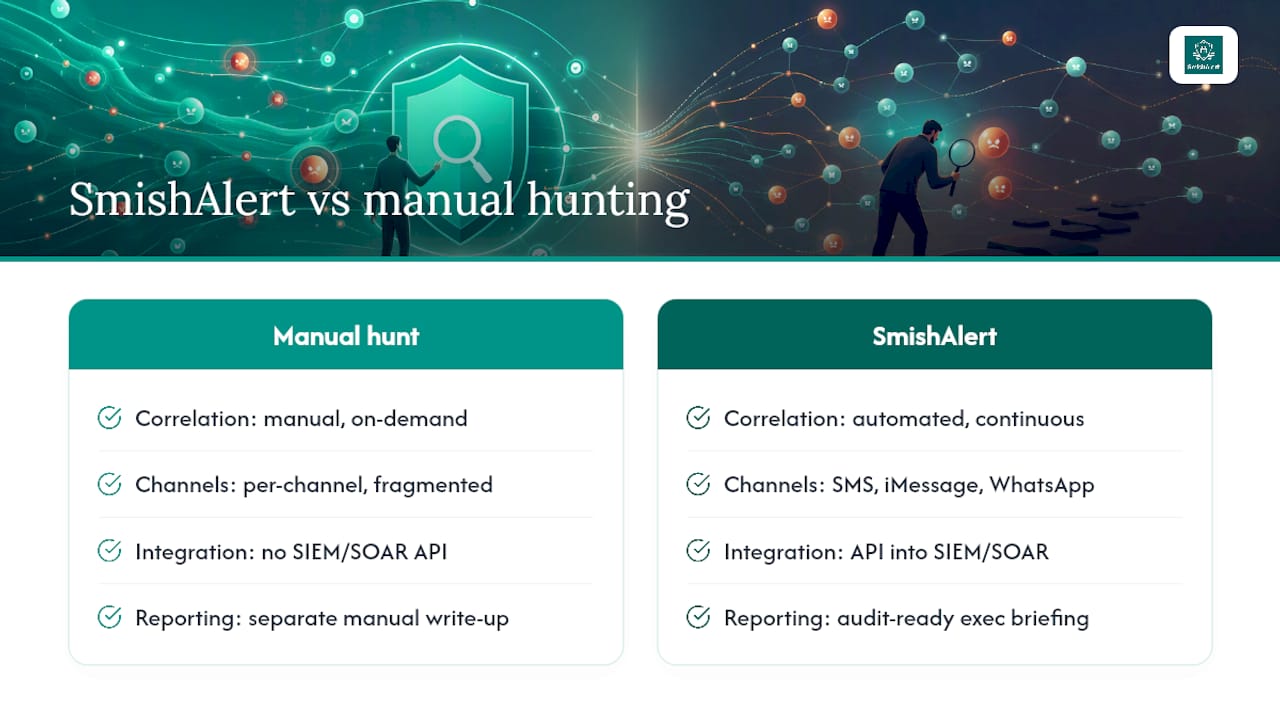
Every step above is buildable in-house, but several of them are exactly where manual hunting slows down: correlating messages across channels, tracking infrastructure reuse over weeks, and producing a report an executive will actually read.
SmishAlert automates campaign correlation across SMS, iMessage, and WhatsApp, linking message templates to shared URLs and infrastructure the same way a graph-based hunt would, but continuously rather than on-demand. It plugs into existing SIEM and SOAR workflows through API integration, so enrichment results land in the same queue your team already triages. For security leaders who need audit-ready reporting after an incident, that correlation output becomes the executive briefing without a separate write-up cycle.
Explore live campaign examples to see how correlated infrastructure data looks once assembled.
A Threat Hunter’s Note on What Actually Moves an Investigation
Model confidence scores get the attention, but infrastructure pivots close cases. Rapid domain churn and short-lifetime landing pages are the highest-leverage signals in a hunt, often surfacing a campaign before any classifier flags a single message.
See Your Smishing Exposure Before It Becomes an Incident
Every query pattern in this playbook gets faster when correlation runs continuously instead of on-demand for each hunt. SmishAlert turns the manual pivot sequence, message to URL to infrastructure, into a standing correlation layer, so your team spends triage time validating instead of assembling.
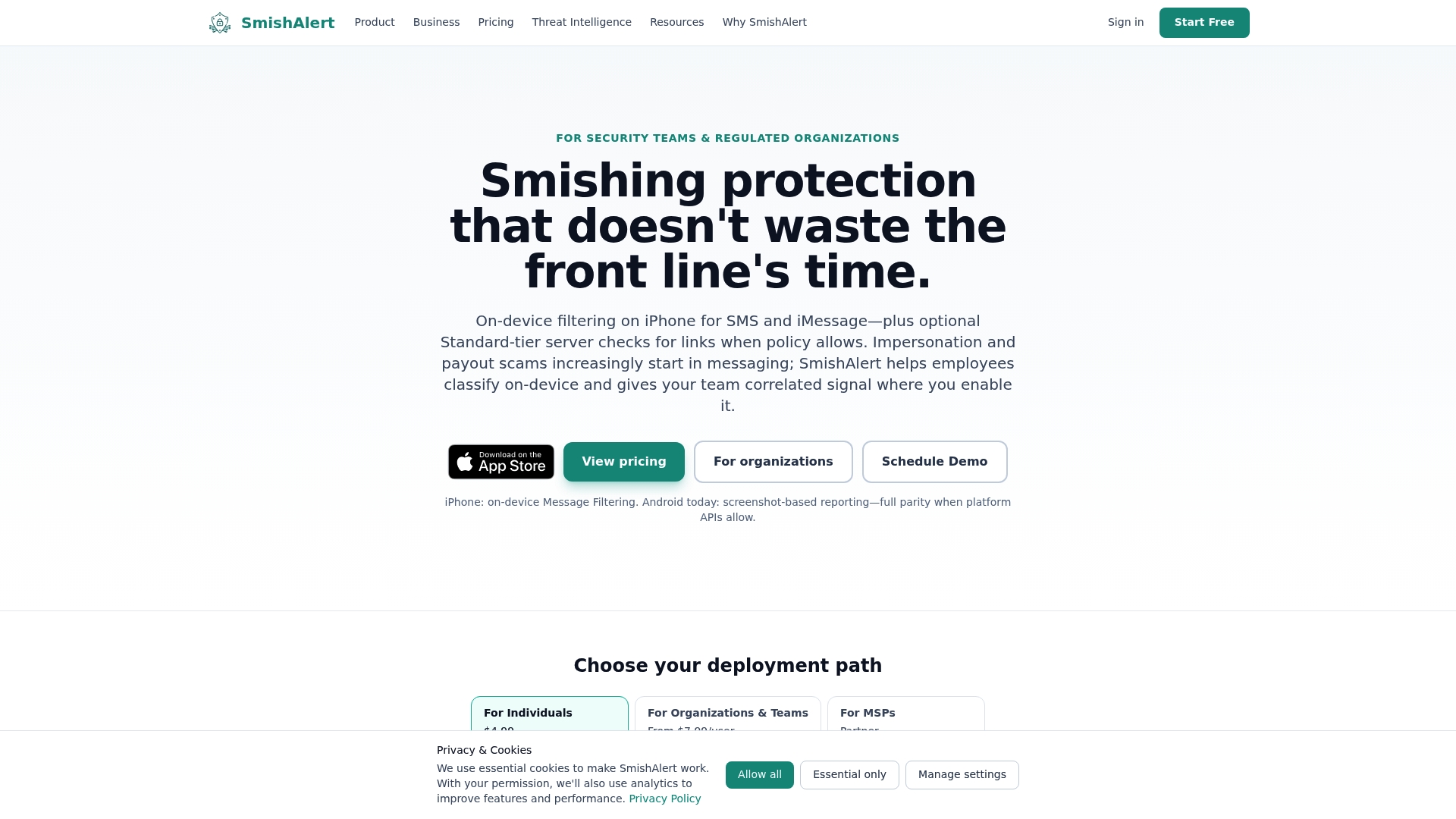
That matters most for organizations juggling executive impersonation, payroll fraud, and vendor compromise attempts across multiple messaging channels at once, where manual graph-building simply can’t keep pace with campaign volume. If you want a concrete read on where your organization’s exposure sits before building an in-house hunting program from scratch, run the SmishAlert Self-Eval, a two-minute readiness check that maps directly against the signals covered in this playbook.
Sources
- SNS Direct-to-Phone Messaging Spike (Elastic detection rule docs)
- SmishViz: Towards A Graph-based Visualization System for Monitoring and Characterizing Ongoing Smishing Threats
- Transformer-based ensemble models for smishing detection (IEEE Access)
- Adversarial robustness in smishing detection: classical vs transformer-based models (arXiv)
- Fishing for Smishing: Understanding SMS Phishing Infrastructure and Strategies by Mining Public User Reports (ACM)