
How Smishing Intersects with Privacy Law: A Compliance Brief

A smishing incident is not just a security event. Under U.S. law, it can simultaneously trigger breach-notification obligations, EFTA/Regulation E liability, HIPAA reporting duties, FTC enforcement exposure, and TCPA-related risk, often within the same 72-hour window. The compliance priority is clear: contain the incident, preserve message evidence and telephony metadata, assess whether protected data was accessed or exfiltrated, and begin your breach-notification decision tree before the clock runs out.
The legal hooks that convert a text-message attack into a privacy or consumer-protection matter fall into three categories:
- Unauthorized access and data exfiltration: When a smishing message harvests credentials that enable downstream account access, the resulting exposure of personally identifiable information (PII), protected health information (PHI), or financial account data triggers sector-specific notification and data-security obligations.
- Unfair or deceptive acts: The deceptive content of the message itself, impersonating a bank, government agency, or employer, can constitute an unfair or deceptive act or practice under Section 5 of the FTC Act, and similar state consumer-protection statutes.
- Unauthorized processing of communications: Depending on how your organization detects, logs, or shares smishing telemetry, you may create secondary data-handling obligations under the Stored Communications Act or state wiretapping analogs.
Immediate actions for security and compliance teams:
- Preserve raw message content, sender metadata, and delivery timestamps before carriers purge records.
- Isolate affected accounts and suspend active sessions; coordinate with IAM and fraud teams within the first hour.
- Initiate a breach-notification assessment: determine whether PII, PHI, or financial account data was accessed.
- Review vendor contracts and business associate agreements (BAAs) for incident-notification clauses and indemnity provisions.
Table of Contents
- What smishing is and how a typical SMS attack chain works
- Why privacy and consumer-protection law apply to smishing incidents
- How U.S. law maps onto smishing incidents
- How enforcement and civil liability typically play out
- Sector-specific considerations for financial services, healthcare, and HR/payroll
- How detection tools create their own privacy trade-offs
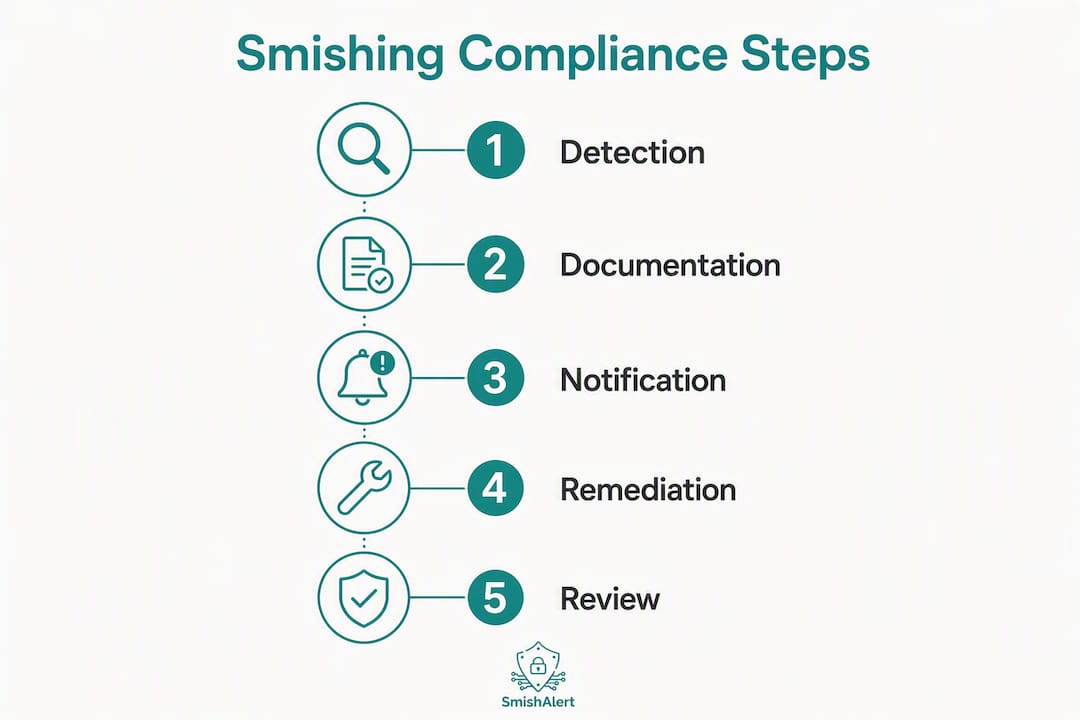
- A compliance checklist for handling smishing incidents
- Research findings and practitioner recommendations
- Key Takeaways
- The compliance gap most organizations are not closing
- How a managed smishing-detection platform reduces your legal exposure
- Authoritative sources and further reading
What smishing is and how a typical SMS attack chain works
Smishing, short for SMS phishing, is a form of social engineering delivered via text message. The attacker’s goal is almost always one of three things: steal credentials, redirect a payment, or harvest personal data that can be monetized directly or used in a follow-on attack. Unlike email phishing, smishing exploits the higher open rates and implicit trust users place in SMS, and it operates almost entirely outside the corporate security perimeter.
A typical attack chain moves through four stages:
- Delivery: The attacker sends a message, often spoofing a legitimate sender ID, to a targeted individual or a bulk list. Messages may arrive via standard SMS, iMessage, WhatsApp, or RCS. SMS blasters and SIM farms allow high-volume campaigns at low cost.
- Social-engineering trigger: The message creates urgency, such as a suspicious login alert, a payroll update request, or a package delivery failure, and directs the recipient to click a link or call a number.
- Credential entry or data capture: The link resolves to a spoofed login page or a form collecting payment card numbers, Social Security numbers, or account credentials. Georgetown Law’s Institute for Technology Law & Policy notes that smishing messages can direct victims to malicious pages that harvest credentials and personal information ranging from usernames and passwords to full names, addresses, birth dates, and Social Security numbers.
- Monetization: Stolen credentials enable account takeover, fraudulent wire transfers, payroll-redirect fraud, or sale of PII on criminal marketplaces.
Representative scenarios in regulated sectors illustrate the legal stakes. In banking, an attacker impersonates a fraud-alert system to capture one-time passcodes, then initiates an unauthorized wire transfer. In healthcare, a spoofed HR message tricks an employee into entering their EHR credentials, exposing patient records. In payroll, an executive-impersonation text redirects direct-deposit accounts to attacker-controlled accounts.
Pro Tip: Document the full attack chain, including the spoofed sender ID, the destination URL, and any form fields presented, before taking down the malicious infrastructure. That evidence record is what regulators and courts will ask for first.
Why privacy and consumer-protection law apply to smishing incidents
The connection between smishing and privacy law is causal, not incidental. When a smishing attack succeeds, it almost always produces one or more legally significant outcomes: unauthorized access to a system containing personal data, exfiltration of PII or PHI, or a fraudulent transaction that triggers consumer-protection statutes.

Even a failed smishing attempt can create data-handling obligations. If your organization collects and stores employee-reported smishing messages, those messages may contain PII belonging to the sender or third parties. Processing that data, sharing it with threat-intelligence platforms, or retaining it beyond operational need creates secondary obligations under applicable privacy frameworks.
The deception element is equally significant. Smishing messages that impersonate financial institutions, government agencies, or employers are, by definition, unfair or deceptive acts. The FTC’s authority under Section 5 of the FTC Act extends to the downstream harm those messages cause, and state attorneys general can pursue parallel actions under state consumer-protection statutes. When the attacker’s deception results in unauthorized access to financial accounts, EFTA/Regulation E enters the picture, placing potential liability on the financial institution if its identity-verification controls were inadequate.
A third causal link involves the Stored Communications Act (SCA). Depending on how smishing telemetry is collected, stored, and shared, organizations may inadvertently create SCA exposure, particularly when message content is intercepted or disclosed without proper authorization.
How U.S. law maps onto smishing incidents
The table below summarizes the primary federal statutes and regulators that security and compliance teams should assess after a smishing incident. State breach-notification laws and sector-specific rules layer on top of this federal baseline.
| Statute / Rule | Legal Hook in a Smishing Context | Key Regulator | Immediate Documentation Obligation |
|---|---|---|---|
| FTC Act, Section 5 | Deceptive or unfair acts in the message content or downstream fraud | FTC | Preserve message content; document consumer harm |
| TCPA | Unauthorized or deceptive outbound SMS (including employee simulations) | FCC | Log sender IDs, message content, consent records |
| EFTA / Regulation E | Unauthorized electronic fund transfers where identity verification was inadequate | CFPB | Preserve device-token logs, authentication timestamps |
| GLBA Safeguards Rule | Failure to protect customer financial data from foreseeable threats | FTC / banking regulators | Document security controls and incident response steps |
| HIPAA / HITECH | PHI exposure triggered by credential theft or unauthorized EHR access | HHS OCR | Initiate breach-risk assessment within 60 days of discovery |
| CCPA / CPRA | Unauthorized disclosure of California residents’ personal information | California AG / CPPA | Assess whether a data breach notification is required |
| State breach-notification laws | Unauthorized access to PII triggering state-specific notification timelines | State AGs | Identify affected residents; map to each state’s threshold |
| Stored Communications Act | Unauthorized access to stored electronic communications | DOJ / civil plaintiffs | Preserve access logs; document authorization chain |
| FCC TCPA guidance | Spoofed sender IDs, robocall/robotext rules | FCC | File complaint records; document spoofing evidence |
Several of these statutes can apply simultaneously. A single smishing campaign that harvests banking credentials and accesses a customer’s account may trigger EFTA/Regulation E, the GLBA Safeguards Rule, state breach-notification obligations, and FTC Act Section 5, all at once.
Key regulator guidance to consult:
- FTC: The FTC’s guidance on impersonation scams and its consumer complaint portal provide the baseline for deceptive-act analysis.
- CFPB: CFPB supervisory guidance on consumer financial harm from unauthorized transfers is the primary reference for Regulation E exposure.
- HHS OCR: The HHS OCR breach-notification guidance specifies the four-factor risk assessment required before a HIPAA breach can be ruled out.
- FCC: FCC TCPA guidance addresses spoofed sender IDs and the treatment of text messages as a regulated communications channel.
Federal and state enforcement can overlap significantly. A smishing campaign targeting California residents, for example, may draw simultaneous action from the FTC, the California AG under the CCPA, and the CFPB if financial accounts are involved.
How enforcement and civil liability typically play out
Enforcement after a smishing-related incident can come from multiple directions at once, and the sequence matters for how organizations should prioritize their response.
Regulatory enforcement actors:
- The FTC brings actions under Section 5 for unfair or deceptive acts, typically seeking injunctive relief, civil penalties, and consumer restitution. The FTC has pursued cases involving impersonation of government agencies and financial institutions via text message.
- State attorneys general can act under state consumer-protection statutes and breach-notification laws, often filing in parallel with federal agencies. Multi-state coalitions are increasingly common in high-volume smishing campaigns.
- The FCC enforces TCPA violations, including unauthorized or spoofed outbound SMS. Civil penalties can reach $51,744 per willful violation under current FCC schedules.
- The CFPB supervises financial institutions for Regulation E compliance and can bring enforcement actions where unauthorized transfers result from inadequate identity verification.
- HHS OCR investigates HIPAA breaches and can impose civil monetary penalties tiered by culpability, from $137 per violation for unknowing violations up to $2,067,813 per violation category per year for willful neglect uncorrected.
Private plaintiffs and class actions frequently follow regulatory enforcement. TCPA class actions are particularly common because the statute provides a private right of action with statutory damages of $500 per violation, trebled to $1,500 for willful violations. A smishing campaign that sends deceptive messages to thousands of employees or customers can generate class-action exposure that dwarfs regulatory penalties.
Legal pressure against criminal smishing infrastructure through platform takedowns and hosting cutoffs has proven effective at disrupting operations at scale, complementing endpoint blocking and regulatory enforcement.
Evidence checklist for demonstrating a commercially reasonable security posture:
- Timestamped logs showing MFA enrollment and authentication events at the time of the incident.
- Device-token activation records, including any delay controls applied to high-risk actions after new device enrollment.
- Incident response timeline documentation from first detection to containment.
- Records of employee security training, including smishing-awareness content and completion dates.
- Vendor contracts and BAAs showing data-security obligations and incident-notification clauses.
Statistic callout: Under the TCPA, statutory damages reach $1,500 per willful violation, and class actions involving bulk deceptive SMS campaigns have resulted in multi-million-dollar settlements. The per-message exposure makes volume the primary liability multiplier in smishing-related litigation.
Sector-specific considerations for financial services, healthcare, and HR/payroll
Legal risk from smishing is not uniform across industries. The sector determines which additional statutes apply, which regulators have jurisdiction, and how tight the notification timelines are.
Financial services
The most significant exposure for financial institutions is under EFTA/Regulation E. Under Regulation E, a bank may be held liable for unauthorized electronic fund transfers resulting from smishing where it failed to implement commercially reasonable identity-verification standards. Courts and regulators have scrutinized whether institutions applied appropriate delays to high-risk activities following new device-token activation. If a customer’s account is drained after a smishing attack and the bank’s authentication controls did not meet a commercially reasonable standard, the institution bears the loss, not the customer.

The GLBA Safeguards Rule adds a parallel obligation: financial institutions must implement and maintain a written information security program that addresses foreseeable threats, including social engineering via SMS. CFPB supervisory examinations increasingly include questions about mobile-channel fraud controls.
Healthcare
When smishing leads to unauthorized access to systems containing PHI, HIPAA’s Breach Notification Rule is triggered. HHS OCR requires covered entities to conduct a four-factor risk assessment to determine whether the exposure constitutes a reportable breach. If it does, notification to affected individuals must occur within 60 days of discovery, and HHS OCR must be notified. For breaches affecting 500 or more individuals in a state, media notification is also required.
BAA review is a critical step that organizations often overlook. If the smishing attack compromised a vendor’s system that handles PHI, the BAA governs notification timelines and remediation obligations. A BAA that lacks specific incident-response timelines or indemnity provisions creates significant exposure. Mobile phishing is a documented compliance risk in healthcare, and BAA language should reflect that.
HR/payroll and payroll processors
Payroll-redirect fraud via smishing is one of the highest-velocity attack patterns in regulated sectors. An attacker impersonates an executive or HR system, directs an employee to update their direct-deposit information, and diverts one or more payroll cycles before the fraud is detected. Contractual obligations to employees and customers, combined with potential EFTA exposure for the payment processor, make this scenario particularly costly.
Vendor controls are the first line of defense. Payroll processors should be contractually required to implement out-of-band verification for account-change requests and to notify the employer within a defined window of any suspicious change activity.
- Review vendor contracts for explicit smishing-related incident-notification clauses.
- Require out-of-band verification for any payroll or banking-detail change request received via SMS or email.
- Align IAM and fraud telemetry so that account-reset requests and direct-deposit changes trigger cross-functional review.
How detection tools create their own privacy trade-offs
Deploying automated SMS scanning or telemetry-sharing tools to detect smishing creates a secondary legal tension. The same capabilities that help identify and disrupt attacks may, if poorly scoped, constitute unauthorized interception of communications or generate PII that itself requires protection.
The core trade-off is proportionality. Broad automated monitoring of message content risks what the EDPS has described as generalized interference with communications privacy, a standard that U.S. courts have begun to consider in SCA and wiretapping cases even without a direct GDPR analog. For organizations with cross-border operations or EU-based employees, this tension is legally concrete.
Internationally, the debate is active. Belgium and Poland have enacted legislation granting telecommunications providers limited rights to block or replace scam SMS content, while regulatory bodies in Spain and Ireland have explored sender registries. These approaches illustrate that even jurisdictions with strong privacy frameworks recognize the need for targeted, proportionate scanning, but they require explicit legal authority and strict safeguards.
For U.S. organizations, the practical mitigation steps are:
- Apply data minimization: retain only hashed indicators or fingerprints for cross-correlation, not raw message content.
- Pseudonymize or remove phone numbers from shared threat reports before external disclosure, consistent with ITU-T X.1237 guidance on PII protection in anti-spam systems.
- Enforce short, auditable retention windows for any stored message content.
- Provide clear employee notice of monitoring scope and purpose, documented in acceptable-use policies.
Employee simulation programs carry their own risk. Regulators treat deceptive outbound SMS similarly to calls for certain enforcement purposes, and an employee who reports a simulated smishing message to the FCC or a state AG can trigger regulatory scrutiny. Before running any simulation program, document a formal privacy impact assessment that addresses necessity, proportionality, and alternatives.
Pro Tip: Before deploying any SMS scanning or simulation tool, confirm that your acceptable-use policy explicitly covers mobile messaging monitoring, and that your privacy impact assessment is on file. Regulators have treated the absence of this documentation as evidence of inadequate governance.
A compliance checklist for handling smishing incidents
Effective incident response to a smishing event requires coordination across security, legal, fraud, and IAM teams. The checklist below is organized by phase.
Pre-incident controls
- Enable persistent logging of authentication events, device-token activations, and account-change requests across all systems that handle PII, PHI, or financial data.
- Harden MFA and account-recovery processes: require out-of-band verification for high-risk actions and apply activation delays after new device enrollment.
- Update BYOD policies to address smishing on personal devices, including employee reporting obligations and acceptable-use scope for monitoring.
- Review vendor contracts and BAAs for explicit smishing-related notification timelines, indemnity provisions, and data-handling obligations.
- Complete a privacy impact assessment for any SMS scanning or simulation tool before deployment.
During-incident response
- Preserve raw message content, sender metadata, and delivery timestamps immediately. Establish chain-of-custody documentation for all telephony metadata.
- Isolate affected accounts and suspend active sessions within the first hour. Coordinate with IAM and fraud teams simultaneously, not sequentially.
- Apply the breach-notification decision tree: determine whether PII, PHI, or financial account data was accessed or exfiltrated, and identify the applicable notification timelines for each affected jurisdiction.
- Notify legal counsel and, where required by contract, notify affected vendors or business associates within the contractually specified window.
- Document all response actions with timestamps for the incident record.
Post-incident obligations
- Complete breach notifications to affected individuals and regulators within applicable deadlines: 60 days for HIPAA, 30 days for most state breach-notification laws (some states require as few as 10 days for certain categories of data).
- Conduct a vendor and third-party audit to confirm that downstream systems were not also compromised.
- Validate remediation: confirm that the attack vector has been closed, that affected credentials have been reset, and that monitoring controls are in place.
- Update training and simulation governance to reflect lessons learned, and confirm that any future simulation programs have documented privacy impact assessments.
| Phase | Key Action | Owner | Legal Rationale |
|---|---|---|---|
| Pre-incident | Persistent authentication logging | CISO / IT | Reg E evidence standard; GLBA Safeguards Rule |
| Pre-incident | Vendor contract review | General Counsel | BAA notification timelines; indemnity exposure |
| During | Evidence preservation with chain-of-custody | Security / Legal | Regulatory and civil litigation evidence standard |
| During | Breach-notification decision tree | Compliance / Legal | HIPAA 60-day rule; state breach-notification laws |
| Post-incident | Breach notifications to regulators and individuals | Compliance | HIPAA, CCPA, state breach-notification statutes |
| Post-incident | Simulation program PIA documentation | Legal / HR | TCPA-like regulatory risk; privacy impact assessment |
Pro Tip: Assign a single incident coordinator who owns the breach-notification decision tree from the moment an incident is confirmed. Fragmented ownership between security and legal teams is the most common reason organizations miss notification deadlines.
Research findings and practitioner recommendations
Three research findings are particularly relevant for security and compliance teams assessing their current posture.
Research finding: Financial institutions may be held liable under EFTA/Regulation E for unauthorized transfers resulting from smishing where they fail to implement commercially reasonable identity-verification standards, including controls such as delaying high-risk activities after new device-token activation. In civil recovery claims, a forensic examination showing that a bank ignored device-token activation timing has proven decisive.
The Regulation E exposure point is frequently underestimated by security teams who treat smishing as a user-awareness problem rather than an institutional liability. The commercially reasonable standard is an objective test, and regulators and courts will compare your controls against industry practice at the time of the incident.
The second finding concerns internal simulation programs. Legal experts caution that smishing simulations can trigger external reporting and regulatory scrutiny unless organizations document legitimate interest or obtain clear consent. An employee who receives a simulated smishing message and reports it to the FCC or a state AG creates a regulatory record that is difficult to unwind. A formal privacy impact assessment, completed before the simulation runs, is the primary mitigation.
The third finding addresses detection tool design. Privacy-compliant anti-smishing tools must adopt data-minimization principles: retain only fingerprints or hashed indicators for cross-correlation, encrypt stored reports, and enforce short, auditable retention windows. ITU-T X.1237 explicitly recommends removing direct identifiers before sharing anti-spam reports, a standard that translates directly into a compliance control for detection tooling.
Operational recommendations that follow from these findings:
- Align identity, fraud, and IAM telemetry so that smishing-driven credential theft is detected at the account-reset stage, not only at the point of unauthorized transfer. High-volume smishing operations exploit weak recovery processes rather than sophisticated technical vulnerabilities.
- Coordinate with legal counsel on platform takedown requests and hosting cutoffs for active smishing infrastructure. Legal pressure against criminal infrastructure disrupts campaigns at scale and creates a documented enforcement record.
- Build evidence collection into your detection workflow from day one. The logs, timestamps, and chain-of-custody records you generate during normal operations are the same records regulators will request after an incident.
Key Takeaways
Smishing incidents trigger overlapping U.S. legal obligations across breach notification, consumer protection, and sector-specific statutes, and the evidence standard for limiting liability is set at the time of the incident, not after it.
| Point | Details |
|---|---|
| Preserve evidence immediately | Telephony metadata and message content are the primary evidence regulators and courts request; purge windows are short. |
| Reg E liability is institutional | Banks that lack commercially reasonable identity-verification controls bear the loss from smishing-driven unauthorized transfers, not the customer. |
| Notification timelines are strict | HIPAA requires breach notification within 60 days of discovery; most state breach-notification laws require 30 days or fewer. |
| Simulation programs carry regulatory risk | Internal smishing simulations require a documented privacy impact assessment to avoid TCPA-like enforcement exposure. |
| Smishalert provides audit-ready evidence | Smishalert’s platform captures, correlates, and reports on smishing incidents with the chain-of-custody documentation compliance teams need. |
The compliance gap most organizations are not closing
The conventional framing of smishing as a user-awareness problem misses the more consequential legal exposure. Training employees to recognize suspicious texts is necessary, but it does not satisfy the commercially reasonable identity-verification standard under Regulation E, and it does not constitute a documented security program under the GLBA Safeguards Rule. Regulators do not grade on awareness; they grade on controls.
The more urgent gap is on the evidence side. Most organizations cannot produce, on short notice, a timestamped record of device-token activations, authentication events, and account-change requests that would allow legal counsel to reconstruct the attack chain and demonstrate that controls were in place. That gap is what turns a manageable incident into a consent decree.
There is also a real tension in detection tool design that practitioners tend to underweight. Deploying SMS scanning or telemetry-sharing without a documented data-minimization framework creates secondary PII exposure. The tool you deploy to reduce smishing risk can itself become a source of regulatory liability if it retains raw message content beyond operational need or shares phone numbers without pseudonymization. The ITU-T X.1237 standard provides a practical baseline for what privacy-compliant detection tooling should look like, and it is worth reviewing before any pilot deployment.
The 30-to-90-day priority for most security and compliance teams should be: close the evidence gap first, then address the detection tool governance, then revisit simulation program documentation. That sequence maps directly to where regulatory and civil liability is most likely to land.
How a managed smishing-detection platform reduces your legal exposure
Security and compliance teams managing smishing risk face a concrete operational problem: the evidence standard regulators apply requires logs, timestamps, and chain-of-custody records that most organizations are not systematically generating from their mobile-messaging environment.
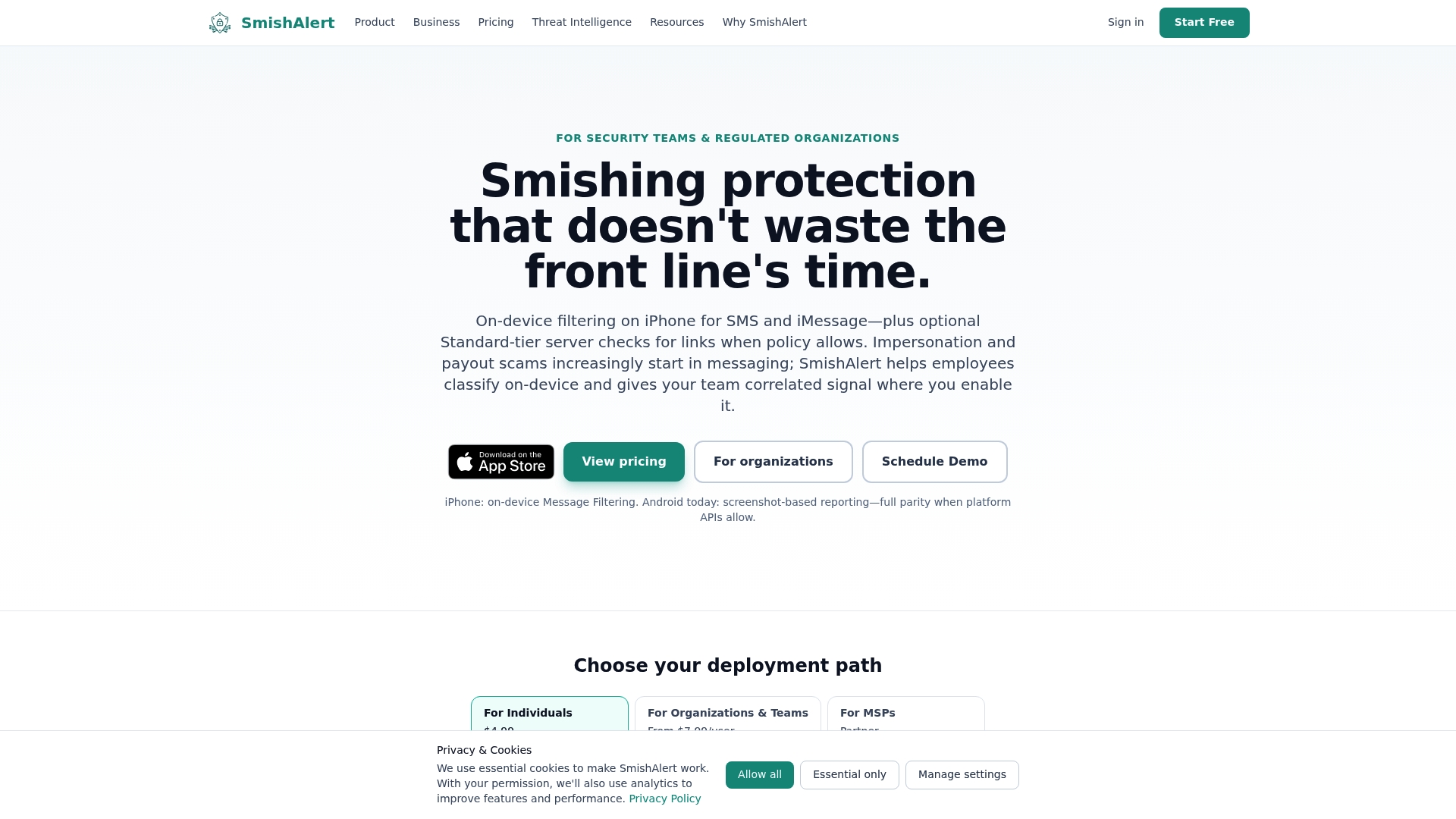
Smishalert is built to close that gap. The platform captures and correlates smishing reports across SMS, iMessage, WhatsApp, and other messaging channels, generating the audit-ready incident records that legal teams need when regulators or plaintiffs come asking. On-device iOS message filtering, Android and cross-channel reporting, and SIEM/API integration mean that evidence is preserved in a format that maps directly to the documentation obligations described in this brief. Campaign correlation surfaces coordinated attack patterns before they result in credential compromise, and the pilot-to-deploy workflow preserves the audit trail from day one.
For compliance-sensitive verticals, including healthcare, financial services, and HR/payroll, Smishalert’s reporting capabilities support the breach-notification decision tree and provide the forensic detail that HHS OCR, the CFPB, and state attorneys general will request. The platform’s data-minimization controls align with ITU-T X.1237 guidance, reducing the secondary PII exposure that poorly scoped detection tools can create.
Take the two-minute readiness check to assess your organization’s current smishing detection posture, or review the platform capabilities that map directly to the compliance controls described in this brief.
Authoritative sources and further reading
The sources below are organized by authority level. Primary legal authorities are marked accordingly.
Primary legal authorities:
- FTC Act, Section 5 guidance on unfair or deceptive acts — the baseline for deceptive-message enforcement; consult FTC’s impersonation scam guidance directly.
- HHS OCR HIPAA Breach Notification Rule — governs the four-factor risk assessment and notification timelines for PHI exposure.
- CFPB Regulation E resources — primary reference for unauthorized electronic fund transfer liability standards.
Technical standards:
- ITU-T Recommendation X.1237 (September 2024) — technical security framework for PII protection in mobile messaging anti-spam systems; directly applicable to detection tool design.
Advisory and practitioner references:
- Georgetown Law Institute for Technology Law & Policy: Text-Based Scams & AI — practitioner-facing analysis of smishing’s privacy and data-security implications.
- Commsrisk: Will privacy laws change to let machines read SMS texts for fraud content? — international comparative analysis of SMS scanning legislation and privacy trade-offs.
Smishalert resources for accelerating response:
- Smishing protection best practices for enterprises — operational controls and TCPA considerations for internal programs.
- Mobile phishing is a compliance risk: 2026 guide — sector-specific compliance guidance for security and legal teams.
This article provides general legal and technical information for security and compliance professionals. It is not legal advice. Confirm current regulatory requirements and notification obligations with qualified legal counsel and the applicable primary sources before making compliance decisions.