
How Location Data Enables SMS Targeting: A CISO's Guide

Attackers use location signals — area-code spoofing, delivery-report timing fingerprints, app-exfiltrated GPS, and HLR metadata — to make smishing messages appear locally credible, dramatically increasing the probability an employee or executive will engage. The immediate defensive priorities are: (1) surface timing and sender metadata in your SIEM telemetry, (2) enforce port-freeze and hardened MFA flows for high-value accounts, and (3) integrate mobile messaging telemetry with user reporting into your SOAR pipeline.
Key context at a glance:
- WiSec 2025 research demonstrates that a multi-signal detection model fusing structural, character-level, semantic, and timing features achieves 97.89% accuracy, 0.963 F1, and 99.73% AUC on a large relabeled SMS corpus.
- USENIX WOOT timing research confirms that silent-SMS delivery-report timing can fingerprint recipient location without carrier cooperation.
- Smishalert’s operational telemetry shows location-aware campaigns consistently outperform generic blasts in employee engagement rates, making geolocation-enabled smishing the higher-priority threat for enterprise SOC teams.
Table of Contents
- How location data enables SMS targeting: attacker techniques
- Where attackers source location signals and what defenders can collect
- How does multi-signal detection work for location-enabled smishing?
- What operational controls should security teams deploy now?
- What does an IR playbook look like for a location-targeted SMS campaign?
- Privacy, legal, and deployment constraints you need to address
- Smishalert gives your SOC visibility into location-enabled smishing
- Key Takeaways
- The signal that changes the calculus
- Selected sources for further reading
How location data enables SMS targeting: attacker techniques
Location awareness gives attackers a precision advantage that generic blasts cannot replicate. The five core techniques below map directly to detection signals your team can operationalize.
Area-code and local sender-ID spoofing. Empirical smishing research confirms that selecting a local area code or a toll-free number matching the recipient’s region is a deliberate tactic to boost perceived legitimacy. An employee in a Chicago office receiving a text from a 312 number is more likely to respond than one from an unrecognized out-of-state code. Attackers source area-code lists from recycled-number registries, corporate directories, and LinkedIn data.
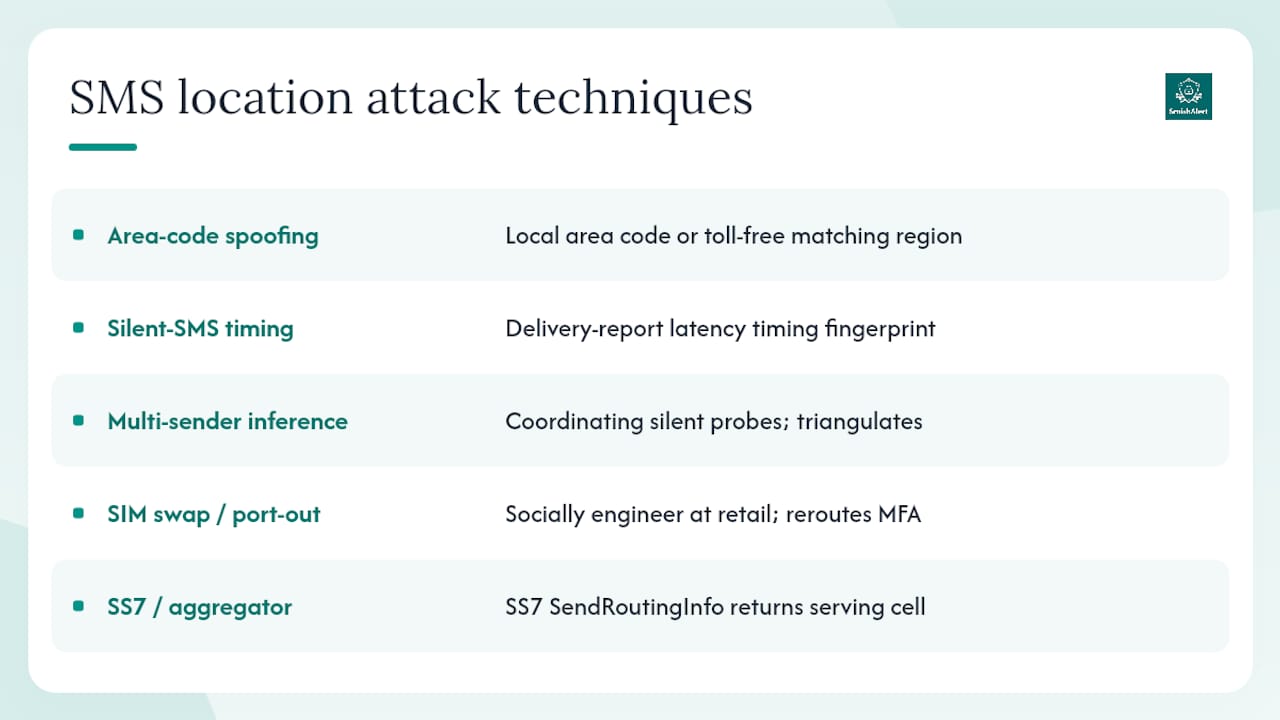
Silent-SMS delivery-report timing fingerprinting. By sending silent (Type 0) SMS messages and measuring the round-trip delivery-report latency, an attacker can build a timing fingerprint for a target device. Repeated samples narrow the location estimate progressively, without any cooperation from the carrier. The USENIX WOOT research shows this side channel is practical and does not require specialized hardware.
Multi-sender timing inference. Coordinating silent probes from multiple geographically distributed senders produces richer timing fingerprints and is more resilient to single-sender blocking. The attacker triangulates from multiple vantage points, improving coarse-to-fine localization accuracy. This technique is harder to block at the carrier level because no single sender generates anomalous volume.
SIM swap, port-out fraud, and bribed retail compromise. Once an attacker knows a target’s approximate location and carrier, SIM swap or port-out requests become easier to socially engineer at retail. A successful swap reroutes all SMS-based MFA to the attacker’s device, enabling account takeover. Smishing infrastructure research documents how SIM-farm appliances and commercial SMS aggregators reduce per-message cost to fractions of a cent, making high-volume targeted campaigns economically viable.
SS7 and aggregator-based interception. Attackers with SS7 access or a compromised aggregator account can intercept or redirect SMS traffic at the network layer. Messages sent through legitimate aggregator accounts bypass many carrier heuristics, and SS7 access allows silent location queries (SendRoutingInfo) that return the serving cell without the subscriber’s knowledge.
Example scenarios: A payroll-fraud campaign timed to the last Friday of the month, spoofing the CFO’s local area code, exploits both timing and locality. A delivery-notice lure sent to employees in a specific city during a known corporate travel window uses city-level geolocation to increase plausibility. For traveling executives, the combination of unfamiliar networks and time-zone disorientation makes location-timed attacks especially effective.
Pro Tip: Prioritize detection of multi-sender timing bursts and unusual delivery-report reply flows. A single sender sending silent probes is easy to miss; coordinated multi-sender patterns leave a distinct footprint in gateway logs that a tuned SIEM rule can surface.
Where attackers source location signals and what defenders can collect
Understanding the upstream data sources attackers exploit tells you exactly which telemetry fields to prioritize in your detection pipeline.
- POSTER: A Multi-Signal Model for Detecting Evasive Smishing (WiSec 2025)
- SMS timing-based location inference (USENIX WOOT / security research)
- Smishing dataset and infrastructure analysis (IMC 2025 paper)
- SMS smishing ecosystem analysis (arXiv / academic smishing dataset)
- Zimperium mishing report (industry analysis)
- Smishing operational techniques and infrastructure (social-engineering tutorial)
- Cybersecurity and the shadow world of geolocation (Cybernoz)
Statistic to anchor your pilot: The WiSec 2025 multi-signal model was validated on a large, relabeled SMS corpus and achieved 97.89% accuracy, 0.963 F1, and 99.73% AUC, demonstrating that fusing these signal types produces detection performance that single-signal heuristics cannot approach.
How does multi-signal detection work for location-enabled smishing?
Single-signal rules — blocking a known shortener domain or flagging a specific area code — are necessary but insufficient. Attackers rotate infrastructure faster than blocklists update. A multi-signal model that fuses structural, character-level, semantic, and timing features closes that gap.
Architecture overview:
- Character-level features: Short messages, informal syntax, and obfuscated strings evade token-only classifiers. Character-level streams capture these patterns, as the WiSec 2025 research demonstrates with measurable accuracy gains over single-stream baselines.
- Timing fingerprints: Delivery-report latency anomalies, burst patterns from SIM farms, and multi-sender probe sequences are ingested as time-series features. Combining these with structural signals, per the USENIX WOOT findings, significantly lowers false positives compared with timing-only detection.
Implementation split: Lightweight structural and timing checks run on-device or at the SMS gateway, keeping latency low. Heavier semantic and NER processing runs in the cloud, with results fed back into the SIEM for alert enrichment. This hybrid approach preserves privacy controls while maintaining accuracy.
For a detailed breakdown of SMS threat detection approaches, including structural tagging pipelines, Smishalert’s technical documentation covers the implementation specifics.
Pro Tip: During your pilot, run ablation experiments that disable one signal channel at a time. The channel whose removal most degrades recall is the one your environment depends on most — and the one attackers will probe first.
What operational controls should security teams deploy now?
Prioritize by speed of deployment and coverage of the highest-risk accounts.
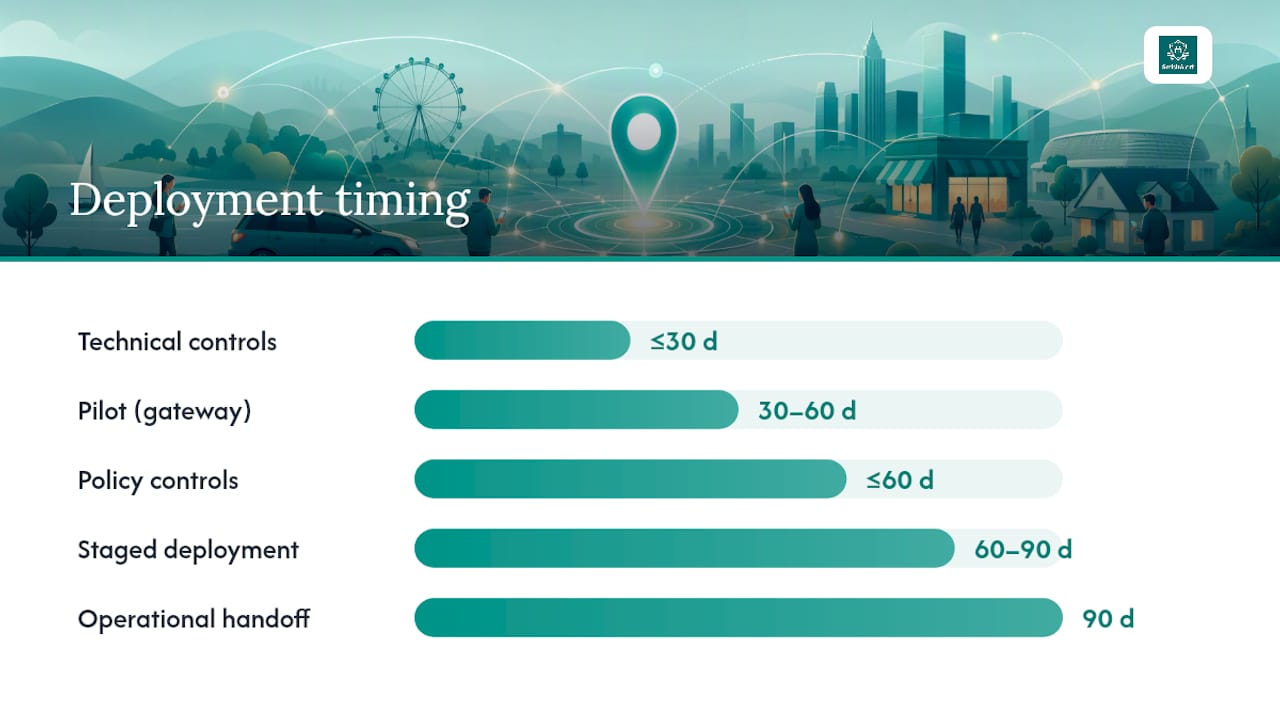
Technical controls (deploy within 30 days):
- Block known URL shorteners and suspicious TLDs at the SMS gateway; feed IMC infrastructure blocklists into your gateway’s URL reputation engine.
- Configure delivery-timing anomaly alerts in your SIEM for burst patterns consistent with SIM-farm probing (high-volume outbound delivery reports from a narrow sender range).
- Enable HLR metadata enrichment on inbound messages to flag originating-network mismatches.
- Deploy on-device iOS message filtering for executive and high-risk employee devices — no MDM required for the iOS filtering API. See Smishalert’s guidance on mobile phishing protection without MDM for deployment options.
Policy controls (deploy within 60 days):
- Enforce port-freeze (number lock) for all executive and privileged-account phone numbers through your carrier account manager.
- Require step-up authentication for any mobile-authenticated flow — SMS OTP alone is insufficient for high-value transactions. Review how smishing bypasses MFA to understand the specific interception vectors.
- Issue travel-safe procedures for executives: pre-notify IT of travel, use app-based authenticators rather than SMS OTP while abroad, and report unsolicited messages immediately.
People and process (ongoing):
- Establish a one-tap employee reporting channel for suspicious messages across SMS, iMessage, and WhatsApp.
- Adjust phishing simulation programs to include SMS scenarios with local area codes and delivery-notice lures.
- Define SOC escalation playbooks that trigger on multi-sender timing anomalies or confirmed SIM-swap events.
Rollout timeline: Pilot (30–60 days) covers gateway controls and SIEM rule tuning. Staged deployment (60–90 days) adds policy controls and carrier engagement. Operational handoff at 90 days includes documented playbooks and owner assignments across SOC, IAM, and carrier liaison teams.
What does an IR playbook look like for a location-targeted SMS campaign?
When a suspected location-targeted smishing campaign is identified, the following sequence minimizes dwell time and preserves evidence.
- Post-incident review. Document which detection signals fired first, which were missed, and update SIEM rules accordingly. Short-lived targeted campaigns often rotate infrastructure within 48 hours, so speed of evidence collection is the critical variable.
Privacy, legal, and deployment constraints you need to address
Collecting messaging telemetry for security purposes introduces privacy obligations that U.S. legal counsel should review before deployment.
- Unified communications integration. When extending telemetry collection to unified communications platforms, deployment constraints vary by vendor and architecture. Unified communications deployment guidance covers integration considerations relevant to on-device vs. cloud processing tradeoffs.
Pro Tip: Architect your telemetry ingestion pipeline with tokenization and SSO-linked identity mapping as defaults, not retrofits. Retrofitting privacy controls after deployment is significantly more costly and creates compliance gaps during the transition period.
This article provides general security guidance, not legal advice. Confirm current U.S. privacy and communications law requirements with qualified legal counsel before deploying messaging telemetry collection.
Smishalert gives your SOC visibility into location-enabled smishing
Location-aware smishing campaigns are designed to stay below the threshold of traditional email security tools. Smishalert surfaces the signals those tools miss: delivery-timing anomalies, structural tagging of sender IDs and URL chains, campaign correlation across SMS, iMessage, and WhatsApp, and on-device iOS message filtering that requires no MDM enrollment.
The Smishalert platform ingests telemetry from mobile agents, user reports, and SMS gateway logs, feeding enriched alerts directly into your SIEM or SOAR via API. For teams ready to validate detection coverage, Smishalert offers a paid 30-day pilot credited toward the first annual subscription. Take the 2-minute readiness self-evaluation to identify your current gaps and scope a pilot for your environment.
Key Takeaways
Multi-signal detection fusing timing, structural, character-level, and semantic features is the only approach that keeps pace with location-aware smishing campaigns that rotate infrastructure faster than single-signal blocklists can update.
| Point | Details |
|---|---|
| Location signals attackers exploit | Delivery-report timing, HLR metadata, area-code spoofing, and app-exfiltrated GPS all enable city-level targeting. |
| Multi-signal model performance | WiSec 2025 research reports 97.89% accuracy, 0.963 F1, and 99.73% AUC when fusing structural, character, semantic, and timing features. |
| Top immediate controls | Port-freeze for executives, step-up MFA, gateway URL blocking, and delivery-timing anomaly alerts in your SIEM. |
| Rollout timeline | Pilot in 30–60 days covers gateway and SIEM controls; full operational handoff targets 90 days. |
| Smishalert coverage | Smishalert captures delivery-timing signals, correlates campaigns across channels, and integrates with SIEM/SOAR without requiring MDM. |
The signal that changes the calculus
The conventional wisdom in enterprise SMS security is that smishing is a volume problem: block enough known-bad domains and sender IDs, and you reduce exposure to an acceptable level. That framing is wrong, and the WiSec 2025 and USENIX timing research makes it demonstrably wrong.
Location-aware campaigns are not high-volume. They are low-volume, high-precision, and timed to moments of reduced employee vigilance — a payday Friday, a travel window, a city-specific event. The attacker does not need to reach a thousand employees. They need to reach one CFO assistant at the right moment with a message that looks exactly right for where that person is.
The implication for SOC teams is that recall on low-volume, high-precision campaigns matters more than precision on bulk blasts. A detection model tuned only for volume will miss these entirely. The operational recommendation is to run ablation experiments during your pilot specifically on low-volume, geotargeted test scenarios — not just on bulk smishing datasets — and to weight timing and structural signals accordingly. That is where the gap between adequate and effective detection actually lives.
Selected sources for further reading
Security and research teams building pilot datasets or justifying detection metrics should consult these primary sources directly.
- WiSec 2025: A Multi-Signal Model for Detecting Evasive Smishing — multi-signal fusion methodology, dataset construction, and performance benchmarks.
- USENIX WOOT: SMS Timing-Based Location Inference — silent-SMS delivery-report side channel and multi-sender localization techniques.
- IMC 2025: Smishing Dataset and Infrastructure Analysis — URL shortener usage, registrar/TLD/ASN attribution, and campaign infrastructure mapping.
- arXiv: SMS Smishing Ecosystem Analysis — empirical classification of smishing methods (CLICK, REPLY, CALL) and area-code selection patterns.
- Zimperium Mishing Threat Report — industry analysis of device-aware geolocation redirection and mishing trends.
- Cybernoz: Cybersecurity and the Shadow World of Geolocation — analysis of how app pings, IP lookups, and check-ins create exploitable location signatures.
- Smishing Operational Techniques and Infrastructure — practical attacker infrastructure: SMS aggregators, SIM farms, SS7 access, and detection heuristics.