
Executive Smishing Protection Checklist for CISOs

The most effective defense against executive smishing combines four controls deployed in this order: enforce phishing-resistant MFA (FIDO2/WebAuthn passkeys or hardware security keys), ban SMS as an authorization channel for wire transfers, payroll changes, and credential resets, require out-of-band verification for any financial or sensitive request that originates from a text, and enroll executive devices in a UEM/MDM solution with a Mobile Threat Defense agent. Smishing click rates far exceed email phishing rates. Research shows that smishing click rates range from 19% to 36%, while email phishing click rates are only 2% to 4%. This means attackers targeting your C-suite are operating on a channel where urgency and trust work in their favor, not yours. The Verizon DBIR consistently frames social engineering as the dominant initial access vector, and SMS is now a primary delivery path precisely because it sits outside the corporate security perimeter.
Three immediate stops your team can execute today:
- Remove SMS OTP from executive accounts. Disable SMS-based account recovery for all C-suite and senior-leader accounts in your identity provider. Replace with FIDO2 passkeys or hardware security keys.
- Publish a one-page SMS authorization rule. No wire transfers, payroll changes, or credential resets may be initiated or approved via text message. Period. Distribute to executives, assistants, and finance.
- Activate carrier reporting. Forward any suspicious executive texts to 7726 (SPAM) to report campaigns to carriers and help block them at scale.
Pro Tip: Pre-register a dedicated internal reporting alias (e.g., smishing@yourcompany.com) before you run any awareness campaign. Without a clear destination for reports, employees will report nothing.
Table of Contents
- What does your executive smishing protection checklist look like by day 30?
- Which technical controls actually harden the executive attack surface?
- What policies and behavioral rules reduce impulsive responses to smishing?
- How do you detect and monitor smishing campaigns targeting senior leaders?
- What does an executive smishing incident response playbook look like?
- How do you test executive smishing resilience before an attacker does?
- What does a realistic 90-day implementation timeline look like?
- Why does smishing succeed against executives? Research-backed patterns
- Key Takeaways
- Why executive smishing deserves a line item on the board agenda
- Smishalert gives your security team the visibility this checklist requires
- Useful sources for executive smishing defense
What does your executive smishing protection checklist look like by day 30?
The table below maps every critical action to a time window, an owner, and a verification method. Security teams that have tried to run broad awareness programs without this kind of ownership matrix consistently find that nothing gets done. Assign names, not roles.

| Time Window | Action | Owner | Verification |
|---|---|---|---|
| 1 hour | Disable SMS OTP and SMS account recovery for all executive accounts | IT Identity/IAM | Screenshot of IdP config; no SMS recovery option visible |
| 1 hour | Publish one-page SMS authorization rule to executives, assistants, finance | CISO / Security comms | Distribution receipt or Slack/email confirmation |
| 1 hour | Register internal smishing report alias and forward instructions to executive assistants | IT Ops | Test report received and logged |
| 1 day | Enroll all executive devices in UEM/MDM; verify encryption and passcode policy | IT Ops | MDM console shows 100% executive device enrollment |
| 1 day | Issue hardware security keys or configure passkeys for all executive primary accounts | IT Identity/IAM | Passkey/FIDO2 credential visible in IdP for each executive |
| 1 week | Deploy MTD agent on all executive handsets (corporate and BYOD) | IT Ops | MTD console shows active agents on all enrolled devices |
| 1 week | Configure SIEM to ingest smishing reports from internal alias | Security Engineering | Test event appears in SIEM within 15 minutes of submission |
| 30 days | Run targeted smishing simulation against executive assistants and finance | Security Awareness | Simulation report with click/response rates and follow-up training records |
| 30 days | Conduct tabletop exercise covering SMS-initiated wire fraud scenario | CISO + Legal + Finance | After-action report filed; gaps documented |
Responsibility summary by role:
- CISO: Policy publication, tabletop ownership, board reporting
- IT Identity/IAM: Passkey rollout, SMS OTP removal, account recovery hardening
- IT Ops: MDM/UEM enrollment, MTD deployment, SIEM integration
- Executive assistants: First-line report submission, verification script adherence
- Finance controller: Payment authorization rule enforcement, dual-approval workflows
A practical, short checklist focused on links, MFA prompts, money movement, and executive requests changes behavior more reliably than broad, theatrical awareness programs. Keep the executive-facing version to one page.

Which technical controls actually harden the executive attack surface?
Phishing-resistant identity
FIDO2/WebAuthn passkeys and hardware security keys are the definitive mitigation against credential harvesting and real-time MFA relay attacks. For executive accounts, this is not optional hardening. Migrate all C-suite and senior-leader accounts to passkeys or hardware keys, then remove SMS OTP from every recovery path in your identity provider. Attackers who obtain a one-time code via a smishing link or a SIM swap are stopped cold by FIDO2 because the credential is bound to the device and the origin.
Device posture and mobile threat defense
MTD agents are required for BYOD executive devices because EDR and email security cannot inspect SMS content or detect malicious link overlays inside messaging apps. Enroll all executive handsets in UEM/MDM, enforce full-disk encryption, require strong passcodes (minimum 6-digit PIN or biometric), and push MTD agents to detect overlay attacks, malicious configuration profiles, and suspicious network behavior. For executives who resist MDM on personal devices, a containerized work profile is a workable compromise that still allows MTD deployment.
Pro Tip: Configure your MDM to alert the security team automatically when an executive device falls out of compliance, such as when a passcode is removed or an unapproved app is sideloaded. Passive enrollment without active alerting provides false assurance.
Carrier and inbox-level controls
Enable carrier-level spam filtering through your mobile carrier account management portal. Where available, configure platform-level SMS filtering (iOS has a built-in Unknown Senders filter that routes unrecognized numbers to a separate tab). For organizations issuing corporate SIMs, work with your carrier to restrict international SMS origination and enable SIM-swap alerts. These controls reduce noise and make it easier for executives to spot anomalous messages.
For deeper enterprise protection guidance, the smishing protection best practices resource covers device hardening and carrier controls in additional detail.
What policies and behavioral rules reduce impulsive responses to smishing?
Policy language works only when it is short, specific, and repeated. Broad acceptable-use policies that executives sign once and never see again do not change behavior under pressure. The rules below are designed to be posted, laminated, and referenced.
Core policy rules (publish verbatim or adapt):
- No wire transfer, payroll change, or vendor payment may be initiated or approved via SMS, iMessage, or WhatsApp.
- No credentials, passwords, or MFA codes may be shared via any text-based channel.
- Any financial or credential request received via text must be verified by calling the requestor on a pre-validated directory number before any action is taken.
- Executive assistants must not act on urgent payment or access requests from an unknown number claiming to be a senior leader.
Verification script for executive assistants and finance:
When a text message requests urgent action from someone claiming to be an executive, the assistant or finance contact should say: “I need to verify this request. I’m going to call you back on the number we have on file.” Then hang up and call the pre-validated number. Do not call back a number provided in the text.
Decision flow for staff:
- Did the request arrive via SMS, iMessage, or WhatsApp? If yes, pause.
- Does it involve money movement, credentials, or access changes? If yes, escalate.
- Call the requestor on a pre-validated directory number. Do not use contact information from the message.
- If the requestor cannot be reached, escalate to the security team before taking any action.
Pro Tip: Publish a one-page “pre-validated numbers” card for executive assistants and finance. When an attacker calls back impersonating the executive, the assistant already has the real number in hand.
Defining which business actions are categorically off-limits over text reduces cognitive load on staff and improves compliance, particularly under the time pressure attackers deliberately create.
How do you detect and monitor smishing campaigns targeting senior leaders?
Reporting flow
Designate a single internal reporting channel for suspicious texts, such as a dedicated email alias or a one-tap mobile reporting button. Route all submissions into your SIEM or XDR platform so that individual reports can be correlated into campaign patterns. Instruct all executives and assistants to forward suspicious texts to 7726 in parallel with internal reporting. Carrier-side reporting and internal reporting together give you both population-level blocking and organizational-level visibility.
Threat intelligence and campaign correlation
Ingest indicators from mobile threat reports into your threat intelligence platform. Correlate SMS content, sender numbers, and embedded URLs with email and voice alerts to identify multi-channel attack chains. A message that arrives via text, followed by a phone call from the same attacker, is a pattern your SIEM should be able to surface if the reporting flow is working. The mobile messaging blind spot that most IT teams face stems from the absence of this telemetry layer.
Logging and retention
| Data Element | Capture Method | Retention Recommendation |
|---|---|---|
| Message metadata (sender, timestamp, recipient) | MDM/MTD agent or user report | — |
| Message content (body text, embedded URLs) | User report or MTD capture | — |
| Clicked URL destinations | MTD agent or DNS logging | — |
| Device state at time of incident | MDM compliance log | 24 months for executive devices |
| Internal report submissions | SIEM ingestion log | 24 months |
Retain evidence long enough to support law enforcement requests. The FBI’s Internet Crime Complaint Center (IC3) accepts smishing complaints and may request message logs and metadata as part of an investigation.
What does an executive smishing incident response playbook look like?
When an executive reports a suspicious text or a compromise is suspected, the following sequence applies.
- Isolate immediately. Suspend the executive’s active sessions in your identity provider. If a link was clicked, quarantine the device through MDM and revoke all active tokens for associated accounts.
- Pause related payment flows. Notify the finance controller to place a hold on any pending wire transfers or payroll changes that may have been requested via the compromised channel.
- Preserve evidence. Export message headers, screenshots, and any call recordings before wiping or resetting the device. Capture the full message thread, sender number, and any URLs.
- Notify the escalation matrix. Alert the CISO, legal counsel, finance controller, and the executive’s assistant within one hour of confirmed or suspected compromise.
- Conduct out-of-band verification. Confirm the executive’s identity and account status using a pre-validated phone number before restoring access.
- Report externally. File a complaint with the FBI IC3 and notify your carrier. If personal data was exposed, assess notification obligations under applicable state breach notification laws.
- Document and close. Complete an after-action report capturing the attack vector, timeline, evidence collected, and remediation steps taken.
Escalation timelines: Notify the CISO within 15 minutes of a confirmed click or credential entry. Notify legal counsel within one hour if personal data or financial accounts may be affected. Notify the finance controller immediately if any payment instruction was received via the compromised channel. External reporting to IC3 and the carrier should occur within 24 hours of confirmed compromise.
For managed incident support and audit-ready reporting templates, the managed smishing protection resource covers escalation workflows in additional detail.
General information only. Consult qualified legal counsel for breach notification obligations specific to your organization’s jurisdiction and data types.
How do you test executive smishing resilience before an attacker does?
Simulation and tabletop exercise design
- Design a realistic smishing pretext. Use scenarios that mirror actual executive-targeted campaigns: a fake wire transfer request from the “CFO,” a fake IT alert about account suspension, or a fake vendor payment update. The pretext should arrive via SMS and reference real organizational context (a known project name, a real vendor relationship).
- Chain the attack. After the initial SMS, follow up with a simulated vishing call from the “IT helpdesk” or “CFO’s assistant.” Multi-channel pressure is how real attackers increase success rates, and your simulation should reflect that.
- Run a tabletop for the response team. Present the CISO, legal, finance, and IT leads with a scenario where an executive has clicked a link and entered credentials. Walk through the escalation matrix, evidence preservation steps, and external reporting decisions.
- Measure outcomes. Track click and response rates from simulations, time-to-report for suspicious texts, and executive device compliance rates from MDM.
Metrics to track:
- Click/response rate from smishing simulations (target: below 5% after two simulation cycles)
- Mean time to detect (MTTD) for messaging incidents
- Mean time to respond (MTTR) from report to containment
- Executive device MDM compliance rate (target: 100%)
- Internal report submission rate per simulation
Cadence:
- Quarterly tabletop exercises for the CISO, legal, finance, and IT leads
- Targeted smishing simulations for executive assistants and finance every 60–90 days
- Annual full-chain simulation (SMS + vishing + email) for the executive cohort
Pro Tip: Run your first simulation before publishing the SMS authorization policy, not after. Baseline click rates give you a defensible before/after metric to present to the board.
What does a realistic 90-day implementation timeline look like?
| Phase | Days | Activity | Owner | Acceptance Criteria |
|---|---|---|---|---|
| Pilot | 1–30 | Enroll executive cohort in MDM; deploy MTD agents; remove SMS OTP; issue passkeys; publish SMS authorization rule | IT Ops, IAM, CISO | 100% executive device enrollment; passkeys active for all C-suite accounts |
| Expand | — | Extend MDM/MTD to high-risk assistants and finance; configure SIEM ingestion; run first smishing simulation | Security Engineering, IT Ops | SIEM receiving reports; simulation baseline established |
| Measure | — | Conduct tabletop exercise; review simulation results; adjust policy based on gaps; present metrics to board | CISO, Legal, Finance | After-action report filed; board briefing delivered; updated policy distributed |
Primary cost drivers to budget:
- Hardware security keys: Per-unit cost for executive cohort plus spares; typically procured in sets of two per user
- MTD/MDM licensing: Per-device annual licensing; executive-only pilots are scoped to a small cohort to control initial spend
- Pilot engagement: A paid 30-day pilot with a platform like Smishalert to establish baseline visibility and reporting
- Simulation design: Internal staff time or vendor cost to build realistic pretexts and run measurement
- SIEM integration engineering: One-time effort to configure ingestion pipelines and correlation rules
Pilot sizing should cover the full executive cohort plus high-risk assistants and finance contacts. That group typically represents 15–40 people at a mid-sized organization, which keeps the pilot manageable and the results statistically meaningful for a board presentation.
Why does smishing succeed against executives? Research-backed patterns
Smishing works against senior leaders for three compounding reasons: executives operate under time pressure that makes verification feel like friction, they are publicly identifiable targets whose names and roles are easy to research, and their devices frequently sit outside corporate security controls.
The core pattern: Smishing commonly serves as the first move in a chained attack. An urgent text establishes a pretext; a follow-up phone call from the same attacker adds voice credibility and social pressure. By the time the executive is on the phone with someone claiming to be their bank or IT team, the initial SMS has already done its job of priming the target to expect the call.
Multi-channel attacks pair smishing with vishing to increase success rates, and defenders must train people to expect that follow-up call. A text alone is suspicious; a text followed by a call from a “known” number feels legitimate.
The BYOD problem compounds this. Most executives use personal devices for at least some work communication, and those devices have no EDR, no email security gateway, and no SMS inspection capability. MTD agents on executive handsets fill that gap because they can detect overlay attacks, malicious profiles, and suspicious link behavior that no perimeter tool can see.
Common executive-targeted pretexts to include in training:
- Fake wire transfer approval requests attributed to the CFO or CEO
- Fake IT alerts about account lockout or suspicious login requiring immediate action
- Fake vendor payment updates with a new account number
- Fake board member requests for gift cards or urgent personal assistance
Pro Tip: Build pre-shared code phrases into your executive verification protocol. When a senior leader receives an urgent request via any channel, the requestor should be able to provide a rotating code phrase that was established out-of-band. Attackers cannot guess it, and its absence is an immediate red flag.
The risks of work SMS on personal devices extend beyond smishing to include data retention gaps and legal hold complications, which makes the MTD and MDM investment defensible on multiple grounds.
Key Takeaways
Enforcing phishing-resistant MFA, banning SMS as an authorization channel, and deploying MTD on executive devices are the three controls that most directly reduce executive smishing risk within 30 days.
| Point | Details |
|---|---|
| Remove SMS OTP immediately | Disable SMS-based account recovery for all executive accounts and replace with FIDO2 passkeys or hardware keys. |
| Ban SMS for high-risk transactions | Publish and enforce a written rule: no wire transfers, payroll changes, or credential resets may be authorized via text. |
| Deploy MTD on all executive devices | MTD agents are required on BYOD handsets because EDR and email security cannot inspect SMS or detect overlay attacks. |
| Run simulations before publishing policy | Baseline click rates from a pre-policy simulation give you a measurable before/after metric for board reporting. |
| Smishalert provides the visibility layer | Smishalert’s 30-day pilot establishes campaign correlation, on-device filtering, and SIEM-ready reporting for the executive cohort. |
Why executive smishing deserves a line item on the board agenda
The conventional framing of smishing as an employee awareness problem misses the actual risk profile. When an executive is targeted, the attacker is not fishing randomly. They have researched the target, identified the right pretext, and chosen a channel that bypasses every perimeter control the organization has invested in. The result is that a single successful smishing attack against a CFO or CEO can initiate a wire fraud event, a credential compromise that enables lateral movement, or a reputational incident that reaches the press before the security team knows it happened.
What most organizations underestimate is the compounding effect of BYOD invisibility. Security teams often have no telemetry from the channel where the attack actually occurs. They find out about a smishing incident when the executive calls the help desk, not when the message arrives. That gap between delivery and detection is where the damage happens.
The board-level argument is straightforward: executive compromise elevates operational, financial, and reputational risk simultaneously. A 30-day pilot that establishes baseline visibility, deploys device controls, and runs one targeted simulation is a defensible, bounded investment with measurable outcomes. The alternative is discovering the gap after an incident.
Security leaders who have built concierge response paths for senior leaders, where an executive can reach a named security contact by phone within minutes, consistently report faster detection and higher executive cooperation with security programs. That relationship is worth building before the incident, not during it.
Smishalert gives your security team the visibility this checklist requires
The controls in this checklist depend on one capability most organizations currently lack: visibility into what is actually happening on executive messaging channels. Smishalert fills that gap directly.
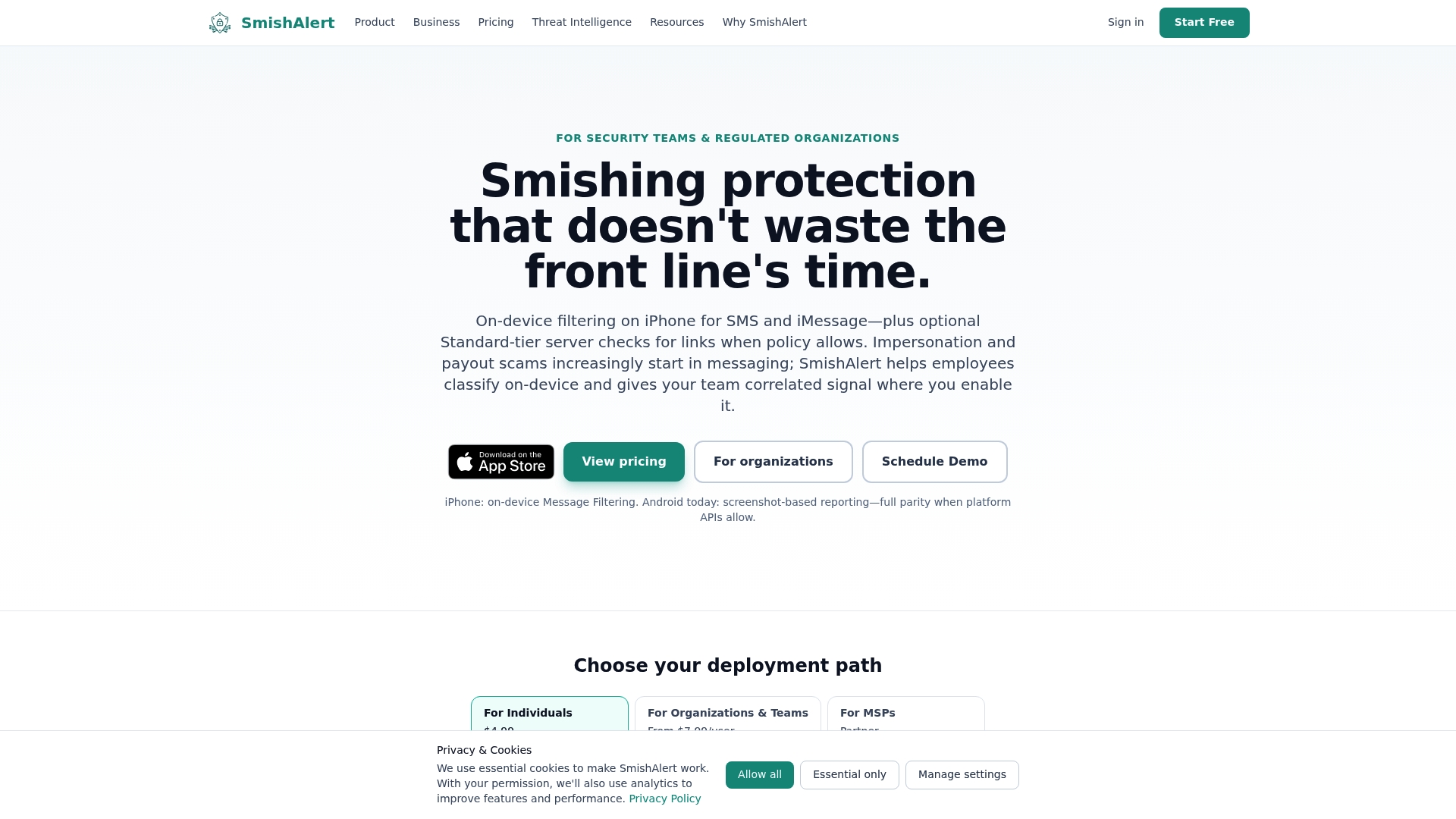
Smishalert’s platform covers the full scope of this checklist: on-device iOS message filtering, Android and cross-channel reporting, campaign correlation across SMS, iMessage, and WhatsApp, SIEM/API integration for alert ingestion, and audit-ready incident reporting for managed, BYOD, and executive devices. The solutions overview maps each capability to the attack types most commonly targeting executive cohorts, including impersonation, credential harvesting, and payroll fraud.
Two natural next steps for security leaders: run the 2-minute self-evaluation to assess your current executive messaging exposure, or start a 30-day paid pilot scoped to your executive cohort. The pilot fee applies toward the first annual subscription, so the assessment itself carries no sunk cost. Contact the Smishalert team to scope a pilot sized for your executive group and high-risk support staff.
Useful sources for executive smishing defense
The resources below are the primary references used in this article, selected for authority and practical applicability to executive security programs.
| Source | Why It Matters |
|---|---|
| FCC: Avoid the Temptation of Smishing Scams | Primary U.S. regulatory guidance on smishing; covers reporting steps and consumer protections |
| FBI Internet Crime Complaint Center (IC3) | Official channel for reporting smishing incidents; accepts complaints from organizations |
| CISA | Federal cybersecurity guidance including mobile threat advisories and incident response resources |
| Canadian Centre for Cyber Security: ITSAP | Detailed smishing defense guidance including phishing-resistant MFA recommendations |
| Adaptive Security: Executive Impersonation Attacks | Practitioner-level playbook for detecting and stopping executive impersonation via AI-assisted attacks |
| Smishalert: Mobile Messaging Security Checklist for IT Teams | Operational checklist for IT teams securing messaging on corporate and BYOD devices |
| Smishalert: BYOD Smishing Protection | Practical steps for protecting executive BYOD devices from smishing and overlay attacks |
| Smishalert: Enterprise Smishing Best Practices | Deeper checklist and playbook for enterprise security teams building a full program |
| Smishalert Threat Intelligence | Live campaign examples and correlation data for security teams tracking active smishing threats |
| NACD: Personal Cybersecurity Protection Guide for Corporate Directors | Board-level cybersecurity guidance covering personal device hygiene for corporate directors |