
The Most Common SMS Log Analysis Gaps and How to Fix Them

Most enterprises miss six critical gaps in SMS and messaging-log analysis: missing sender verification fields, absent URL resolution snapshots, no device or app context, rule-only detection, inconsistent carrier routing checkpoints, and sparse user reporting with short retention windows. Fix these by adding enriched metadata at ingestion, capturing resolved URL snapshots on receipt, integrating SSO and MFA telemetry into a correlation engine, and deploying a structured reporting flow for employees.
Immediate operational next steps:
- Add
resolved_url_snapshotandurl_domain_agefields to your SMS log schema today. - Deploy a one-click reporting mechanism for employees on both managed and BYOD devices.
- Ingest SSO and MFA authentication logs into the same SIEM pipeline that receives messaging events.
Pro Tip: Track two metrics before anything else: employee reporting rate (what percentage of suspected smishing messages get submitted) and time-to-detect (how long between message delivery and analyst triage). Both are leading indicators of program health and are easy to present to executive stakeholders.
Key Takeaways
The single most important action for U.S. enterprise security leaders is to establish a reporting rate and time-to-detect baseline before investing in detection automation, because you cannot tune what you cannot measure.
| Point | Details |
|---|---|
| Capture resolved URL snapshots | Snapshot every submitted URL at receipt; domain rotation destroys evidence within hours. |
| Add a reporting flow immediately | Employee reporting rate is the leading indicator of SMS program health and costs little to deploy. |
| Ingest SSO and MFA logs | Joining authentication events with messaging logs is the minimum viable correlation layer. |
| Pilot on high-risk roles first | Targeting executives, payroll, or HR produces measurable gains within 30 days. |
| Smishalert operationalizes these fixes | Smishalert provides on-device reporting, URL resolution, campaign correlation, and SIEM integration across SMS, iMessage, and WhatsApp. |
Table of Contents
- Why SMS log analysis differs from email security
- What data and metadata fields are missing from your SMS logs
- What telemetry and correlation signals your team is probably missing
- Why rule-based SMS detection fails and what to use instead
- Operational and privacy gaps that break detection even when logs exist
- How to prioritize fixes: quick wins first, then correlation, then automation
- What a recommended SMS detection architecture looks like
- Smishalert closes the gaps this guide describes
- The gap that matters most is the one you haven’t measured yet
- Sources
Why SMS log analysis differs from email security
Email-focused scanning and authentication controls — SPF, DKIM, and DMARC — do not catch SMS-delivered threats. SMS arrives as a phone number or display name, bypasses email gateways entirely, and carries none of the header metadata that email defenses rely on. That structural difference is why organizations with mature email security programs still have near-zero visibility into smishing.
The technical gaps compound quickly. SMS routing in the U.S. travels through aggregators and grey routes, producing inconsistent carrier checkpoints and no standardized verified-sender scheme comparable to STIR/SHAKEN for voice or DMARC for email. Academic research on smishing mitigation notes that U.S. carrier infrastructure lacks the uniform inspection points that would allow back-end filtering to catch threats reliably.
The cognitive and UX layer makes it worse:
- Small screens eliminate the hover-to-preview URL behavior that desktop users rely on.
- iOS and Android render sender identity differently, creating inconsistent visual trust signals.
- Immediate-response bias is higher on mobile; a controlled study found approximately 16.9% of participants responded to fake smishing messages, with reward-themed templates producing notably higher response rates.
- Researchers propose haptic or context-aware in-app warnings to interrupt impulsive taps, a mitigation with no email analog.
Operationally, BYOD devices sit entirely outside the enterprise logging stack. Enterprise smishing defense guidance consistently identifies on-device reporting or secure submission as the only practical path to visibility on personal devices. Without it, the majority of smishing events targeting employees never reach the SOC.
What data and metadata fields are missing from your SMS logs
The most critical missing categories are sender verification, resolved URL snapshots, message origination path, and timestamp-plus-interaction metadata. Most SMS log schemas capture only the raw message text and a timestamp, leaving analysts without the fields needed to triage, correlate, or preserve evidence.
| Log Field | Why It Matters |
|---|---|
sender_display |
Captures spoofed display names used in executive impersonation |
sender_number |
Enables cross-campaign correlation and roster matching |
sender_short_code_flag |
Distinguishes A2P traffic from P2P; short codes have different abuse patterns |
carrier_gateway_id |
Identifies routing path anomalies and grey-route indicators |
routing_path |
Surfaces aggregator hops that obscure true sender origin |
raw_message_text |
Required for keyword, behavioral, and LLM-assisted triage |
resolved_url_snapshot |
Captures destination before link rot or domain rotation removes evidence |
url_final_destination |
Reveals redirect chains and cloaking behavior |
url_http_status |
Flags live vs. parked pages at time of delivery |
url_domain_age |
Newly registered domains are a strong smishing indicator |
device_id |
Ties message events to endpoint telemetry for correlation |
device_os |
Informs OS-specific UI risk and MDM coverage gaps |
app_context |
Distinguishes SMS, iMessage, WhatsApp, and other channels |
message_received_ts |
Anchors the event timeline for incident reconstruction |
message_interaction_ts |
Captures whether and when the user tapped a link |
user_report_flag |
Marks analyst-submitted events and feeds reporting-rate metrics |
A minimal viable log entry should include at least sender_number, raw_message_text, resolved_url_snapshot, url_domain_age, device_id, message_received_ts, and user_report_flag. SOC teams mapping vendor fields to this schema will often find that SMS blaster campaigns rotate domains fast enough that a snapshot taken at delivery is the only reliable evidence of the original destination.
What telemetry and correlation signals your team is probably missing
Without device and authentication telemetry, you cannot reliably escalate a suspicious SMS event into a confirmed incident. The message log alone tells you a link was delivered; it cannot tell you whether a credential was used.
The telemetry sources that close this gap:
- SSO and IAM logs — login events, session tokens, and authentication timestamps.
- MFA event logs — push approvals, denials, and fatigue patterns.
- EDR/endpoint telemetry — process launches, browser navigations, and file writes following a message interaction.
- Mobile app events — in-app navigation and credential-entry signals where MDM or on-device agents permit collection.
- DNS and URL resolution logs — query records that confirm whether a device resolved a smishing domain.
- URL sandbox verdicts — detonation results from services like any.run or VirusTotal for submitted URLs.
- Threat-intel feed mappings — domain and IP reputation enrichment tied to known smishing infrastructure.
The most common operational gap is that SSO logs exist but are siloed from messaging events. Analysts see an MFA anomaly and a suspicious SMS in separate consoles with no automated join. Rule-based detection alone cannot bridge this gap because the correlation requires temporal and behavioral logic across systems.
Pro Tip: A minimal high-signal correlation rule: flag any sequence where an SMS link click event is followed within 10 minutes by an MFA push denial and a new-IP SSO login. That three-event chain has a very low false-positive rate and catches credential-harvesting attempts before lateral movement begins.
Why rule-based SMS detection fails and what to use instead
Static keyword and blacklist engines miss modern smishing because attackers use URL shorteners, rapid domain rotation, and conversational lures that contain no flagged terms. Research on rule-based detection limitations confirms this brittleness and recommends shifting toward behavioral correlation tied to endpoint signals.
Detection improvements to prioritize:
- URL resolution and sandboxing — resolve every URL at delivery time, snapshot the destination, and submit to a sandbox. Domain rotation means a URL that is clean at scan time may redirect to a credential-harvesting page minutes later.
- Domain-age filtering — flag any URL whose registered domain is fewer than 30 days old. Smishing infrastructure is typically stood up within days of a campaign launch.
- Behavioral interaction models — correlate message receipt with subsequent authentication anomalies rather than scanning message content alone.
- LLM-assisted triage — where privacy policy permits, use language model classification to score conversational lures (gift card requests, payroll redirect asks) that carry no URLs and evade keyword filters.
- Reply-to-number roster matching — escalate any message where the reply-to number does not appear in the organization’s known-sender registry.
Ensemble ML models can achieve high accuracy in balanced lab datasets, but real-world class imbalance, evolving URL practices, and false-positive costs mean operational deployment requires correlation and tuning rather than plug-and-play models. Lab accuracy figures should not be used to justify skipping the tuning phase.
Pro Tip: Require two corroborating signals before automated blocking: a URL sandbox verdict plus at least one authentication anomaly. Single-signal blocks generate enough false positives to erode employee trust in the reporting program.
Operational and privacy gaps that break detection even when logs exist
Operational gaps — low reporting rates, inconsistent playbooks, and short retention — often nullify technical gains. A well-instrumented logging pipeline produces no value if analysts lack a playbook for what to do with a confirmed smishing event, or if evidence is purged before an investigation can begin.
Quick wins (0–30 days):
- Publish a one-page SMS incident playbook covering triage steps, evidence preservation, and escalation criteria.
- Deploy a reporting form or button accessible from both managed and BYOD devices.
- Set a 90-day retention policy for messages flagged by users or automated rules.
Medium-term (1–6 months):
- Integrate MDM or on-device reporting agents for executive and high-risk role devices.
- Coordinate with HR and Legal on BYOD inspection scope before any evidence collection.
- Run tabletop exercises that include an SMS-delivered credential-harvesting scenario.
Common pitfalls to avoid:
- Collecting full message content from personal devices without a documented legal basis and employee notice.
- Treating SMS incidents as low-priority email-phishing variants in the ticketing system, which misroutes them to teams without mobile context.
- Failing to preserve the
resolved_url_snapshotbefore closing a ticket; domain rotation means the evidence disappears within hours. - Skipping BYOD-friendly deployment options in favor of waiting for full MDM rollout, which delays visibility by months.
How to prioritize fixes: quick wins first, then correlation, then automation
Visibility comes before correlation, and correlation comes before automation. Investing in ML-based detection before you have consistent log coverage produces models trained on incomplete data.
0–30 days:
- Update the incident playbook to include SMS-specific triage steps.
- Add
resolved_url_snapshotandurl_domain_ageto the log schema. - Deploy a reporting flow and begin tracking the employee reporting rate.
- Map which roles (executives, payroll, HR) receive the highest SMS volume.
1–6 months:
- Integrate URL resolution and sandboxing into the enrichment pipeline.
- Ingest SSO and MFA logs into the SIEM alongside messaging events.
- Pilot cross-channel correlation rules on the high-risk role population identified in month one.
6–18 months:
- Pursue carrier-level integrations and verified-sender program enrollment where available.
- Standardize telemetry schema across SMS, iMessage, WhatsApp, and other messaging channels.
- Evaluate LLM-assisted triage for linkless social-engineering lures.
Metrics to track throughout:
- Reporting rate — percentage of suspected smishing messages submitted by employees.
- Time-to-detect — interval between message delivery and analyst triage.
- False-positive rate — percentage of escalated events that clear investigation.
- Correlated-event rate — percentage of smishing events with at least one linked authentication anomaly.
What a recommended SMS detection architecture looks like
An effective architecture combines four layers: message intake and enrichment, URL resolution and sandboxing, a correlation engine that joins messaging events with authentication and endpoint signals, and SIEM or SOAR workflows for response.
Architecture components:
- Message intake — on-device reporting (iOS message filtering, Android reporting app) plus admin submission for forwarded messages.
- Enrichment pipeline — carrier gateway flags, resolved URL snapshots, domain-age lookups, and sender reputation scoring.
- Correlation layer — joins
message_received_tsanduser_report_flagwith SSO login events, MFA push logs, and EDR process telemetry. - Automated triage and analyst UI — scores events by severity, surfaces corroborating signals, and routes to the appropriate playbook.
- SIEM and SOAR integration — exports enriched incidents to Splunk, Microsoft Sentinel, or equivalent for case management and audit reporting.
- Audit reports — preserves chain-of-custody evidence for compliance and legal review.
Implementation tips: store message hashes rather than full content where privacy policy requires it; snapshot URLs at receipt rather than at investigation time; apply TTLs to personal-device data that does not meet the threshold for preservation; and stage integrations starting with SSO logs and URL sandboxing before adding EDR telemetry.
Contextual phishing warnings at the device layer — haptic alerts, in-app banners — complement back-end enrichment by reducing the window between delivery and user interaction. The SMS verification constraints that limit sender authentication at the carrier level make device-layer signals especially important for organizations that cannot rely on network-side filtering alone.
Pro Tip: Pilot the architecture on one high-risk population — executives, payroll staff, or HR — before broad rollout. A focused pilot produces measurable reporting-rate and time-to-detect improvements within 30 days, giving you concrete data to justify wider investment.
Smishalert closes the gaps this guide describes
Closing SMS log analysis gaps requires a platform purpose-built for messaging-based social engineering, not an email security tool extended to cover mobile. Smishalert centralizes message reporting across SMS, iMessage, and WhatsApp; resolves and snapshots URLs at submission time; and correlates messaging events with SSO and EDR telemetry to surface the multi-signal patterns that matter. The result is audit-ready incident reports that security teams can act on and present to compliance stakeholders without manual reconstruction.
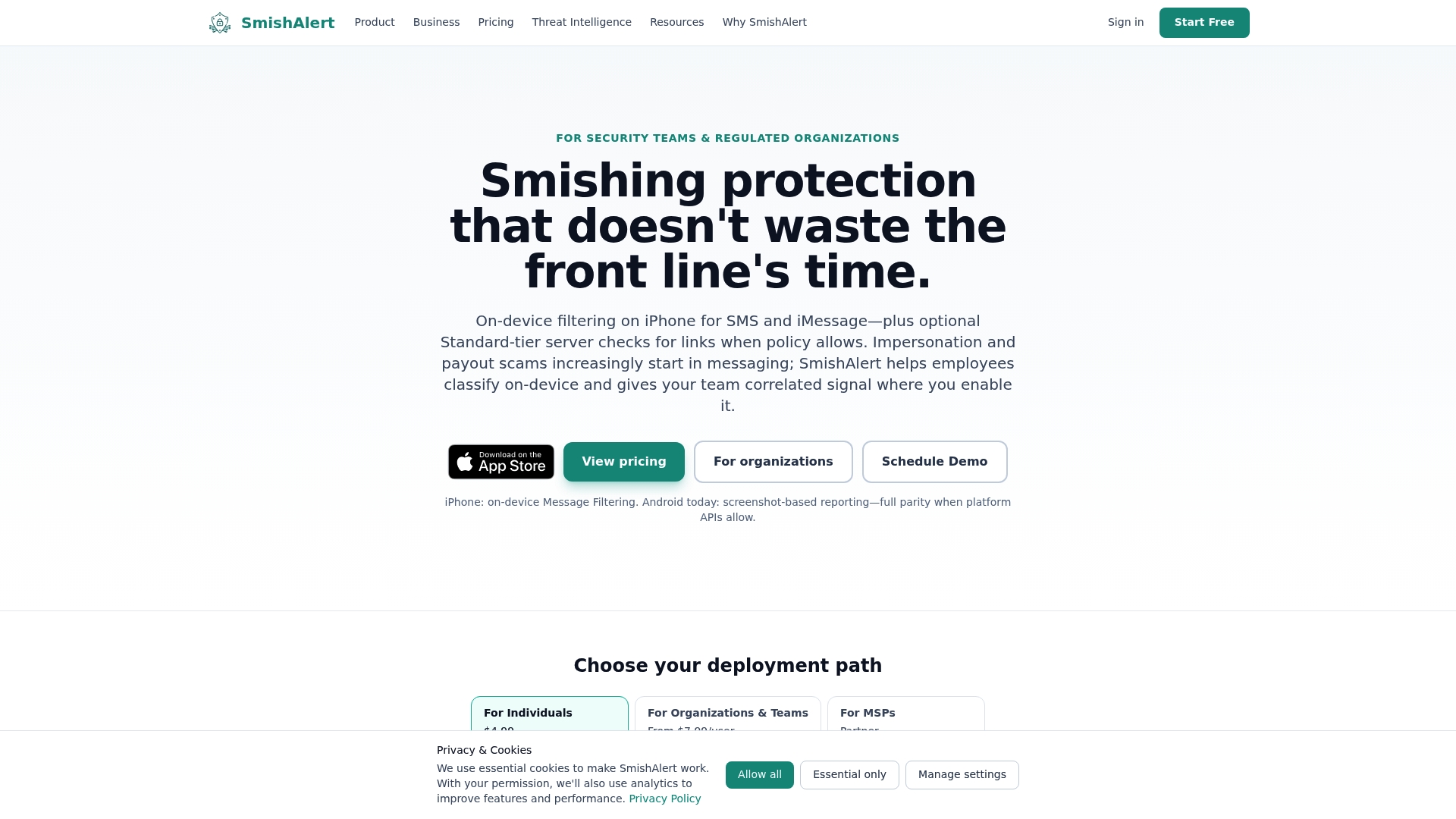
For BYOD environments, Smishalert’s mobile phishing protection without MDM approach gives organizations visibility on personal devices without requiring full device enrollment. Campaign correlation surfaces coordinated attacks — including the executive impersonation and SMS blaster campaigns that evade rule-based detection — and maps them to the log fields and telemetry schema described in this guide. SIEM and API integrations mean enriched events flow directly into existing SOC workflows.
Take the 2-minute SMS readiness self-eval to baseline your current coverage against the gaps above, or review the full Smishalert solutions page to see how each product capability maps to the detection and operational gaps your team needs to close.
The gap that matters most is the one you haven’t measured yet
Most security teams underestimate SMS exposure not because they lack the technical capability to close these gaps, but because they have never measured their current state. No reporting rate. No time-to-detect baseline. No schema audit. Without those numbers, it is nearly impossible to build a business case for investment or to demonstrate improvement after a fix.
The pragmatic path is to start with the two metrics that cost nothing to add: reporting rate and time-to-detect. Both are visible within weeks of deploying a reporting flow, and both translate directly into executive-level risk language. Organizations that run a focused pilot on a single high-risk population — executives, payroll, HR — consistently find that the data from that pilot is sufficient to justify broader program investment. Start there, measure it, and the rest of the roadmap becomes a sequencing problem rather than a budget argument.
Sources
- Smishing in Cybersecurity: Spot and Stop SMS Scams - N-able
- Mitigating Smishing: Challenges and Future Work
- Smishing attack landscape and user susceptibility (systematic survey and experiments)
- Rule-based smishing detection limitations and need for behavioral correlation