
Common Smishing Detection Rule Failures: A Systems Guide

Most smishing detection rules fail for operational reasons, not accuracy problems: blacklist evasion via shorteners, URL obfuscation, character-level perturbations, sender ID and SIM-based spoofing, latency mismatches between device and cloud models, and stale rules that never get retrained against new campaigns. The common thread across nearly every one of these common smishing detection rule failures is architecture and process, not a weak classifier.
Security teams can act on this within days, not quarters. The immediate fixes matter more than a model swap.
- Canonicalize every URL before matching against reputation lists, including full shortener expansion and path normalization.
- Deny unverified links by default rather than allowing anything not explicitly flagged malicious.
- Sample your last 90 days of alerts for adversarial variants (homoglyphs, line breaks, punctuation injection) and measure how many slip through.
- Enforce a hard update cadence for keyword lists and model weights, no less than monthly.
- Pilot an on-device check for latency-sensitive detection paths before committing to a cloud-only architecture.
Research backing this: adversarial training cut attack success rates roughly in half in controlled experiments, multi-tier device/edge/cloud architecture guidance from financial IoT smishing research explains why single-tier detection buckles under real-world constraints, and platforms like SmishAlert exist specifically to close the visibility gap these failures create.
Key Takeaways
Smishing detection rules fail primarily because of architecture, testing gaps, and update cadence, not because the underlying models are inaccurate.
| Point | Details |
|---|---|
| Canonicalize and verify URLs | Expand every shortener and check reputation against a time-windowed list, not a static one. |
| Run adversarial replay tests | Test against homoglyphs, line breaks, and URL variants monthly to catch bypasses before attackers do. |
| Pilot multi-tier detection | Combine on-device, edge, and cloud checks to balance latency, privacy, and robustness. |
| Set telemetry-based rollback SLOs | Define a false-positive threshold that automatically triggers rule reversion within hours. |
| Validate with a structured pilot | SmishAlert’s 30-day assessment measures detection coverage and false-positive impact before full rollout. |
Table of Contents
- What Are the Most Common Smishing Detection Rule Failures?
- Why Do Smishing Detection Rules Fail in Production?
- How Should You Test Smishing Detection Rules Before Deployment?
- Which Design Patterns Actually Prevent These Failures?
- How Do You Roll Out and Maintain Detection Rules Safely?
- How Does SmishAlert Address These Failure Modes?
- How Do You Handle Zero-Day Smishing Techniques Rules Haven’t Seen Yet?
- What Integration Challenges Come With Adding Smishing Detection to Existing Infrastructure?
- How Do User Education and Feedback Loops Strengthen Automated Detection?
- Why Do Cross-Channel Tactics Break Single-Channel Detection Rules?
- Treating Smishing Detection as an Engineering Discipline
- Close the Gaps With a Structured SmishAlert Pilot
- Sources
What Are the Most Common Smishing Detection Rule Failures?
Rule failures rarely announce themselves. They show up as a quiet increase in reported incidents weeks after a rule “passed” testing.
Blacklist and reputation lookups fail first, and they fail predictably. Attackers register a fresh domain, run it through a shortener, and burn it within hours. By the time your reputation feed catches up, the campaign has moved to a new link. Rule-based frameworks that rely on static lists consistently underperform against this churn because the list is always a step behind the domain.
Content heuristics and keyword rules get bypassed by phrasing, not just vocabulary. A rule tuned to catch “verify your account” gets rewritten as “confirm you received this” and sails through untouched. Attackers testing against consumer anti-smishing apps learn exactly which phrases trip filters and route around them within days.
Structural and character perturbations break naive tokenizers. Inserting a zero-width space mid-word, swapping a Latin “a” for a Cyrillic look-alike, or breaking a sentence across unexpected line breaks can defeat a rule that was never tested against those inputs. These aren’t exotic attacks. They show up in commodity smishing kits sold on underground forums.
Sender ID and SIM-based evasion exploit carrier blind spots directly. Attackers increasingly test payloads using regular consumer SIMs instead of registered A2P short codes, sidestepping the sender verification checks carriers rely on. Protocol loopholes in SIM registration and RCS give attackers a structural advantage that no keyword rule can close.
Overly tight rules erode trust faster than loose ones erode security. When legitimate messages get flagged repeatedly, users start overriding warnings or disabling the filter entirely. Field testing shows this trust decay happens quickly once false positives cross a threshold users notice.
Consider a synthetic example: a rule flags any message containing “gift card” plus a shortened URL. An attacker sends “your reward is ready, tap here to claim” with a full unshortened redirect chain. Zero keyword matches, zero shortener flags. The rule passes it straight through.
The gap between a rule that works in a lab and a rule that works against a live attacker isn’t model quality. It’s how fast the attacker can iterate against your blind spots.
Pro Tip: Triage new alert types by asking whether the bypass required a new technique or just a phrasing tweak. Phrasing tweaks mean your rule is too narrow; new techniques mean your architecture has a gap.
Why Do Smishing Detection Rules Fail in Production?
Treating this as a pure machine-learning accuracy problem misses most of what actually breaks. The real causes sit in engineering trade-offs and organizational habits.
Device, edge, and cloud each impose different constraints, and most teams pick one tier and hope. On-device models must stay small enough to avoid draining battery or memory, which forces lighter-weight, less contextual detection logic. Cloud models can run heavier transformers but add latency that lets a malicious link get clicked before a verdict returns. The financial IoT smishing research roadmap argues explicitly that no single tier can satisfy latency, robustness, and privacy simultaneously, which is why multi-tier designs keep surfacing as the answer.
Organizational gaps compound the architecture problem. Rule ownership often sits with whoever built the original ruleset years ago, with no standing process for adversarial testing or update review. Telemetry policy frequently lags behind what detection actually needs, especially in BYOD environments where privacy constraints limit what can be logged.
Technical debt accumulates quietly. Tokenization logic written for plain ASCII text chokes on homoglyphs. URL normalization gets patched piecemeal, one shortener at a time, until nobody can explain the full logic path. Layered rules from different eras interact unpredictably, producing false negatives nobody can trace back to a root cause.
Dataset provenance drives concept drift. A model trained on last year’s campaigns overfits to patterns attackers have already abandoned.
| Assurance Metric | What It Measures | Failure Mode It Drives |
|---|---|---|
| Asymmetric error cost | Cost of a missed threat vs. a false alarm | Rules tuned for low false positives miss high-severity threats |
| Recovery latency | Time to detect and roll back a bad rule | Slow recovery lets a broken rule run for days |
| Energy cost | Battery/CPU drain from on-device checks | Heavy models get disabled by users or MDM policy |
| User friction | Frequency of unnecessary warnings | High friction leads to override and disabled protection |
Pro Tip: Assign a single named owner for rule rollback decisions and set a lightweight service-level objective, such as “any rule causing a 2x spike in false positives gets reverted within four hours.” Without an owner, rollback decisions stall during the exact window when damage compounds.
How Should You Test Smishing Detection Rules Before Deployment?
The core tests that expose common smishing detection rule failures are adversarial perturbation tests, URL-variation replay, shortener expansion checks, and sender-number rotation tests. Skipping any one of these leaves a specific evasion path completely unvalidated.
Build the testing program in this order:
- Construct a replay harness that feeds historical smishing messages back through the rule engine with controlled variations.
- Generate synthetic variants covering homoglyphs, line-break injection, and punctuation manipulation, per the perturbation categories documented in rule-based framework research.
- Run red-team exercises where a dedicated tester actively tries to craft messages that bypass current rules, not just confirm known detections.
- Compare on-device versus cloud regression suites separately, since a fix validated in one tier may not carry over to the other.
- Snapshot test datasets by time period to catch concept drift before it shows up as a live incident.
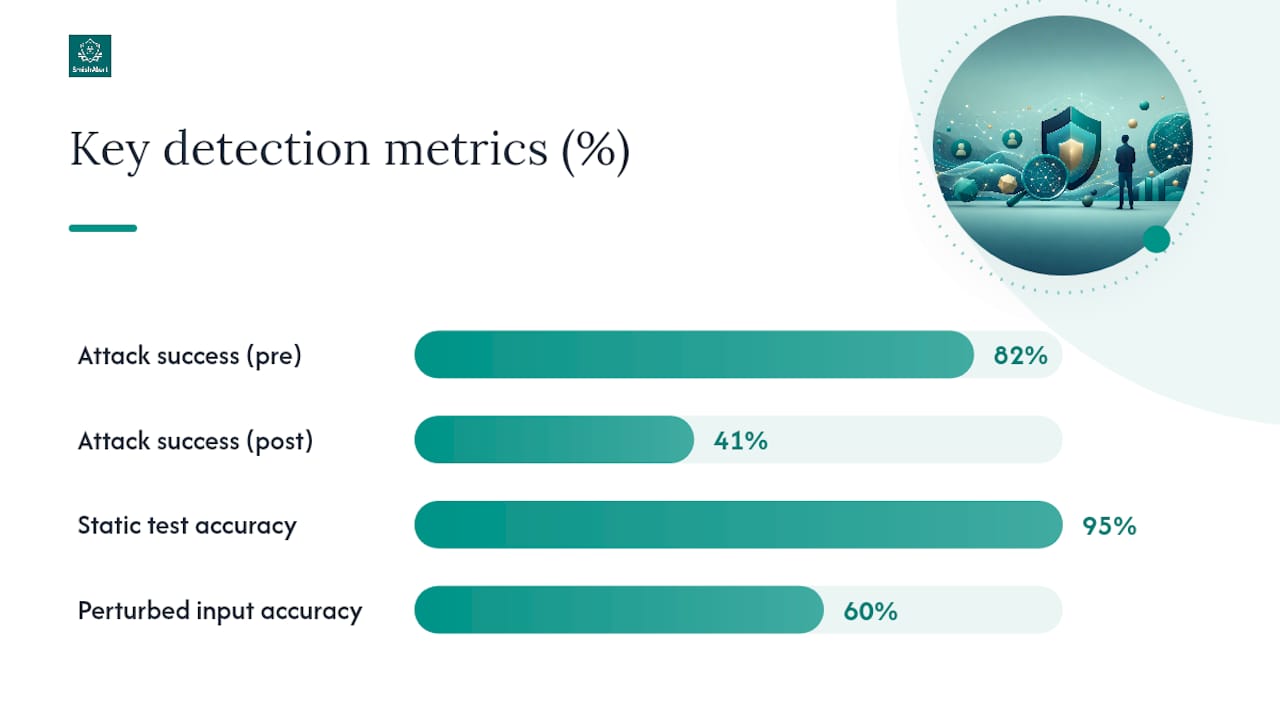
Track five metrics consistently: false positive rate, false negative rate, attack success rate, detection latency, and user override rate. Attack success rate is the metric most teams skip, and it’s the one that most directly answers whether your rules survive contact with a motivated attacker. Adversarial retraining experiments show attack success rate dropping from roughly 0.82 to roughly 0.41 after retraining with adversarial examples, a meaningful improvement that still leaves substantial residual risk.
Build test datasets from real-world message variants, not just synthetic ones. Real campaigns generate high-velocity variants of the same base message, swapping URLs and rewording slightly, which means your test set needs breadth across time as much as volume at a single point.
When running adversarial evaluation tools, measure the robustness degradation ratio, the gap between clean-dataset accuracy and adversarial-input accuracy. A rule scoring 95% on a static test set and 60% against perturbed inputs looks fine on a dashboard and fails badly in production.
Which Design Patterns Actually Prevent These Failures?
Multi-tier detection combined with Zero Trust URL verification is the most resilient pattern available, because it distributes the failure modes described above across layers instead of concentrating them in one point of weakness.
| Pattern | Latency | Privacy | Robustness | Update Speed |
|---|---|---|---|---|
| Lightweight on-device heuristics | Very low | High | Low | Slow (app update cycle) |
| Edge-based contextual models | Low to moderate | Moderate | Moderate | Moderate |
| Cloud transformers with delayed verdicts | Higher | Lower | High | Fast |
Each tier catches what the others miss. On-device heuristics block the obvious cases instantly without sending data off the device. Edge models add context without the full round trip to cloud infrastructure. Cloud transformers catch subtle, novel patterns but arrive too late to stop the first click, so they work best as a follow-up verdict that flags a sender for future messages.
Adversarial training closes real gaps but has limits worth knowing before you invest. Retraining with adversarial message sets measurably reduces attack success rate, but no experiment in the current research shows it eliminating evasion risk entirely. Plan for retraining cycles using dataset sizes large enough to cover multiple perturbation categories, not just one attack style.
URL handling deserves its own layer. Canonicalize every link, expand every shortener, and check reputation against a time-windowed blocklist rather than a static one. For unresolved or newly registered domains, quarantine the message rather than blocking or allowing it outright. A fail-safe of “warn and hold” preserves user trust better than an outright block that turns out wrong.
Pro Tip: Set your false-positive tolerance before deployment, not after complaints start. A rule that catches 99% of threats but flags 5% of legitimate messages will get disabled by users faster than a rule catching 92% with a 0.5% false-positive rate.
How Do You Roll Out and Maintain Detection Rules Safely?
A disciplined rollout paired with telemetry gating and a rollback SLO prevents most production failures before they reach users at scale.
- Define pilot criteria before writing a single new rule: sample size, expected detection rate, acceptable false-positive ceiling.
- Run a canary rollout to a small user segment, typically 5 to 10 percent, before wider deployment.
- Gate expansion on telemetry, not on a calendar date. If override rate spikes, hold the rollout.
- Define escalation paths so a spike in missed threats reaches a named owner within a set window.
- Set rollback criteria in advance: a specific false-positive or false-negative threshold that automatically triggers reversion.
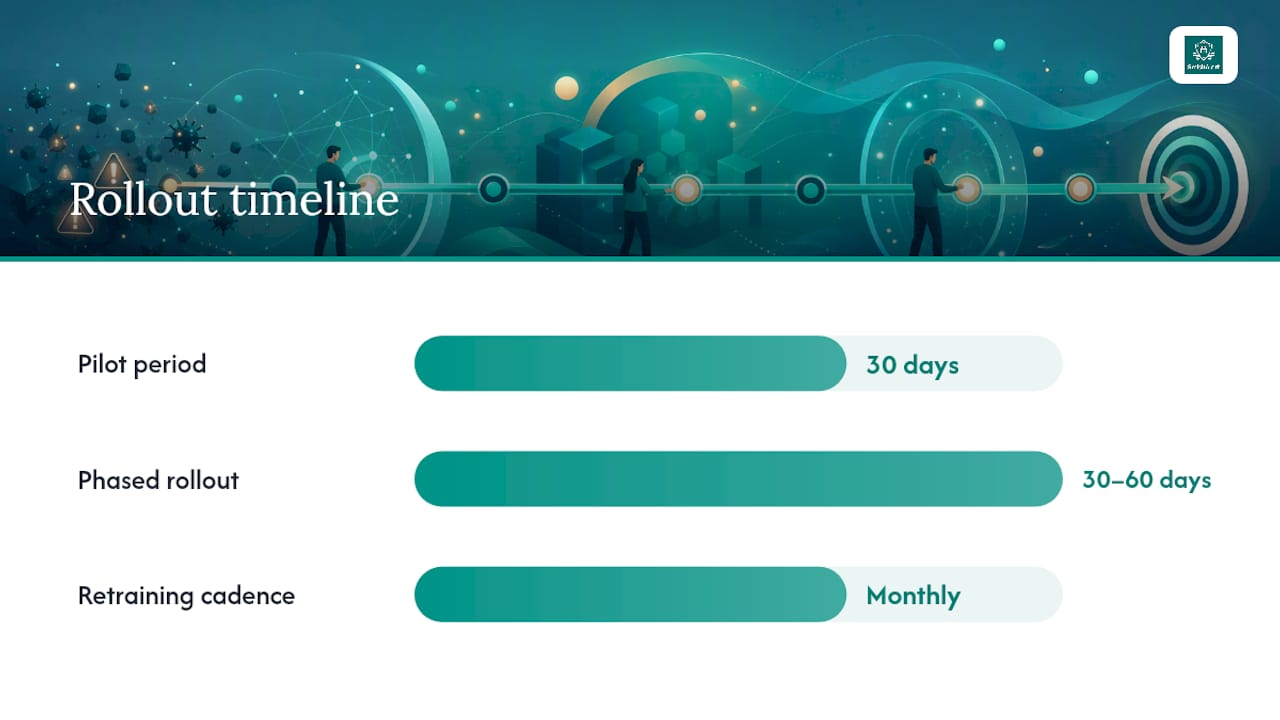
A realistic timeline runs 30 days for pilot, another 30 to 60 for phased rollout, and ongoing monthly retraining after that. Budget for telemetry storage and retraining compute as recurring costs, not one-time setup.
Monitoring dashboards should track attack success rate over time, spikes in user override behavior, and any drop in detection latency that suggests a tier is falling behind. Feed alerts into your existing SIEM so smishing signals sit alongside other incident data rather than in an isolated dashboard nobody checks daily.
For BYOD environments, privacy constraints shape what telemetry you can collect. Guidance on deploying protection across BYOD devices covers the specific trade-offs between visibility and device ownership.
A practical 30-day pilot should target a defined sample of flagged messages, track false-positive and false-negative rates weekly, and set a clear bar: no more than a small single-digit percentage of legitimate messages flagged before expanding beyond canary.
Pro Tip: Alert fatigue kills rollout discipline as fast as bad rules do. If your SOC team starts ignoring smishing alerts because volume is too high, the rollout has already failed regardless of what the detection metrics say. Alert fatigue’s operational cost compounds quickly once a team starts triaging by gut feel instead of process.
How Does SmishAlert Address These Failure Modes?
SmishAlert’s architecture maps directly onto the mitigations described above, addressing gaps that static rule engines and carrier-level filtering consistently miss.
- On-device iOS message filtering closes the latency gap that pure cloud detection can’t, catching threats before a click happens rather than after.
- Cross-channel reporting extends coverage beyond SMS into iMessage and WhatsApp, closing the visibility gap carriers can’t see into.
- Campaign correlation helps distinguish a one-off phishing attempt from a coordinated campaign hitting multiple employees, which static per-message rules can’t do alone.
- SIEM and API integration feeds smishing signals into existing security infrastructure instead of creating an isolated alert silo.
For teams evaluating whether their current setup has these gaps, a structured pilot beats guesswork:
- Collect a baseline sample of reported and missed messages over 30 days.
- Define evaluation metrics upfront: false-positive rate, detection latency, and user override rate.
- Set success criteria before starting, such as a measurable drop in unreported incidents by pilot end.
- Compare pilot results against your pre-pilot incident volume, not against an industry benchmark that may not reflect your threat mix.
Pro Tip: Run the pilot against your highest-risk group first, typically finance or executive assistants with payment authority, rather than a broad low-risk sample. Failure modes show up faster where attackers already concentrate effort.
Review live campaign patterns through SmishAlert’s threat intelligence feed to calibrate what a realistic pilot sample should include.
How Do You Handle Zero-Day Smishing Techniques Rules Haven’t Seen Yet?
No rule catches an attack pattern it has never encountered, which is precisely why static blacklists and keyword filters degrade so quickly against new campaigns. Novel scam patterns can drop keyword-only filter accuracy to roughly 38.6%, a collapse that happens fast once attackers shift phrasing or targets.
The practical answer is layering behavioral and contextual signals on top of keyword rules rather than relying on either alone. A message from a never-before-seen sender requesting urgent payment action, paired with a newly registered domain, triggers suspicion even with zero keyword matches. Contextual models trained on message structure and metadata, not just vocabulary, catch a wider slice of genuinely new attacks.
Retraining cadence matters more here than anywhere else in the system. A model that goes three months without retraining against new campaign data will miss techniques that were common knowledge among attackers weeks earlier. Treat retraining frequency as a security control, not a maintenance chore.
What Integration Challenges Come With Adding Smishing Detection to Existing Infrastructure?
Smishing detection rarely slots cleanly into infrastructure built around email security and network perimeter tools, because mobile messaging traffic doesn’t pass through the same chokepoints.
Legacy email gateways and network firewalls have no visibility into SMS, iMessage, or WhatsApp traffic at all. Traditional security tools consistently miss this channel because they were never architected to see it. That forces a separate ingestion path into the SIEM, which means mapping smishing alerts into existing incident response workflows rather than assuming they’ll arrive in a familiar format.
MDM coverage adds another wrinkle. Managed devices offer more integration options, but BYOD devices, often a majority of an organization’s mobile fleet, require detection that works without full device management access. Carrier-level defenses don’t reliably fill this gap either; testing of US mobile carrier SMS defenses found that malicious URLs frequently reach users because carriers optimize for spam volume and billing fraud rather than phishing links specifically.
How Do User Education and Feedback Loops Strengthen Automated Detection?
Automated rules catch what they’re built to catch. Users catch everything else, provided they know what to report and have an easy way to do it.
A reporting mechanism that takes ten seconds gets used. One requiring a support ticket doesn’t. Every reported message that turns out to be a genuine miss should feed directly back into the retraining pipeline, closing the loop between human judgment and rule updates rather than leaving reports in a queue nobody reviews.
Training matters less than most security awareness programs assume. A single annual training module rarely changes behavior. Short, specific examples tied to recent real campaigns, delivered close to when an attack style is actually circulating, perform better than generic annual refreshers. The goal isn’t making every employee a detection expert. It’s making the report button the reflexive first move when something feels off.
Why Do Cross-Channel Tactics Break Single-Channel Detection Rules?
A rule built for SMS structure often has no idea what to do with an MMS attachment or a WhatsApp message containing an embedded link inside a forwarded thread.
Attackers exploit this directly by starting a conversation on one channel and pivoting to another mid-attack, sometimes moving a target from SMS to a messaging app specifically because they know detection coverage drops there. Generative content tools have made this pivot easier to execute at scale, letting attackers produce convincing, channel-appropriate follow-up messages automatically rather than reusing an obvious template. A rule that only watches SMS traffic misses the entire second half of that attack chain, and once credentials get harvested through that pivot, the escalation into browser-based credential theft happens fast.
Effective detection needs a consistent policy applied across every channel a message could arrive through, not a separate ruleset per app that drifts out of sync with the others.
Treating Smishing Detection as an Engineering Discipline
Accuracy metrics on a static test set tell you almost nothing about how a detection rule survives contact with a live attacker. That gap is the single most consistently underestimated risk in this field, and it explains why so many teams get blindsided by a bypass technique their dashboards never flagged as a risk.
The fix isn’t a better model. It’s operational discipline: fund adversarial testing as a recurring line item, not a one-time audit before launch. Invest in multi-tier architecture even when a single-tier model tests well, because that model will eventually meet an attacker who tests against it specifically. Build the telemetry and rollback infrastructure before you need it, not after a bad rule has already caused damage.
Security leaders who treat this as a systems-engineering problem, with pilots, metrics, and named ownership, consistently outperform teams still treating it as a model-tuning exercise.
Close the Gaps With a Structured SmishAlert Pilot
Reading about failure modes is useful. Watching your own environment fail or pass against them is what actually changes your risk posture. SmishAlert’s self-eval readiness check gives security teams a fast way to see where their current mobile messaging defenses stand against the exact failure classes covered above, in about two minutes.
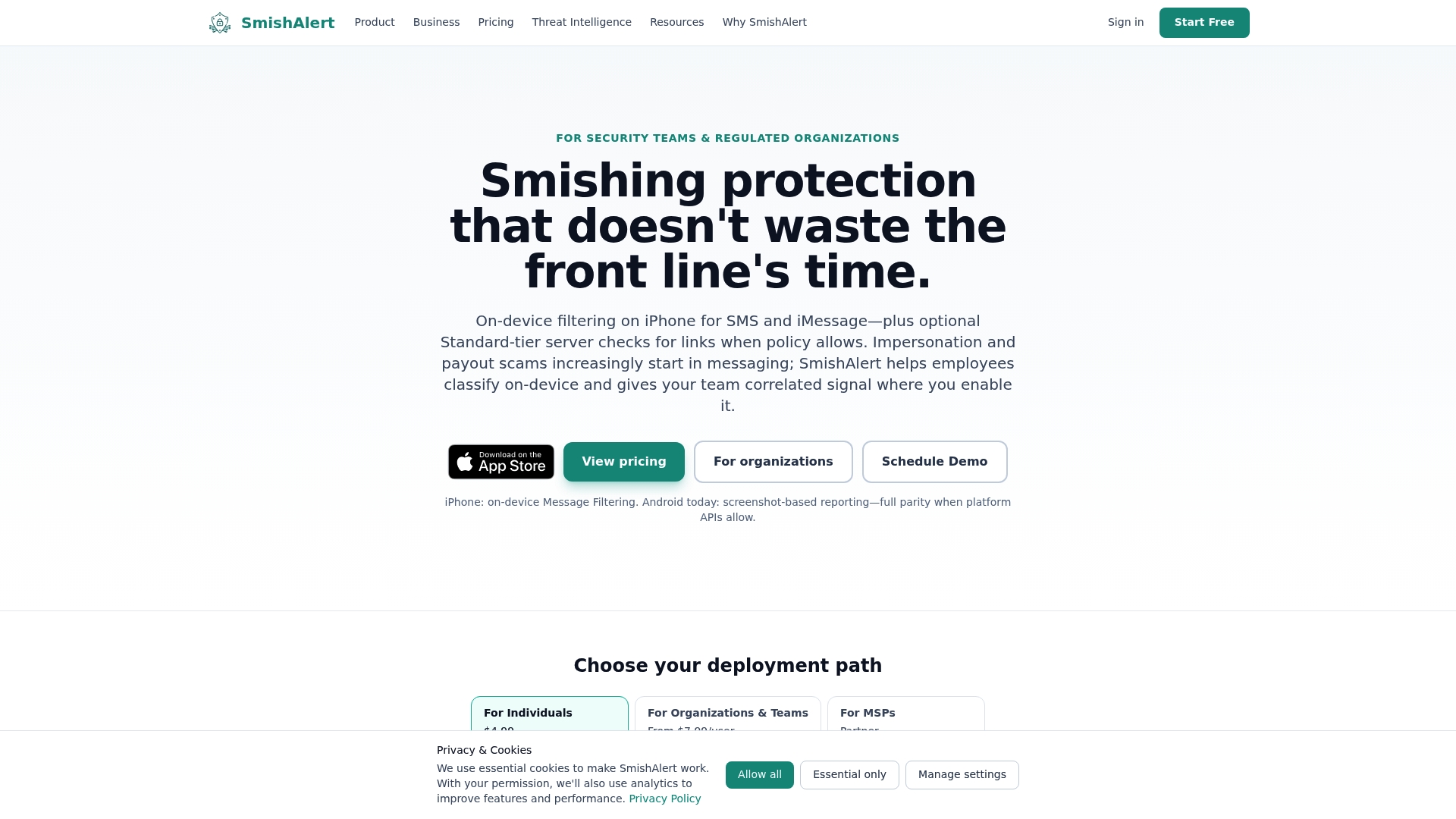
For teams ready to go deeper, SmishAlert offers a paid 30-day pilot that validates detection coverage against real campaign traffic, measures false-positive impact on your own user base, and produces operational telemetry your team can review before committing to a full deployment. The pilot fee credits toward your first annual subscription if you move forward, so the evaluation costs nothing extra in the long run. Deliverables typically include a coverage report, a false-positive breakdown, and recommended tuning before enterprise rollout. Start with the 30-day exposure assessment to get a defined timeline and success criteria in writing before your pilot begins.
Sources
- Financial IoT Smishing Detection: Challenges, Gaps, and Research Roadmap
- Investigating Evasive Techniques in SMS Spam Filtering: A Comparative Analysis of Machine Learning Models
- Rule-based framework for detection of smishing messages in mobile environment
Use these when designing your own adversarial test suite or setting pilot metrics. The methodology sections in each are more valuable than the headline findings for teams building their own replay harness.