
10 Second Check That Flags CEO Text Scams for Employees and SOCs

A CEO text scam is an SMS-based impersonation in which a criminal poses as a senior executive to pressure an employee into an urgent favor, typically a gift card purchase, a wire transfer, or a credential handover. If you receive one, do not reply or click any link. Verify the request through a phone number or email you already had on file before the message arrived. Gift card and wire fraud remain the two most common outcomes, with credential theft close behind.
TL;DR:
- Most CEO text scams use urgency and secrecy to pressure employees into bypassing normal verification processes for payments or credentials.
- Attackers often scrape organizational data to impersonate specific executives, making the fake requests more convincing and targeted.
- Employees should verify suspicious requests by calling the executive’s known contact number or email, not by replying or clicking links in the message.
- Implementing dual approval policies, external monitoring, and regular simulated exercises can significantly reduce the risk of successful impersonation scams.
- Messaging platform visibility tools that detect coordinated campaigns across channels are essential for early identification and response.
Table of Contents
- How the CEO Text Scam Actually Gets Staged
- Red Flags That Should Make You Stop and Verify
- What to Do the Moment You Get a Suspicious Text
- Building Organizational Defenses Against Executive Impersonation
- Why Messaging Visibility Changes the Response Timeline
- What Security Leaders Should Prioritize Next
- Get a Clear Picture of Your Messaging Risk
- Where to Report and Learn More
- Sources
- FAQ
How the CEO Text Scam Actually Gets Staged
The goal is almost always speed. Attackers want a decision made before anyone stops to check whether the “CEO” texting from an unfamiliar number is real. The boss text scam works because it borrows two things people rarely question at work: authority and urgency. A message that appears to come from a founder or finance director, arriving on a Friday afternoon with a tight deadline, short circuits the normal instinct to verify.
Attackers build the pitch using a small set of consistent tactics:
- Requests for Apple or Google Play gift cards, framed as a client gift or urgent personal favor
- Pressure for a same-day wire transfer or a change to a vendor’s payment details
- Fishing for login credentials or MFA codes under the guise of an IT or HR request
- A spoofed display name paired with a freshly registered number, sent over SMS, iMessage, or WhatsApp
- Escalation to a phone call or, increasingly, a voice-cloned message when the text alone doesn’t land
Targeting isn’t random. Attackers scrape LinkedIn profiles, org charts, press releases, and leaked databases to figure out who reports to whom, then match a plausible executive name to a plausible employee. A finance coordinator gets a text from “the CFO,” not from a rank-and-file manager, because the ask carries more weight coming from the top.
Red Flags That Should Make You Stop and Verify
Most CEO text scams share a handful of tells once you know what to look for. Here’s a quick scan you can run in ten seconds:
- The message pushes secrecy or urgency (“don’t tell anyone yet,” “need this before my flight”)
- It asks you to skip the normal approval chain for a payment or purchase
- The payment request involves gift cards, a personal account, or an unfamiliar payment method
- It comes from an unknown number, at an odd hour, with no prior context
- The tone or grammar doesn’t match how that executive actually writes
Pro Tip: Save your executives’ real numbers in your contacts under their full names. If a text claiming to be from “Mike, CEO” doesn’t match the contact card you already have, that mismatch alone is reason enough to stop and verify.
None of these signs alone proves fraud, but two or three together are a strong signal to pause. A real executive with a genuine emergency will not object to a callback.

What to Do the Moment You Get a Suspicious Text
Follow this order, every time:
- Do not reply, click any link, or buy anything. Replying can confirm your number is active and invite more attempts.
- Verify independently. Call the executive’s saved number, email them through your company directory, or ask a colleague who sits near them, using contact information you already had, not anything included in the text itself. This single step is the primary defense against executive impersonation that carrier advisories and consumer-protection groups consistently recommend.
- If it’s fraudulent, escalate immediately. Notify security or finance, preserve the message (screenshot, don’t delete), and forward the text to 7726, the short code most US carriers use for spam and phishing reports.
- If you clicked a link, treat it as a possible compromise: isolate the device, change your passwords, and confirm your multi-factor authentication hasn’t been altered.
The FBI’s Internet Crime Complaint Center also takes reports on impersonation fraud and publishes advisories tracking how these campaigns evolve. Filing a report there helps investigators connect your incident to a broader pattern, even when your own loss was small or narrowly avoided.
Building Organizational Defenses Against Executive Impersonation
Employee vigilance catches individual messages. Policy and controls stop the pattern. Security teams building resilience against CEO text scams tend to focus on five areas:
- Independent verification policy. Require a callback to a saved number before acting on any payment request that arrives by text, plus dual approval for anything above a set dollar threshold.
- Payment process controls. Separate the person who requests a payment from the person who approves it, and require a documented, verified process before any vendor bank-account change goes through.
- Simulated smishing exercises. Run periodic test campaigns targeting finance and HR staff specifically, since they’re the most frequently impersonated targets.
- External monitoring. Watch for lookalike executive profiles, spoofed numbers, and leaked contact details circulating outside the company’s own systems.
- Clear reporting flows. Give employees a BYOD-safe way to report a suspicious text without needing to hand over their personal device.
No single control stops executive impersonation on its own. Combining verification rules with external monitoring for lookalike accounts and exposed executive data catches both the fabricated identity and the case where a real account or number has actually been compromised.
Training vendors like Ventis Consulting offer structured frameworks for building these simulations if your organization hasn’t run one before. The point isn’t to catch employees making mistakes. It’s to find out where your verification policy breaks down before an attacker does.
Why Messaging Visibility Changes the Response Timeline
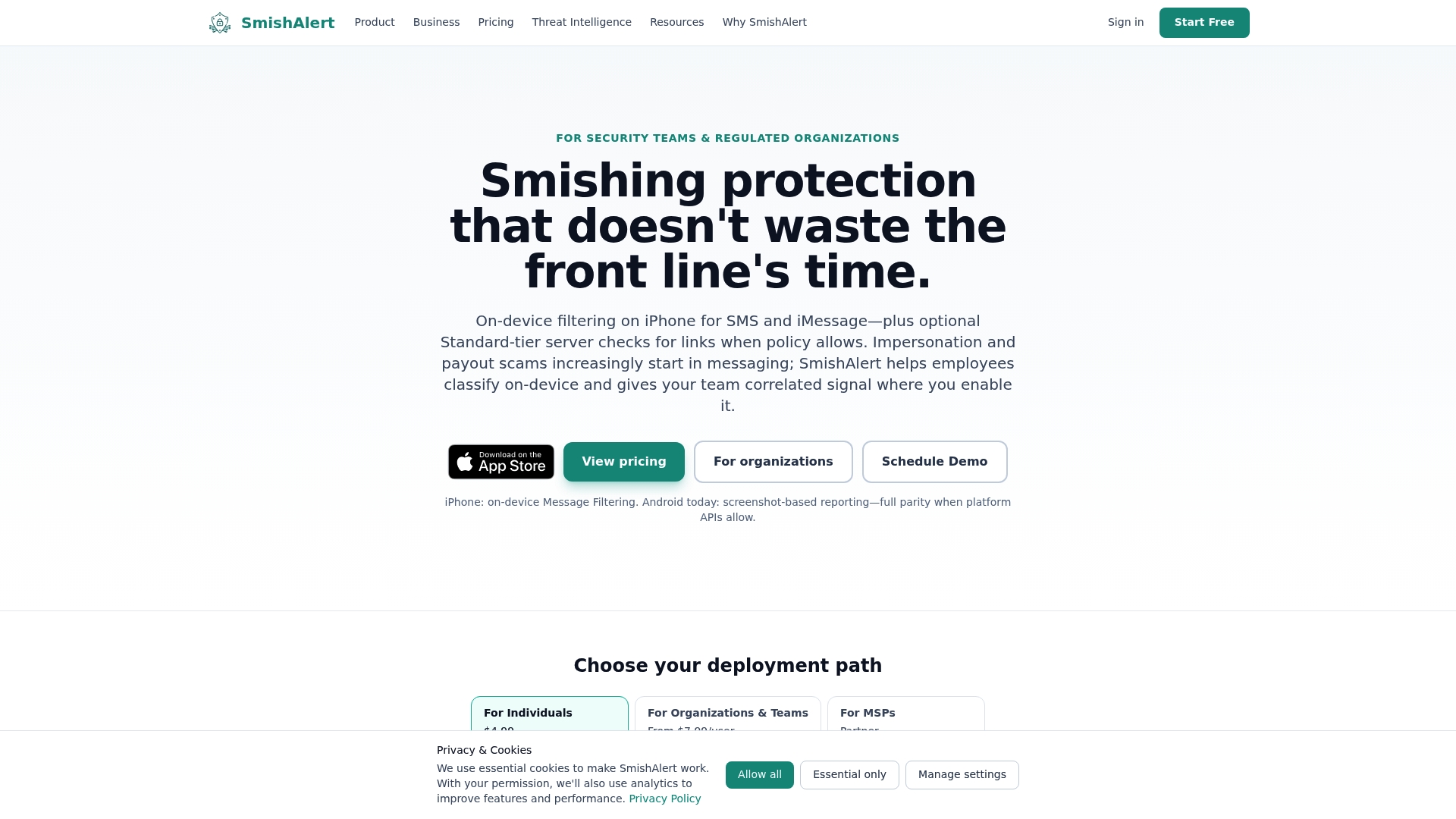
Email security tools don’t see SMS, iMessage, or WhatsApp traffic, which is exactly where CEO text scams live. That blind spot is the gap SmishAlert is built to close, correlating employee-reported messages across channels to surface campaigns hitting multiple people at once rather than treating each report as an isolated event.
- Cross-channel reporting turns individual smishing reports into a correlated campaign view
- On-device iOS filtering flags suspicious messages before an employee has to make the call alone
- SIEM integration puts messaging-threat data next to the rest of a SOC’s telemetry
Pro Tip: When evaluating any messaging-security vendor, ask specifically how they correlate reports across employees. A tool that only logs one person’s report misses the pattern that reveals a coordinated campaign.
What Security Leaders Should Prioritize Next
If you run security for an organization, the fix isn’t more awareness posters. It’s a verification policy people actually follow, dual approval on payment changes, and a reporting pipeline that doesn’t dead end in someone’s inbox. Run a smishing tabletop exercise this quarter, then fix whatever breaks. Most organizations discover their weakest link isn’t the employee who almost fell for it. It’s the process that let the request get that far in the first place.
— Sophie
Get a Clear Picture of Your Messaging Risk
Most organizations have zero visibility into the texts, iMessages, and WhatsApp messages landing on employee phones, which is precisely where CEO text scams are designed to operate unnoticed. Security tools that provide visibility into messaging channels like SMS, iMessage, and WhatsApp help security teams see, correlate, and respond to executive impersonation attempts across multiple messaging platforms, not just email.
If your organization handles sensitive finance or HR workflows, a dedicated executive impersonation defense layer is worth evaluating rather than relying on employee instinct alone. The fastest way to see where you stand is the 2-minute self-eval, which flags gaps in your current reporting and verification setup. From there, most security teams move to a scoped pilot to test detection against real campaign patterns before committing to a full rollout. Start with the self-eval, then request a pilot conversation with the vendor’s team to see what a live deployment looks like for your organization.
Where to Report and Learn More
- IC3 Public Service Announcement — file a federal report on impersonation fraud
- Forward suspicious texts to 7726 — AT&T’s carrier reporting instructions
- Boss Text Scams overview — AT&T’s Cyber Aware advisory
- Executive smishing protection checklist — action items for CISOs
Sources
- Boss Text Scams — AT&T
- BBB Scam Alert: That’s not your boss texting — BBB
- No, your CEO is not texting you — Cybersecurity Dive
- IC3 Public Service Announcement — IC3
FAQ
What is the newest text scam targeting employees?
CEO text scams and executive impersonation via SMS are among the fastest-growing smishing tactics, with attackers now using multiple messaging channels and even voice cloning to make the impersonation more convincing.
What is the CEO scam?
The CEO scam, also called the boss text scam, is when a criminal impersonates a senior executive over text to pressure an employee into buying gift cards, sending a wire transfer, or sharing login credentials.
Can a scammer access my phone if I reply to a text?
Replying alone doesn’t install malware on most phones, but it confirms your number is active and monitored, which often leads to more scam attempts; clicking a link inside the message is the far bigger risk.
How do I check if a text message is legit?
Call or email the sender using contact information you already had before the message arrived, never the number or link included in the text itself, since that’s the primary way to confirm a request is genuine.