
How to Build a Business Case for SMS Security Investment

Fund SMS and messaging security now. The risk is quantifiable, the controls are available, and the cost of inaction compounds with every undetected smishing campaign, payroll redirect, or SIM-swap event your organization absorbs without visibility. The recommended immediate next step: authorize a 30-day paid pilot to establish baseline telemetry, measure your current exposure, and produce the financial evidence your CFO needs to release full budget.
Three value drivers justify the investment to leadership:
- Direct cost avoidance. Payroll fraud, account takeover, and credential-harvesting via SMS carry median remediation costs that dwarf the annual subscription cost of a monitoring platform. A single payroll redirect incident can cause significant direct losses before legal and HR remediation are counted.
- Operational savings and revenue recovery. An SMS firewall that reclassifies disguised Application-to-Person (A2P) traffic previously delivered via grey routes can recover messaging revenue that was effectively invisible on the balance sheet.
- Regulatory and reputational risk reduction. CISA’s Making a Business Case for Security framework, NIST SP 800-63B, and NCSC guidance all treat high-value SMS flows as a distinct risk class requiring compensating controls. Non-compliance exposure in regulated industries (healthcare, finance, professional services) adds a liability dimension that finance teams understand immediately.
Smishalert is the recommended operational solution to detect, measure, and validate results across this pilot. Take the 2-minute readiness check to scope your starting point before the next section.
Table of Contents
- Why does SMS/messaging security matter in dollar terms?
- How do you build an SMS risk inventory your executives will actually read?
- How do you build the numbers for an SMS security cost/benefit model?
- What KPIs prove that SMS security investment is working?
- Why must SMS security controls be layered, not singular?
- What controls and platforms should you include in the investment case?
- What does a realistic 30–90–180 day rollout look like?
- How do you structure the executive pitch for CFOs and boards?
- How do you design a pilot that produces CFO-grade evidence?
- Appendix: assumptions, calculations, and evidence to attach
- Key Takeaways
- What security leaders consistently underestimate about this pitch
- Smishalert makes the pilot the proof
- Useful sources and further reading
Why does SMS/messaging security matter in dollar terms?
SMS is not a legacy channel. It carries OTPs for payroll systems, MFA for financial platforms, appointment confirmations with PII, and executive communications that bypass every email security control your organization has deployed. The attack surface is wide, the visibility is near-zero for most security teams, and the financial consequences are concrete.
The five attack vectors that drive the largest losses in U.S. organizations are:
- SIM swapping. An attacker convinces a carrier to port a target’s number to an attacker-controlled SIM. All SMS traffic, including OTPs, is then redirected. The result is full account takeover with no malware and no endpoint alert.
- SS7/Diameter signalling abuse. Exploits in the global telecom signalling protocol allow a remote attacker to intercept SMS messages in transit. Financial OTPs authorizing wire transfers are the primary target.
- SMS pumping / IRSF fraud. Attackers trigger high volumes of OTP sends to premium-rate numbers they control, generating direct monetary losses billed to the organization’s messaging account. For U.S.-only applications, a country-prefix allow-list permitting only “+1” destinations can block the majority of this fraud with a single configuration change.
- Smishing and sender-ID spoofing. Employees receive messages impersonating executives, HR, or IT. The attack chain typically ends in credential harvesting, payroll redirect authorization, or gift card purchase. Business SMS compromise via these vectors is underreported because the initial vector is never logged.
- Multi-channel coordinated campaigns. Attackers combine email, SMS, and WhatsApp in a single campaign to increase credibility and bypass single-channel detection. These are the hardest to detect without cross-channel telemetry.
Statistic callout: A country-prefix allow-list restricting OTP sends to “+1” destinations can block approximately 95% of SMS pumping fraud for U.S.-bound flows — a single configuration change with immediate, measurable financial impact.
The NCSC guidance on protecting SMS in critical business processes explicitly classifies OTPs authorizing financial payments as “high risk” and requires additional protective controls. That classification matters for investment thresholds: if your organization uses SMS to authorize payroll changes, wire transfers, or system access, the NCSC and NIST SP 800-63B both provide regulatory justification for the spend. The CISA Making a Business Case for Security framework reinforces this by requiring that security investments be framed in terms of risk reduction and loss avoidance, not technical capability.
The revenue-recovery angle is less obvious but equally compelling. An SMS firewall that inspects and classifies traffic can identify A2P volume that was previously delivered via grey routes and billed at P2P rates, or not billed at all. Reclassifying that traffic to the correct A2P rate recovers revenue that was already being generated but not captured. For organizations with high OTP or notification volume, this recovery can partially or fully offset the cost of the security control.
How do you build an SMS risk inventory your executives will actually read?
The NCSC recommends creating and maintaining a formal inventory of every SMS use case before selecting controls. That inventory is also one of the most persuasive artifacts for executive approval because it translates “SMS risk” from an abstract technical concern into a mapped list of business processes, owners, and dollar exposures.
Inventory template fields (one row per use case):
- Use case: What the SMS flow does (e.g., payroll change OTP, MFA for VPN, appointment reminder with PII)
- Channel: SMS, iMessage, WhatsApp, or multi-channel
- Business owner: The department or individual accountable for the process
- Data sensitivity: PII, financial authorization, authentication credential, or low-sensitivity notification
- Financial exposure: Estimated maximum loss per incident (fraud amount, remediation cost, regulatory fine)
- Regulatory impact: HIPAA, PCI-DSS, SOX, or state-level privacy law applicability
- Recovery difficulty: Time and cost to restore the process if the channel is compromised
Priority scoring heuristic: Score each use case on impact (1–5), likelihood (1–5), and detectability (1–5, where 5 means currently undetectable). Multiply the three scores. Use these triage bands:
- High (score 75–125): Immediate controls required; include in pilot scope
- Medium (score 25–74): Compensating controls within 90 days
- Low (score 1–24): Monitor; review annually
Two-week discovery checklist:
- Query CPaaS/aggregator logs for send volume, delivery receipt rates, and channel breakdown
- Interview business owners for each identified use case to confirm exposure estimates
- Contact aggregator or vendor for route transparency documentation
- Review historical helpdesk tickets tagged to SMS or authentication failures
- Map integration points: which internal systems trigger SMS sends and which receive delivery receipts
The output is a one-page inventory summary for the executive presentation, with the full scored table available as an appendix. Mapping SMS risks to business owners is what converts a technical threat list into a budget conversation.
How do you build the numbers for an SMS security cost/benefit model?
A worked example grounds the ROI conversation. The following model uses conservative, auditable assumptions a finance team can stress-test.
Baseline annualized loss scenario (mid-market organization, 500 employees):
- Two payroll redirect incidents per year with significant average direct losses each.
- One account takeover via SIM swap requiring IT remediation, legal review, and customer notification.
- SMS pumping fraud on OTP flows undetected can cause substantial financial losses over time.
- Increased customer support volume from failed OTP deliveries due to grey-route degradation contributes to operational costs.
- The total estimated annualized loss is substantial.
Control costs (annual):
- Smishalert platform subscription (500 users): per-user SaaS pricing (contact for quote)
- 30-day paid pilot fee: credited toward first-year subscription
- Integration effort: approximately 40 FTE-hours for SIEM and CPaaS API connection
- Ongoing monitoring and incident response: approximately 2 hours/week security analyst time
Benefit line items:
- Fraud losses avoided with detection and blocking controls in place are significant and impactful.
- Recovered messaging revenue from A2P reclassification: depends on current grey-route volume; often material for organizations sending more than 100,000 OTPs per month
- Reduced support ticket volume from improved delivery reliability can meaningfully decrease SMS-related helpdesk load.
- Reduced regulatory exposure: difficult to quantify precisely, but HIPAA breach notification costs alone average well above $100,000 per incident at the lower end of enforcement actions
Pro Tip: Frame the sensitivity table around the two inputs that drive the most variance: the assumed fraud frequency and the assumed detection rate. If your CFO challenges the fraud frequency assumption, show the historical helpdesk ticket data and aggregator delivery anomalies as proxies. If they challenge the detection rate, the pilot is designed to measure exactly that.
Sensitivity table (base / best / worst case ROI):
| Scenario | Fraud frequency assumption | Detection rate | Estimated annual benefit | Estimated net benefit after controls |
|---|---|---|---|---|
| Best case | 3 incidents/year | 90% detection | — | Strongly positive |
| Base case | 2 incidents/year | 75% detection | $143,000+ | Positive |
| Worst case | 1 incident/year | detection rate | — | Near break-even to positive |
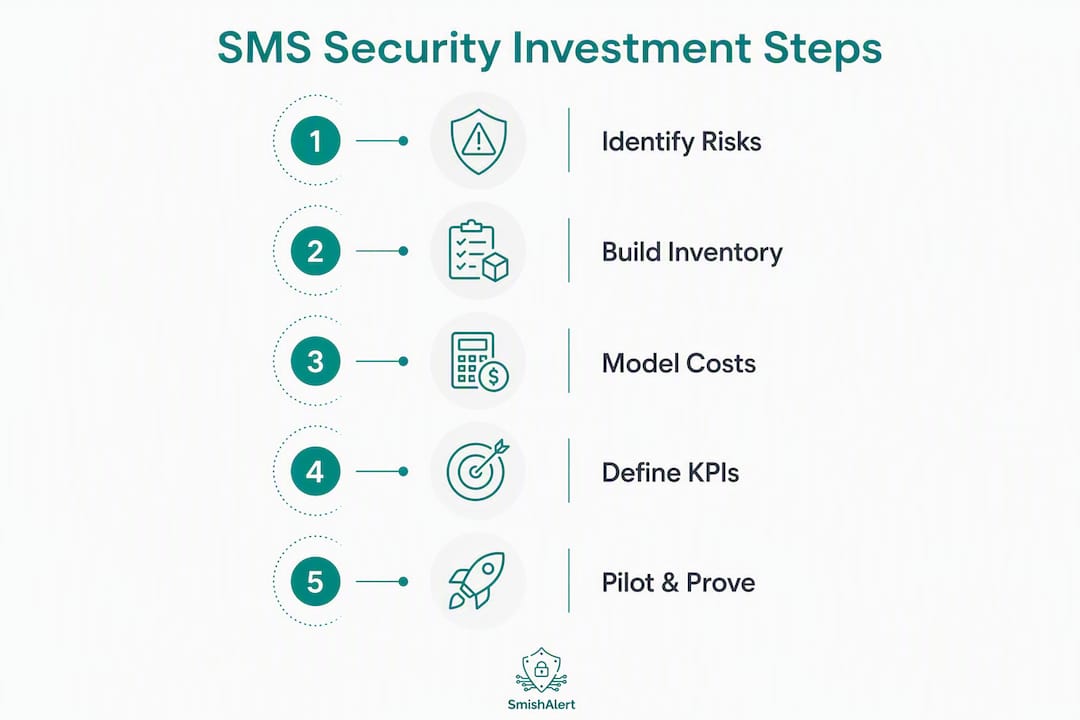
The operational risk framework used by finance teams for digital asset risk applies directly here: quantify the expected loss, apply the control’s estimated effectiveness, and present the residual risk as the investment justification. That structure is what CFOs recognize.
What KPIs prove that SMS security investment is working?

Measurement is what separates a funded pilot from a one-time expense. Define KPIs before the pilot starts, collect baseline data during the first two weeks, and report against them at 30, 60, and 90 days.
Core KPI list:
- Fraud dollars avoided: Estimated value of intercepted or blocked fraud attempts, calculated from blocked payroll redirect attempts and SIM-swap alerts
- OTP send-to-verify ratio: The ratio of OTP messages sent to successful verifications completed. A ratio above 2:1 is an early warning indicator for SMS pumping or grey-route degradation; treat it as an incident trigger
- Blocked malicious messages: Count of smishing, sender-ID spoofing, and executive impersonation messages detected and blocked per reporting period
- A2P reclassification volume: Number of messages reclaimed from grey routes and correctly classified, with associated revenue recovery
- Mean time to detect (MTTD) messaging incidents: Time from first anomalous signal to security team awareness
- Mean time to respond (MTTR) messaging incidents: Time from detection to containment or mitigation
Metric thresholds and alert triggers:
| KPI | Baseline target | Alert threshold | Action |
|---|---|---|---|
| OTP send-to-verify ratio | — | > 2:1 | Treat as incident; investigate pumping or route abuse |
| Blocked malicious messages | Establish in pilot week 1–2 | 3× baseline spike | Escalate to threat hunting |
| MTTD messaging incidents | Establish in pilot | — | Review telemetry gaps |
| A2P reclassification volume | Establish in pilot | Declining month-over-month | Investigate grey-route re-emergence |
Reporting cadence and ownership:
- Weekly: Security operations owns OTP ratio and blocked message counts; reviewed in SOC standup
- Monthly: Security director presents fraud dollars avoided and MTTD/MTTR to CISO
- Quarterly: CISO presents full KPI dashboard to CFO and board, including A2P revenue recovery and regulatory exposure reduction
The dashboard should be segmented by channel (SMS, iMessage, WhatsApp), by region or business unit, and by use-case category (authentication, HR/payroll, customer notification). That granularity is what allows finance to attribute savings to specific business processes rather than accepting a single aggregate number.
Why must SMS security controls be layered, not singular?
NIST SP 800-63B classifies SMS as a restricted authenticator at Authentication Assurance Level 2 (AAL2) and explicitly recommends phishing-resistant alternatives for high-assurance scenarios. That guidance does not mean abandoning SMS. It means building compensating controls around it and knowing when to step up.
The recommended layered controls stack for U.S. organizations includes signalling firewalls, SIM-swap signal integration, route transparency, rate limits, sender-ID registration, multi-channel fallback, and phishing-resistant step-up authentication. Migrating away from SMS is advised for transactions above high value thresholds, explicit regulatory requirements, frequent intercept signals, or audit citations.
Pro Tip: Add home-routing requests to your carrier or aggregator contract. Home routing ensures that inbound SMS messages are routed through the subscriber’s home network before delivery, which closes a common SS7 interception path used in targeted attacks against executives.
Smishalert’s contextual phishing warnings and on-device iOS message filtering operate at the enterprise layer of this stack, providing the detection and reporting telemetry that makes the other controls auditable.
What controls and platforms should you include in the investment case?
The business case needs a controls inventory that maps each control to its expected impact, time-to-value, and resource requirement. Finance and legal will want to see alternatives considered before approving the recommended solution.
Controls inventory:
| Control | Business impact addressed | Estimated time-to-value | Required resources |
|---|---|---|---|
| SMS firewall / route policing | SMS pumping, grey-route interception, A2P revenue recovery | 2–4 weeks post-deployment | CPaaS vendor engagement; minimal FTE |
| SIM-swap signal integration | Account takeover via SIM swap | 1–2 weeks (API integration) | 8–16 FTE-hours; carrier API access |
| Sender-ID registry (TCR) | Sender spoofing, carrier filtering | 2–6 weeks (registration process) | Compliance and vendor coordination |
| OTP rate-limiting and verification telemetry | SMS pumping, grey-route abuse | Days (configuration change) | Security engineering; 4–8 FTE-hours |
| Multi-channel fallback | Delivery failure, route degradation | 2–4 weeks | CPaaS configuration; product team |
| Monitoring + blocking + measurement platform (Smishalert) | Smishing, executive impersonation, payroll fraud, campaign correlation, audit reporting | 30-day pilot to baseline; 90 days to full value | 30-day paid pilot; SIEM/API integration |
RFP/capability checklist for a monitoring and measurement platform:
- Route transparency reporting with delivery receipt reconciliation
- Signalling-abuse metrics (SIM-swap signals, SS7 anomaly flags)
- Multi-channel audit trails covering SMS, iMessage, and WhatsApp
- SIEM integration (Splunk, Microsoft Sentinel, or equivalent)
- Campaign correlation to link individual incidents into coordinated attack patterns
- Audit-ready incident reporting for finance, legal, and regulators
- Per-user and per-executive coverage with BYOD support
- Pilot-to-subscription path with pilot fee credited to first-year contract
Smishalert meets all of these criteria. Its platform provides telemetry, campaign correlation, and audit-ready reporting across SMS, iMessage, and WhatsApp, with SIEM/API integration and a 30-day paid pilot that feeds directly into the business case financials. The pilot fee is credited toward the first annual subscription, so the assessment cost is not a sunk expense.

What does a realistic 30–90–180 day rollout look like?
A phased roadmap gives finance a clear view of when costs occur and when benefits materialize. The following timeline assumes a mid-market organization (200–1,000 employees) with an existing CPaaS vendor and a SIEM in place.
-
Days 1–30: Discovery and baseline (Pilot phase)
- Deploy Smishalert pilot on executive, HR, and payroll user populations
- Collect baseline OTP send-to-verify ratio, delivery receipt rates, and incident telemetry
- Run the two-week SMS risk inventory discovery (logs, interviews, aggregator documentation)
- Establish baseline KPIs for all metrics defined in the measurement plan
- Deliverable: Pilot baseline report with initial fraud signals and inventory summary
- Owner: Security operations lead; finance observer assigned
-
Days 31–60: Validate and tune (Pilot phase continued)
- Tune blocklist rules and rate-limit thresholds based on pilot telemetry
- Identify and document A2P reclassification opportunities with aggregator
- Present 30-day pilot results to CISO and CFO; confirm or revise ROI assumptions
- Decision gate: CFO signs off on full-year budget based on pilot evidence
- Deliverable: Updated ROI model with real pilot data substituted for assumptions
- Owner: CISO presents; CFO and legal review
-
Days 61–90: Expand and integrate (Scale phase)
- Extend platform coverage to full employee population
- Complete SIEM integration and configure automated alerting
- Register sender IDs via TCR if not already complete
- Implement SIM-swap signal queries for high-value OTP flows
- Deliverable: Full integration checklist signed off; policy documentation updated
- Owner: Security engineering; compliance and legal sign-off
-
Days 91–180: Operationalize and report (Steady-state phase)
- Establish quarterly KPI reporting cadence for CFO and board
- Conduct first formal review of A2P revenue recovery with finance
- Assess whether any high-value flows require step-up to FIDO2/passkeys
- Update the SMS risk inventory with any new use cases identified during rollout
- Deliverable: First quarterly board report on messaging security posture
- Owner: CISO; board reporting via executive and board reporting framework
Integration risk register (common blockers):
- CPaaS vendor delays in providing route transparency documentation: mitigate by requesting in writing at contract renewal
- SIEM integration complexity with legacy SIEM versions: mitigate by scoping API integration in pilot contract
- BYOD policy gaps preventing on-device deployment: mitigate by scoping managed device population first, then expanding
How do you structure the executive pitch for CFOs and boards?
The business case structure that finance teams recognize includes an executive summary, problem statement, alternatives considered, recommendation, financials, and appendices. For SMS security, the pitch needs to be tighter than a standard IT investment request because the threat is less visible to non-technical executives.
One-page executive summary template:
- BLUF: Fund a 30-day SMS security pilot to establish baseline exposure and validate the ROI model before committing to full-year budget.
- Expected ROI: Base-case net benefit of $143,000+ annually against control costs; pilot produces the evidence to confirm or revise this figure.
- Pilot ask: Approve 30-day paid pilot (fee credited to first-year subscription) and 40 FTE-hours for integration.
- Risk statement: Without controls, the organization carries undetected exposure to payroll fraud, account takeover, and SMS pumping with no current telemetry to measure or respond.
- Ask: Pilot budget approval and CISO authority to engage Smishalert for the assessment.
Six-slide pitch outline:
- Slide 1 — The problem: SMS is a high-value attack surface with zero current visibility. Show the attack vector map and the inventory of high-risk use cases.
- Slide 2 — Business impact: Translate each attack vector into a dollar loss scenario. Use the annualized loss model from the cost/benefit section.
- Slide 3 — Controls and solution: Present the layered controls stack and position Smishalert as the measurement and detection layer.
- Slide 4 — Pilot plan: 30-day scope, target user population, baseline metrics, and decision gate criteria.
- Slide 5 — Numbers and ROI: Base/best/worst case sensitivity table. Highlight the payback period and the pilot-to-subscription credit.
- Slide 6 — Ask and next steps: Pilot budget approval, timeline, and the specific stakeholder actions required in the next 30 days.
CFO Q&A pre-emption:
- “What is the payback period?” Base case: less than 12 months if two or more fraud incidents are prevented. The pilot will confirm the fraud frequency assumption with real telemetry.
- “Is this capital or operating expense?” SaaS subscription is OPEX. Pilot fee is OPEX and credited to the first-year subscription.
- “What if the pilot shows lower-than-expected fraud?” Lower fraud frequency reduces the ROI but does not eliminate it. A2P revenue recovery and reduced support costs remain. The sensitivity table shows break-even at one incident per year.
- “Why not just use existing email security tools?” Email security platforms have no visibility into SMS, iMessage, or WhatsApp. The attack vectors described here operate entirely outside the corporate perimeter and are invisible to endpoint and email controls.
Keep the live pitch to the six slides. Attach the full cost/benefit model, assumptions table, and NCSC/NIST/CISA citations as appendices available on request.
How do you design a pilot that produces CFO-grade evidence?
A pilot that produces anecdote is not a pilot. The design must be experiment-grade: defined control conditions, a baseline collection period, and a measurement plan that finance can audit.
-
Define the control population. Scope the pilot to executive, HR, and payroll users first. These populations carry the highest financial exposure and will produce the most meaningful fraud-signal data in 30 days.
-
Collect a two-week baseline before activating blocking controls. Run Smishalert in detection-only mode for the first two weeks to establish pre-intervention metrics: OTP send-to-verify ratio, delivery receipt rates, smishing report volume, and any existing fraud signals. This baseline is the “before” in your before/after comparison.
-
Activate controls in week three and measure the delta. Enable blocking rules, rate limits, and SIM-swap signal queries. Track the same metrics daily. The delta between baseline and post-activation is your primary evidence for the ROI model.
-
Capture per-verification audit metadata. For every OTP send, log the channel used, the carrier SIM-swap signal result, the delivery receipt timestamp, and the verification completion event. This telemetry, as recommended for U.S. OTP defense, is what allows post-hoc analysis of intercept patterns and reduces detection latency from weeks to hours.
-
Harden against pilot manipulation. Inflated OTP traffic during the pilot period (e.g., from a test environment with unrealistic send volumes) will distort the send-to-verify ratio. Isolate production traffic from test traffic at the aggregator level before the pilot begins.
-
Define statistical significance thresholds for key KPIs. For the OTP send-to-verify ratio, a sustained reading above 2:1 for more than 48 hours constitutes a statistically meaningful signal given typical production volumes. For blocked smishing messages, a 3× spike above the two-week baseline triggers escalation. Document these thresholds in the pilot design before the pilot starts so finance cannot later argue the thresholds were set post-hoc.
-
Produce the pilot report in a format finance can audit. The report should include: baseline metrics table, post-activation metrics table, delta calculation, estimated fraud dollars avoided (with methodology), A2P reclassification volume, and a one-page narrative summary. Attach raw log exports as supporting evidence.
The SMS threat triage checklist provides a practical incident-level framework to run alongside the pilot, ensuring that any live incidents detected during the 30 days are documented and included in the pilot report.
Appendix: assumptions, calculations, and evidence to attach
A CFO who cannot audit the numbers will not sign the budget. The appendix is where you make the math traceable.
Assumptions checklist:
- Baseline fraud frequency: sourced from historical helpdesk tickets, aggregator anomaly reports, or industry benchmarks (FBI IC3 annual report for BEC/payroll fraud rates by sector)
- Estimated remediation cost per incident: direct loss + IT remediation hours + legal review + customer notification (if applicable); document each component separately
- Average A2P misclassification rate: request from aggregator; if unavailable, use delivery receipt reconciliation data from the pilot baseline
- Expected uplift from blocking controls: use the 70–85% detection rate range from the base-case model; the pilot will replace this assumption with measured data
- OTP send volume: pull from CPaaS dashboard for the trailing 90 days; segment by use case
Worked-calculation table structure:
| Input | Source | Value | Formula | Output |
|---|---|---|---|---|
| Fraud incidents per year | Historical tickets | 2 | Incidents × avg. loss | — |
| Avg. loss per incident | Finance/legal estimate | — | ||
| Detection rate (base case) | Industry benchmark | 75% | Loss × detection rate | $67,500 avoided |
| A2P reclassification volume | Aggregator data | TBD in pilot | Volume × rate delta | TBD |
| Integration FTE cost | HR rate × hours | 40 hours × $85/hr | — |
Evidence list to attach:
- NCSC guidance on protecting SMS in critical business processes: regulatory justification for high-risk SMS classification and inventory requirement
- CISA Making a Business Case for Security: framework for structuring the investment request and presenting to leadership
- NIST SP 800-63B: technical justification for SMS as a restricted authenticator and step-up requirements
- Smishalert threat intelligence: live campaign examples and pilot evidence showing real attack patterns
- Aggregator route transparency documentation: written confirmation of direct operator routes
- Historical helpdesk tickets tagged to SMS or authentication failures: baseline fraud frequency evidence
- Delivery receipt reconciliation data from pilot: empirical evidence for detection rate assumptions
Auditability note: Document all financial assumptions in a version-controlled spreadsheet with named inputs, formulas, and data sources. Internal audit will want to trace every number in the executive summary back to a primary source. The pilot report, once complete, replaces the assumption-based inputs with measured values and becomes the primary evidence for the full-year budget request.
Key Takeaways
Funding SMS security is justified when the investment is structured as a measurable pilot with defined KPIs, a traceable cost/benefit model, and a phased roadmap that produces CFO-grade evidence before full budget commitment.
| Point | Details |
|---|---|
| Fund the pilot first | Authorize a 30-day paid pilot to replace assumptions with measured fraud signals and delivery telemetry before committing full-year budget. |
| Build the risk inventory | Map every SMS use case to a business owner, financial exposure, and regulatory impact; this single artifact is the most persuasive executive document in the case. |
| Layer the controls | No single control eliminates SMS risk; combine a signalling firewall, SIM-swap signal queries, sender-ID registration, rate limits, and a monitoring platform for auditable defense. |
| Track the OTP ratio | A send-to-verify ratio above 2:1 sustained for 48 hours is an incident trigger for SMS pumping or grey-route abuse; establish this baseline in the pilot’s first two weeks. |
| Smishalert as the measurement layer | Smishalert provides the detection, campaign correlation, and audit-ready reporting that converts pilot telemetry into CFO-grade evidence for full-year budget approval. |
What security leaders consistently underestimate about this pitch
The hardest part of building a case for SMS security investment is not the ROI model. Finance teams are comfortable with sensitivity tables and payback periods. The real friction is the visibility gap: most organizations have no telemetry on their SMS attack surface, so the baseline fraud frequency assumption in the cost/benefit model is an estimate, and CFOs know it.
The instinct is to compensate by making the fraud frequency assumption more conservative, which reduces the modeled ROI and weakens the case. That is the wrong move. The right move is to make the pilot the centerpiece of the pitch. The ask is not “approve $X for SMS security.” The ask is “approve a 30-day pilot so we can replace assumptions with data.” That framing converts a speculative ROI argument into a structured experiment with a defined decision gate, which is a request finance teams approve far more readily.
There is also a tendency to over-promise on detection rates. A monitoring platform will not catch every incident in the first 30 days. What it will do is establish a baseline, surface signals that were previously invisible, and give the security team the telemetry to respond faster. Promising 90% fraud elimination in year one sets an expectation the pilot cannot meet. Promising “we will know what we are dealing with for the first time” is accurate, defensible, and often more compelling to a CFO who has been approving security budgets without measurement for years.
One more thing: the regulatory angle is underused. CISA’s business case framework, NCSC’s high-risk SMS classification, and NIST SP 800-63B’s restricted-authenticator guidance are not just technical references. They are the basis for a liability argument. If your organization uses SMS OTPs to authorize financial transactions and has no compensating controls, you are carrying documented regulatory exposure. That sentence, in those terms, tends to move budget conversations faster than any ROI table.
Smishalert makes the pilot the proof
Security leaders in regulated industries, including healthcare, finance, and professional services, need more than a threat report to justify SMS security spend. They need measured evidence from their own environment, in a format their CFO can audit.
Smishalert’s 30-day paid assessment is designed to produce exactly that. The pilot deploys across executive, HR, and payroll populations, captures telemetry across SMS, iMessage, and WhatsApp, and delivers an audit-ready report showing detected threats, blocked campaigns, and the baseline metrics your ROI model needs. The pilot fee is credited toward the first annual subscription, so the assessment is not a separate cost. It is the first month of your investment, producing the evidence that justifies the rest.
The platform provides SIEM integration, campaign correlation, and per-channel reporting that maps directly to the KPI dashboard and board reporting requirements described in this guide. CISOs and security directors who have completed the pilot consistently report that the baseline telemetry alone surfaces attack patterns that were entirely invisible before deployment.
To start, request your 30-day social engineering exposure assessment and scope the pilot to your highest-exposure user population. The data you collect in 30 days will do more for your budget conversation than any industry benchmark.
Useful sources and further reading
The following sources support the recommendations in this guide and are appropriate to attach to the business case appendix.
- Protecting SMS messages used in critical business processes — NCSC: The primary regulatory justification for treating high-value SMS flows as a distinct risk class and maintaining a formal use-case inventory. Attach this to the appendix when presenting to legal and compliance.
- Making a Business Case for Security — CISA (2023 Edition): The U.S. government framework for structuring security investment requests. Use the executive summary and financials structure from this document to align your pitch with what federal and regulated-industry reviewers expect.
- NIST SP 800-63B — nist.gov: The technical authority for SMS as a restricted authenticator at AAL2 and the basis for step-up authentication recommendations. Cite in the layered controls section and when presenting to technical reviewers.
- SS7 Attacks on SMS OTP API for USA: 2026 Defense Guide — Message Central: Practical architecture guidance for U.S. OTP flows, including the layered defense stack and per-verification audit metadata requirements.
- SMS pumping fraud prevention — Message Central: Source for the country-prefix allow-list statistic and the OTP send-to-verify ratio as an incident trigger. Use in the cost/benefit model and KPI sections.
- Inside the SMS Firewall — PC Tech Magazine: Explains the revenue-recovery mechanism of A2P reclassification and the route transparency requirement. Use when presenting the revenue-recovery benefit to finance.
- Smishalert Threat Intelligence — Live Campaign Examples: Real campaign examples and pilot evidence showing current attack patterns. Attach to the appendix as proof-of-concept for the threat landscape described in the business case.
- Smishalert Q2 2026 Threat Signal Report: Quarterly threat intelligence showing current smishing and social engineering trends in the U.S. Use to support the fraud frequency assumptions in the cost/benefit model.