
On-Device SMS Filtering Benefits for Security Teams

On-device SMS filtering is one of the highest-impact, lowest-friction controls available to enterprise security teams today. It stops smishing at the endpoint, preserves employee privacy through local processing, and measurably reduces the cognitive load that spam and social engineering messages impose on your workforce.
TL;DR for executive briefings: On-device SMS filtering intercepts threats before they reach the user’s attention, requires no message content to leave the device, and can be deployed across BYOD and managed fleets with minimal operational overhead.
Key benefits at a glance:
- Endpoint protection: Suspicious messages are filtered before notifications fire, cutting the attack surface for credential-harvesting and payroll fraud.
- Privacy-by-design: All classification runs locally. No message content is transmitted to a cloud service.
- Productivity gains: Eliminating spam interruptions reduces task-switch recovery time per phishing SMS glanced at.
- Operational efficiency: Native OS filters add ≤0.1% battery draw per hour, versus an average 4.3% per hour for third-party filter apps.
Table of Contents
- How on-device SMS filtering works at a technical level
- Concrete security, privacy, and productivity benefits for enterprises
- Common tradeoffs and how to address them
- Deployment models: BYOD, MDM, and pilot planning
- KPIs to track during a pilot or rollout
- Connecting on-device filtering to SIEM and incident response
- A practical 30-day pilot: step-by-step
- Key Takeaways
- Why on-device filtering is harder to sell internally than it should be
- Smishalert adds enterprise visibility where native filtering stops
- Useful sources and further reading
How on-device SMS filtering works at a technical level
Modern mobile operating systems intercept messages at the OS layer before they surface in the UI. On Android, the MessageFilterService API and TelephonyManager broadcast receivers allow registered filtering extensions to classify an incoming message and route it silently to a junk folder. On iOS, Apple’s MessageFilterExtension framework gives third-party apps a sandboxed classification call that never exposes message content to the extension developer’s servers.
Classification itself relies on a layered stack:
- Local heuristics and reputation lists: Fast, low-memory lookups against known sender IDs, short codes, and keyword patterns.
- On-device ML models: Lightweight transformer variants (MobileBERT, Gemma 4 LiteRT) run on the device’s Neural Engine or ARM NEON units, producing threat scores in 50–150 ms per message with no network dependency.
- Rule-based offline filters: Open-source implementations like SMS Shield demonstrate that keyword, sender, wildcard, and country-based rules can operate entirely offline with no analytics pipeline.
Pro Tip: Native OS filters intercept messages before they reach UI threads, which is why they avoid the persistent background services that drain battery on third-party apps. On Android 13+, stricter default-app and telephony permission rules mean sideloaded filtering apps require explicit user action to become the default SMS handler — plan pilot communications accordingly.
Concrete security, privacy, and productivity benefits for enterprises
Security
On-device filtering stops smishing attacks at the moment of delivery, before a user taps a link. This is the critical window for credential-harvesting campaigns, executive impersonation texts, and payroll or gift-card fraud requests. Google’s Scam Detection on Android analyzes conversations with on-device AI and warns users in real time about conversational scams, covering the longer-form social engineering patterns that simple keyword filters miss. Carrier-level reporting via short code 7726 complements device filtering by adding senders to network blacklists, though true network blocking requires carrier cooperation because SMS lacks a universal cryptographic sender ID.

Privacy
Because classification runs locally, no message content leaves the device during normal operation. This aligns with privacy-by-design principles and satisfies the data-minimization requirements most legal and HR teams will raise during a pilot review. Google’s implementation makes the privacy posture explicit: processing stays on-device unless the user actively chooses to report a message for broader telemetry. Opt-in and opt-out controls are core to the design, not an afterthought.
Productivity and operational efficiency
Proactive filtering preserves the usefulness of messaging channels by preventing the user fatigue that causes employees to ignore legitimate alerts. When spam volume is high enough that employees start dismissing all message notifications reflexively, the signal-to-noise ratio of your entire messaging channel collapses. Native OS filtering addresses this without adding endpoint agents or requiring users to install and maintain a separate app.
Pilot metrics to include in your charter:
- Target a measurable reduction in risky link clicks within the pilot cohort during the 30-day window.
- Track the volume of user-reported suspicious messages as a proxy for residual threat exposure.
- Confirm battery and latency impact stays within the ≤0.1% per hour threshold for native filters.
Common tradeoffs and how to address them
Every control has costs. On-device SMS filtering introduces three worth planning for.
False positives. Legitimate transactional messages (two-factor authentication codes, appointment reminders) can be misclassified and silently filtered. Mitigations: build a sender whitelist for known business short codes before rollout, enable manual override so users can retrieve filtered messages, and phase the rollout starting with a small cohort to surface false-positive patterns before broad deployment.
Visibility gap. On-device filtering by design keeps message content off your security team’s radar. That privacy benefit creates an investigative gap when you need to correlate a smishing campaign across multiple employees. Mitigation: pair filtering with a user-initiated reporting workflow. When a user flags a message, metadata (sender, timestamp, anonymized threat score) flows to your SIEM without exposing message body content.
Privacy pushback from legal and HR. Automated scanning of employee messages raises legitimate questions even when processing is local. Coverage of Google’s Android AI scanning acknowledges this tradeoff directly, noting that on-device processing and user control options are the primary risk-mitigating design choices. Prepare a one-page explainer for legal that distinguishes local inference from cloud scanning, and include opt-out language in your acceptable-use policy update.
Platform compatibility. iOS filtering extensions work within Apple’s sandboxed MessageFilterExtension framework. Android’s behavior varies by OS version: Android 13+ enforces stricter default-app rules that can block sideloaded filtering apps from functioning without explicit user action.
Pro Tip: For BYOD pilots, frame opt-in consent language around what the filter does NOT do: it does not read, store, or transmit message content. That framing typically resolves the majority of employee objections before they reach HR.
Deployment models: BYOD, MDM, and pilot planning
The right deployment model depends on device ownership and your organization’s MDM posture.
BYOD (opt-in, privacy-first). Employees enable native OS filtering themselves, guided by IT-provided instructions. This model has the lowest friction and the strongest privacy story. The tradeoff is lower coverage consistency. For BYOD messaging risk, start with a voluntary pilot cohort of 25–50 employees in high-risk roles.
Corporate-owned and MDM-managed. Policy enforcement through MDM (Jamf, Microsoft Intune, VMware Workspace ONE) can push OS-level filter settings and restrict the default SMS app. This gives IT consistent coverage but requires device enrollment. OS-native filtering fits here without adding another endpoint agent.
Pilot-to-subscription path. The standard SaaS path for enterprise messaging security is a paid 30-day pilot that converts to an annual subscription, with the pilot fee credited toward the first year. Select your pilot cohort from executives and high-risk teams (HR, finance, IT administrators) where smishing impact is highest.
Operational checklist before launch:
- Update the acceptable-use policy to include mobile messaging monitoring language.
- Draft consent language that explicitly describes on-device-only processing.
- Publish a troubleshooting guide for users who experience false positives.
- Configure sender whitelists for known business short codes and transactional senders.
- Identify escalation contacts for incidents that surface during the pilot window.
KPIs to track during a pilot or rollout
Aggregate and anonymize all metrics. Report on patterns, not individual message content.
| KPI | Measurement method | Target threshold |
|---|---|---|
| Risky link clicks | URL reputation logs, proxy telemetry | Measurable reduction vs. pre-pilot baseline |
| User-reported suspicious messages | In-app or email report button count | Stable or declining trend after week 2 |
| Mean time to detect/respond (MTTR) | Ticket open-to-close timestamps | Reduction vs. pre-pilot baseline |
| False-positive rate | User override or whitelist requests | <5% of filtered messages |
| Device battery/latency impact | MDM telemetry or user survey | ≤0.1% battery overhead per hour |
Collect these metrics at the cohort level. Avoid storing individual user data tied to message content. A well-defined SMS filtering program includes training staff to report inaccuracies, which feeds the false-positive KPI and improves model tuning over time.
Connecting on-device filtering to SIEM and incident response
On-device filtering generates signal. The value of that signal depends on whether it reaches your detection and response stack.
Typical integration points:
- SIEM ingestion: API-based event feeds or secure webhook delivery push filtered-message metadata (sender hash, timestamp, threat category) into Splunk, Microsoft Sentinel, or your SIEM of choice.
- CSV exports: Forensic teams can pull structured exports for post-incident analysis without accessing raw message content.
- User reporting workflows: A report button in the messaging interface triggers automated correlation. When multiple employees report messages from the same sender pattern within a short window, the system surfaces a campaign-level alert rather than isolated tickets.
- Audit-ready incident reports: Blinded identifiers and event metadata preserve auditability while respecting privacy obligations.
Pro Tip: Correlate messaging incidents with email and endpoint telemetry. A smishing campaign often runs in parallel with a spear-phishing email wave targeting the same employees. Catching the SMS signal first can surface the broader campaign before the email vector succeeds. Smishalert’s campaign correlation is built specifically for this cross-channel pattern.
A practical 30-day pilot: step-by-step
Days 0–7: Setup and baseline
- Enroll the pilot cohort (executives, HR, finance — 25–50 users).
- Record baseline risky-click rates and suspicious-message report volumes.
- Enable native OS filters on all enrolled devices (iOS Filter Unknown Senders, Android Filter suspected spam messages).
- Confirm SIEM integration is receiving event metadata.
Days 8–21: Active monitoring and tuning
- Collect user-reported false positives daily and update sender whitelists.
- Review SIEM dashboards for campaign-level clustering.
- Track MTTR for any incidents that surface.
- Hold a mid-pilot check-in with the cohort to surface usability issues.
Days 22–30: Evaluation and expansion decision
- Compare all KPIs to the pre-pilot baseline.
- Document ROI: reduced support tickets, reduced risky clicks, MTTR improvement.
- Prepare a broader rollout checklist covering MDM policy updates, consent language revisions, and training materials.
Required artifacts before closing the pilot: signed consent language, a troubleshooting guide, escalation contact list, and a one-page summary for executive stakeholders.
Key Takeaways
On-device SMS filtering delivers measurable security, privacy, and productivity gains for enterprise teams by stopping smishing at the endpoint while keeping message content off external servers.
| Point | Details |
|---|---|
| Productivity impact | Glancing at a phishing SMS increases task-switch recovery time by 23.7 seconds on average. |
| Battery efficiency | Native OS filters add ≤0.1% battery draw per hour, versus an average 4.3% per hour for third-party filter apps. |
| Privacy-by-design | On-device processing and opt-out controls keep message content local during normal operation. |
| Pilot structure | A 30-day paid pilot with executives and high-risk teams is the standard path to subscription. |
| Smishalert’s role | Smishalert adds campaign correlation, SIEM integration, and audit-ready reporting on top of native on-device filtering. |
Why on-device filtering is harder to sell internally than it should be
The technical case for on-device SMS filtering is straightforward. The internal advocacy case is where most pilots stall.
Legal teams hear “automated message scanning” and assume cloud processing. HR teams worry about employee surveillance. Both concerns are legitimate responses to how cloud-based email security tools have historically operated. The privacy-by-design architecture of on-device filtering is a genuine differentiator, but only if you explain it in terms those audiences recognize.
The sentence that tends to move the conversation forward: “This control processes messages on the employee’s device, produces a threat score, and discards the content. No message text is stored, transmitted, or accessible to the security team.” That framing separates on-device filtering from the surveillance tools legal and HR are actually worried about.
The second sticking point is measurement. Security leaders who cannot show a before-and-after comparison will struggle to justify broader rollout. The 30-day pilot model exists precisely to generate that data. Run it with a small, willing cohort, measure the KPIs in the table above, and let the numbers carry the internal argument.
Smishalert adds enterprise visibility where native filtering stops
Native on-device filtering is a strong first layer. What it cannot do is give your security team visibility across the organization, correlate campaigns across employees, or produce the audit-ready incident reports that compliance teams require.
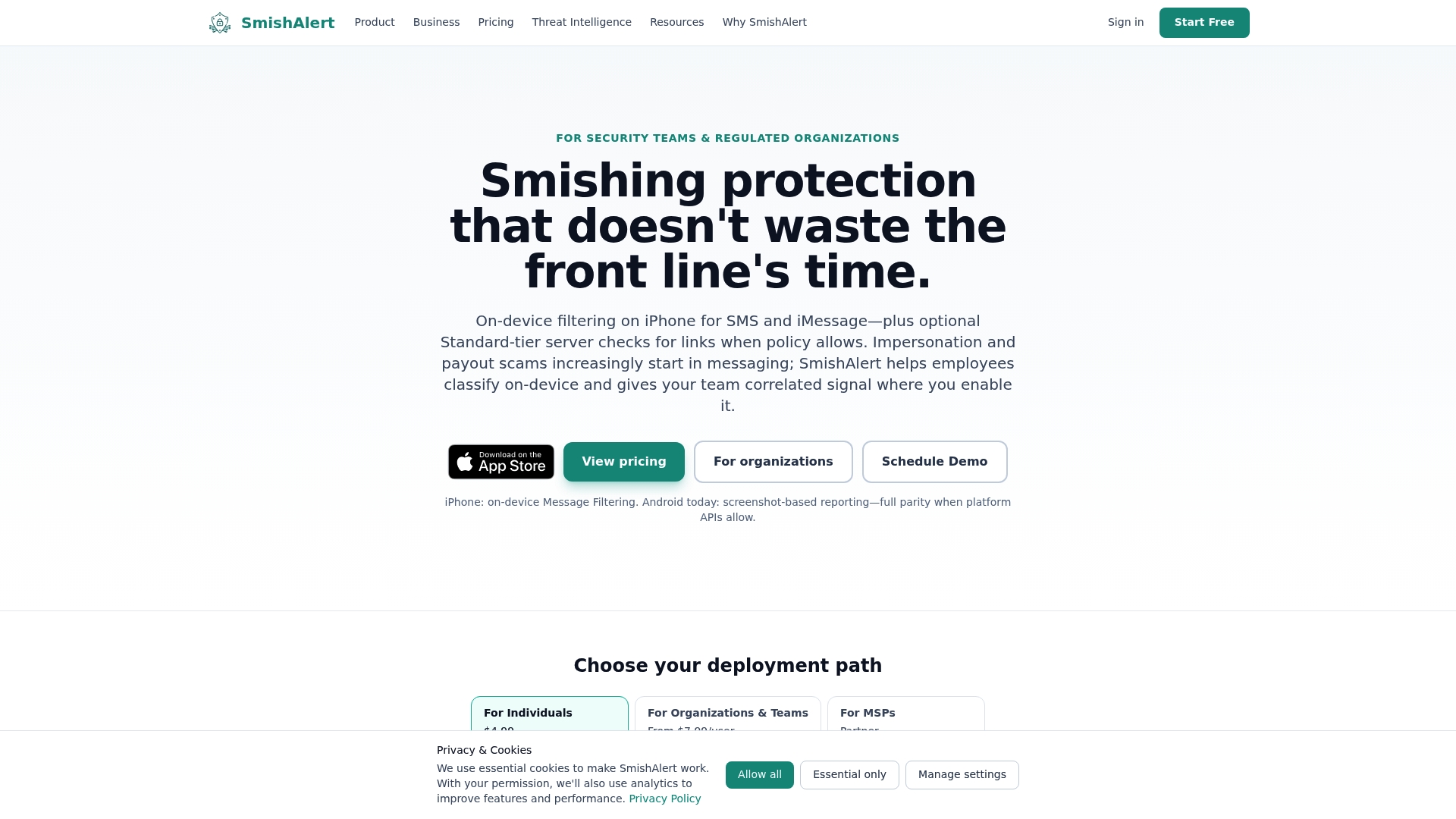
Smishalert is built to fill that gap. It provides on-device iOS message filtering, cross-channel visibility across SMS, iMessage, and WhatsApp, API and SIEM integrations, and campaign-level correlation that surfaces coordinated attacks before they result in compromise. The commercial path is a paid 30-day pilot that converts to an annual per-user subscription, with the pilot fee credited toward year one. During the pilot, your team receives structured incident reports, baseline-to-close KPI comparisons, and the telemetry needed to brief executives and auditors.
If you are ready to measure your organization’s exposure to messaging-based social engineering, the SmishAlert self-evaluation takes two minutes and produces a readiness score your team can act on. For a full picture of what the platform covers, visit smishalert.ai/solutions.
Useful sources and further reading
Technical implementation and OS configuration:
- Apple Support: Screen and filter text messages on iPhone — primary reference for iOS
MessageFilterExtensionconfiguration; best for IT implementation guides. - Google Blog: New AI-powered scam detection features on Android — authoritative source on Google’s on-device Scam Detection design and privacy controls; best for policy briefings.
- SafeSMS on DEV Community — technical walkthrough of Gemma 4 LiteRT on-device inference; best for engineering teams evaluating ML model options.
- SMS Shield on GitHub — open-source reference for offline, rule-based filtering; useful for teams building custom classification rules.
- Yakho Telecoms Security Catalog — carrier-level security feature reference for teams evaluating network-layer complements to device filtering.
Smishalert resources for pilots and production rollouts:
- Mobile OS role in filtering SMS threats — OS-level configuration guide for enterprise deployments.
- Mobile messaging policy best practices — consent language and BYOD policy templates.
- Mobile device messaging security checklist — operational checklist for IT teams running pilots.
- Smishing protection best practices for enterprises — enterprise program guidance that pairs on-device filtering with reporting and awareness.