
Automated SMS Threat Queuing: Key Benefits for SOC Teams

Automated SMS threat queuing immediately reduces mean time to contain messaging-based social-engineering attacks and creates auditable, repeatable triage workflows that manual processes cannot match. For CISOs and security directors at mid-sized to large U.S. organizations, the benefits of automated SMS threat queuing translate directly to measurable SOC outcomes: faster containment, consistent playbook execution, cross-channel campaign correlation, and defensible audit trails for compliance reporting.
Core operational benefits security teams notice first:
- Faster containment: automated scoring and routing cut analyst response latency compared to manual inbox review
- Consistent triage: every suspected smishing message follows the same classification logic, eliminating analyst-to-analyst variance
- Measurable KPIs: mean time to detect (MTTD), mean time to contain (MTTC), and analyst-hours per incident become trackable from day one
- Cross-channel correlation: SMS signals enriched against email, authentication, and identity logs surface coordinated campaigns that single-channel tools miss
- Audit-ready outputs: auto-created tickets and enriched logs satisfy compliance and board-reporting requirements
Pro Tip: Start your pilot by instrumenting two KPIs only: MTTD and analyst-hours per incident. Establish a two-week baseline before activating automated queuing, so the delta is defensible when you present to the board.
Key Takeaways
Automated SMS threat queuing is the operational foundation that converts messaging-based social-engineering visibility into measurable SOC outcomes, including faster containment, auditable triage, and cross-channel campaign detection.
| Point | Details |
|---|---|
| Add SMS to the threat model | NIST and CISA both treat smishing as a multi-channel phishing problem requiring enterprise-level response. |
| Instrument two KPIs first | Establish MTTD and analyst-hours per incident baselines before activating automation, so the delta is defensible. |
| Integrate SIEM and IdP logs | Cross-channel correlation without authentication telemetry produces unreliable scoring and high false positive rates. |
| Run a 30–90-day pilot | Use the structured checklist with acceptance criteria: false positive rate under 15% and automated playbook execution confirmed. |
| Smishalert covers the full scope | The 30-day paid pilot delivers SIEM integration, campaign correlation, and a NIST CSF-mapped outcomes report. |
Table of Contents
- Why SMS and messaging attacks belong in your enterprise threat model
- Concrete operational benefits of automated SMS threat queuing
- How automated SMS threat queuing works: architecture and integrations
- Prioritization rules and playbooks: what to queue, when to escalate
- Implementation and U.S. compliance considerations
- What to measure: KPIs, ROI, and time-to-value
- Common pitfalls in automated SMS threat queuing and how to avoid them
- 30–90-day pilot checklist for SOC teams
- Verdict and recommended next steps for CISOs and security leaders
- What a pilot actually teaches you about your own blind spots
- Smishalert’s 30-day pilot covers the full checklist
- Sources
Why SMS and messaging attacks belong in your enterprise threat model
NIST explicitly frames smishing as part of the multi-channel phishing problem, covering relay/replay attacks, attacker-in-the-middle techniques, and authentication bypass across email, voice, and SMS. Treating SMS as a secondary or out-of-scope channel is an architectural gap, not a policy choice.
CISA’s mobile communications guidance reinforces this by recommending migration away from SMS-based MFA and adoption of end-to-end encrypted messaging for sensitive communications. That guidance also shapes how organizations should collect and handle messaging telemetry, particularly on BYOD devices.
APWG’s Q1 2026 reporting continues to document phishing as a volume-driven, multi-vector problem. SMS-based attacks are particularly dangerous for identity compromise because they exploit three factors simultaneously: the trusted nature of the SMS channel, the absence of enterprise-controlled filtering, and the ease of OTP interception or credential-harvesting via mobile-optimized lure pages. Conversational escalation, where an attacker builds rapport over several messages before requesting action, is a tactic that email-only defenses never see.
If SMS is not in your threat model, SOC playbooks will miss coordinated campaigns that begin with a text message and pivot to credential entry or MFA abuse. The rise of SMS blasters and high-volume smishing infrastructure makes this gap increasingly costly.
Concrete operational benefits of automated SMS threat queuing
The most direct benefit is speed. Automated classification and routing remove the manual step of an analyst reading and categorizing each reported message, which compresses the window between initial delivery and containment action. NIST SP 800-61r3 recommends SIEM/SOAR automation and auto-created tickets precisely because tool-assisted workflows make impact and scope estimates repeatable and auditable, not just faster.
Beyond speed, the advantages of SMS threat queuing include:
- Consistency: classification logic runs identically on every message, removing the variability that comes from analyst fatigue or differing experience levels
- Auditability: every routing decision, enrichment step, and containment action is logged, satisfying NIST CSF Respond and Recover function requirements and supporting post-incident review
- Cross-channel detection: integrating SMS signals into SIEM alongside email and authentication logs surfaces coordinated campaigns that no single-channel tool can identify
- Analyst capacity: routing low-confidence messages to a review queue and auto-closing clear false positives returns analyst hours to higher-value work
- Incident reproducibility: structured ticket data makes tabletop exercises and after-action reviews substantially more useful
Pro Tip: Map your queuing outputs to NIST CSF 2.0 Detect and Respond outcomes before your first board presentation. The mapping takes under an hour and converts operational metrics into governance language executives recognize.
How automated SMS threat queuing works: architecture and integrations
The technical flow moves through six stages: message ingestion, parsing, NLP-based classification, CTI enrichment, risk scoring, and output routing to SIEM, SOAR, or ticketing systems. SMS threat detection signals feed into this pipeline from multiple telemetry sources.
| Telemetry source | What it contributes |
|---|---|
| On-device message metadata | Sender ID, timestamp, thread context, delivery path |
| URL/link analysis | Domain reputation, redirect chains, lookalike detection |
| Authentication logs (IdP/IAM) | Login attempts, MFA events, session anomalies post-message |
| Device posture signals | OS version, jailbreak/root status, MDM enrollment |
| Gateway delivery logs | Carrier route (direct vs. grey), sender registration status |
| Campaign correlation engine | Cross-user, cross-channel pattern matching |
Gateway architecture matters significantly for detection fidelity. Direct carrier routes provide sender registration data and real-time delivery logs; grey-route traffic often lacks both, reducing the signal available to classifiers. Enterprises should validate their routing and delivery log access before scoping any automation project.
NLP-based classifiers, as demonstrated in research on automated social-engineering defense systems, can achieve strong accuracy on known attack patterns. However, evolving attacker language and human-factor variability mean classifiers require ongoing tuning and a human-in-the-loop design for edge cases.
How SMS alerts reach the SOC queue covers the full event flow from mobile message to ticket in detail. Key integration points include SIEM (normalized event ingestion), SOAR (playbook execution), IdP/auth logs (session correlation), and ticketing platforms such as ServiceNow or Jira for audit trail creation.
Prioritization rules and playbooks: what to queue, when to escalate
Scoring dimensions for SMS threat triage should cover: sender reputation, link risk score, language indicators (urgency, impersonation cues, credential-request patterns), account-targeting signals (executive names, HR/payroll references), cross-channel activity, and concurrent authentication events.
| Risk tier | Criteria | Recommended action |
|---|---|---|
| High | Known-malicious sender, active credential-harvest link, concurrent auth anomaly | Immediate containment: revoke session, force MFA reset, open P1 ticket |
| Medium | Suspicious link, impersonation language, no auth signal yet | Analyst review queue, enrich with CTI, monitor auth logs |
| Low | Unusual sender, no link, no account targeting | Auto-log, aggregate for campaign pattern analysis, no immediate action |
Playbook snippets for common scenarios:
- Credential entry detected: revoke active sessions, force password reset, notify user, open incident ticket with full message forensics
- MFA abuse (OTP interception attempt): disable SMS MFA for affected account, escalate to identity team, check for lateral movement in auth logs
- Executive impersonation: alert security and executive assistant, preserve message evidence, check for executive impersonation via text across other channels
- Multi-step conversational campaign: flag thread for analyst review, correlate with email and voice logs, escalate if financial transaction request appears
Smishing response should prioritize authentication and session telemetry as the first containment step, because SMS bypasses enterprise-controlled infrastructure and the message itself is often the only artifact available.
Automated triage steps that must run without analyst intervention: create ticket, pull CTI enrichment, check auth logs for concurrent anomalies, and revoke sessions when a high-tier score is confirmed.
Implementation and U.S. compliance considerations
Data sourcing and BYOD privacy. On-device telemetry collection on personal devices requires explicit policy disclosure and, in many U.S. states, employee consent. Deploying mobile phishing protection without MDM is feasible through on-device filtering apps that process messages locally and report only metadata and threat indicators, not message content, to the SOC.

Carrier and gateway visibility. Direct carrier routing provides sender registration and delivery receipt data. Grey-route traffic, common in bulk SMS, lacks this metadata and reduces classifier confidence. Audit your gateway contracts before assuming full telemetry coverage.
Regulatory and NIST alignment. NIST SP 800-61r3 and CISA guidance both intersect with record retention and incident documentation requirements. Automated queuing systems should log routing decisions with timestamps and analyst actions to satisfy audit requirements under frameworks such as HIPAA, PCI DSS, and SOC 2.
Implementation checklist:
- Define data classification for message content vs. metadata
- Confirm employee/BYOD consent and policy language
- Validate SIEM schema compatibility before ingestion
- Establish API contracts with IdP and ticketing systems
- Document gateway routing type (direct vs. grey) for each SMS channel in scope
Pro Tip: During a pilot, restrict telemetry collection to metadata and link indicators only. This minimizes privacy exposure, simplifies legal review, and still provides enough signal to demonstrate detection value before expanding scope.
What to measure: KPIs, ROI, and time-to-value
Track these KPIs from day one of a pilot:
- Mean time to detect (MTTD): time from message delivery to SOC awareness
- Mean time to contain (MTTC): time from SOC awareness to containment action
- Analyst-hours per incident: total analyst time per confirmed smishing event
- Incidents prevented: estimated based on credential-harvest links blocked before user interaction
- False positive rate: percentage of queued messages that require no action after analyst review
- Simulation-to-report ratio: percentage of red-team smishing scenarios that generate a SOC ticket
A straightforward ROI framing: if automated queuing reduces analyst-hours per incident and increases the number of incidents detected before compromise, the annualized savings scale with incident volume and average breach cost. Executive and board reporting on human risk maps these metrics to NIST CSF outcomes, which is the language governance teams expect.
Realistic time-to-value for a well-scoped pilot is 30–60 days, driven primarily by integration effort (SIEM schema alignment, IdP log access) and telemetry quality. Tuning cadence, typically weekly in the first month, determines how quickly false positive rates stabilize.
Common pitfalls in automated SMS threat queuing and how to avoid them
- Noisy rules: overly broad keyword matching floods the analyst queue. Mitigation: start with high-confidence indicators (known-malicious domains, OTP-interception language patterns) and expand incrementally.
- Non-auditable routing: opaque confidence scores with no logged rationale fail compliance review. Mitigation: require every routing decision to produce a structured log entry with scoring components.
- Missing identity signals: SMS-only indicators without auth log correlation produce high false positive rates. Mitigation: integrate IdP/auth telemetry before go-live.
- Single-channel thinking: treating SMS in isolation misses coordinated campaigns. Mitigation: ingest normalized events from email and voice alongside SMS from the start.
- Vendor black-box claims: unverifiable accuracy claims cannot be validated in production. Mitigation: run a red-team smishing corpus during the pilot, measure detection rate and false positive rate against your own data.
Smishing protection best practices and the SMS threat triage checklist provide additional mitigation guidance mapped to SOC workflows.
30–90-day pilot checklist for SOC teams
Weeks 0–4: foundation
- Define pilot scope: user population, device types (managed, BYOD, executive), and channels (SMS, iMessage, WhatsApp)
- Establish baseline KPIs: MTTD, MTTC, analyst-hours per incident over two weeks pre-activation
- Complete integrations: SIEM ingestion, IdP/auth log access, ticketing system API
- Confirm gateway routing type and delivery log access for each SMS channel
- Deploy on-device or gateway telemetry collection per privacy policy
Weeks 5–8: data collection and tuning
- Activate automated classification and queuing
- Run weekly tuning sessions: review false positives, adjust scoring thresholds
- Execute at least two red-team smishing scenarios to validate detection and playbook execution
- Document all routing decisions and analyst actions in the ticketing system
Weeks 9–12: acceptance testing and handoff
- Measure KPI delta against baseline: target MTTD and MTTC improvement, false positive rate below 15%
- Validate that all three playbook scenarios (credential entry, MFA abuse, executive impersonation) executed automatically
- Complete runbook documentation for SOC/IR team handoff
- Review cost drivers: engineering hours, licensing, gateway access fees
- Present results mapped to NIST CSF Detect and Respond outcomes
Verdict and recommended next steps for CISOs and security leaders
SMS and messaging channels are active attack surfaces that belong in every enterprise threat model, and automated queuing is the operational mechanism that makes them manageable at SOC scale. The SMS threat triage checklist and managed smishing protection guidance provide the tactical starting points.
Three immediate next steps:
- Assign a pilot owner from the SOC or security engineering team with authority to access IdP logs and SIEM schema
- Instrument two KPIs (MTTD and analyst-hours per incident) and establish a two-week baseline before activating any automation
- Prioritize SIEM and IdP integration as the first technical dependency, since cross-channel correlation without auth telemetry produces unreliable results
Map pilot outcomes to NIST CSF 2.0 Detect (DE) and Respond (RS) outcomes before presenting to the board. Messaging risk is an organizational governance concern, not only a technical one, and framing it that way accelerates procurement decisions.
What a pilot actually teaches you about your own blind spots
The most instructive part of running a 30-day SMS threat queuing pilot is not the detection rate. It is the moment you realize how many smishing messages were already reaching your employees with zero SOC visibility. In one representative pilot scenario, the first week of telemetry collection consistently surfaces active campaigns that had been running for weeks, invisible to email security tools and endpoint agents alike. The unexpected finding is almost always the same: authentication anomalies that correlate with message delivery timestamps, suggesting credential entry had already occurred before the pilot even started. The operational payoff is not just faster response going forward. It is the ability to scope what may have already happened, which changes the conversation with legal, compliance, and the board entirely.
Smishalert’s 30-day pilot covers the full checklist
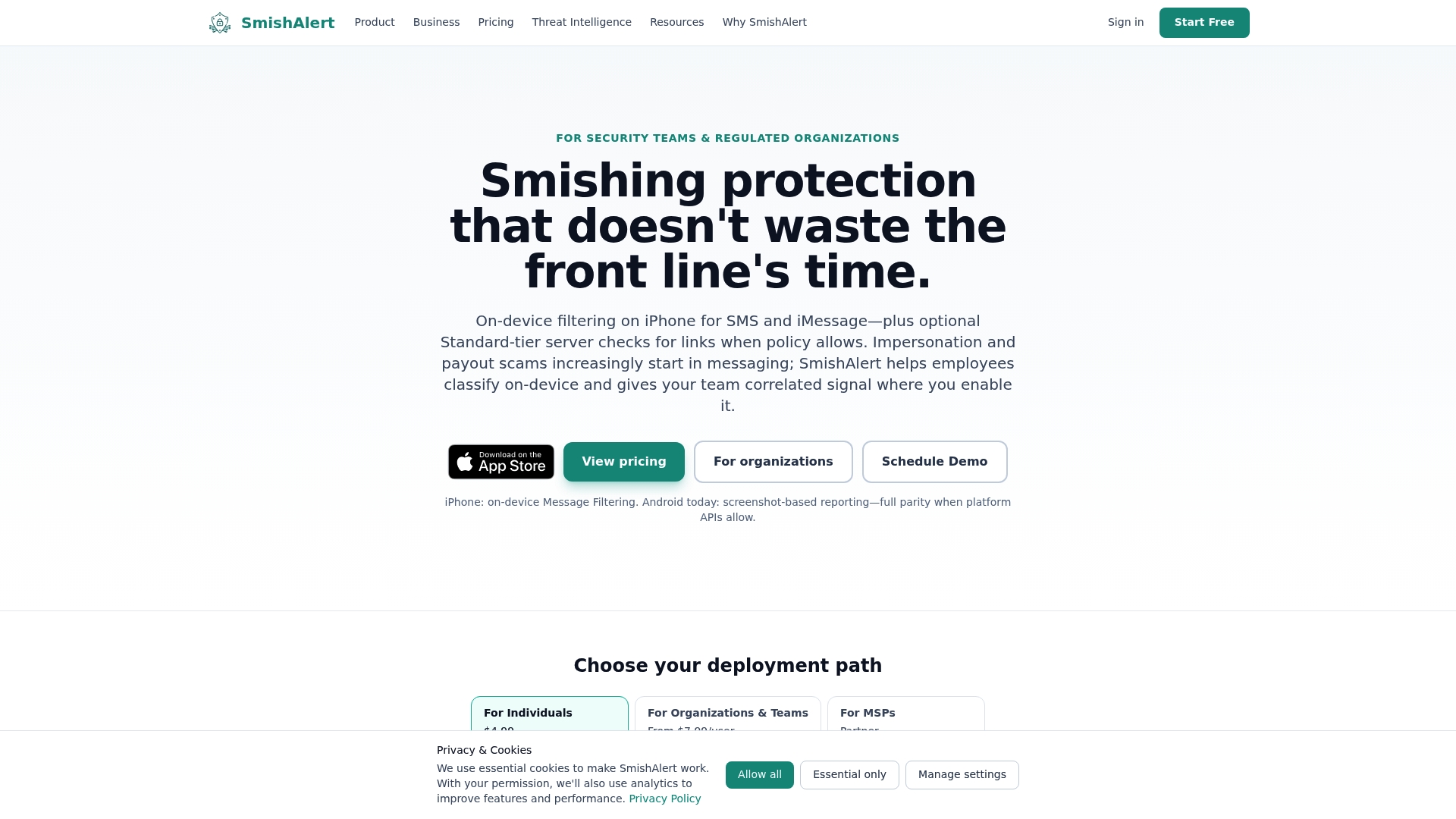
Smishalert delivers visibility into SMS, iMessage, and WhatsApp-based social engineering attacks that email security platforms never see. The paid 30-day pilot is credited toward the first annual subscription and is scoped to cover exactly the checklist above: SIEM integration, campaign correlation, on-device or gateway telemetry collection, and audit-ready incident reporting.
Pilot deliverables include:
- Baseline KPI measurement and post-activation delta report
- Automated playbook execution for credential-harvest, MFA abuse, and executive impersonation scenarios
- SIEM/SOAR integration with your existing stack
- NIST CSF-mapped outcomes report for board presentation
Run the 2-minute readiness check to confirm fit, or review Smishalert’s full detection capabilities to see which attack types map to your threat model. The pilot fee is credited in full to your first annual subscription.
Sources
- Phishing Resistance – Protecting the Keys to Your Kingdom | NIST
- Incident Response Recommendations and Considerations for Cybersecurity Risk Management: A CSF 2.0 Community Profile
- Guidance: mobile communications best practices | CISA