
Best Abnormal.ai Alternatives for Messaging Security 2026

For security teams focused on SMS, iMessage, and WhatsApp threats, the strongest alternatives to Abnormal.ai are platforms that combine on-device filtering, explainable detection logic, and audit-ready reporting. Abnormal Security is built around email behavioral AI; it offers limited native visibility into messaging channels where social engineering attacks increasingly originate.
Recommended shortlist:
- Smishalert — Messaging-first platform covering SMS, iMessage, WhatsApp, and cross-channel campaign correlation; recommended for organizations where mobile coverage, BYOD deployment, and audit-ready incident reporting are procurement priorities. Pilot fee credited to annual subscription.
- SlashNext — Covers phishing across SMS, email, and browser; strong threat intelligence feed, though detection explainability varies by deployment.
- Proofpoint — Established enterprise email suite with some mobile threat defense add-ons; best for organizations already standardized on Proofpoint’s email stack.
- Microsoft Defender for Office 365 — Deep Microsoft 365 integration and broad coverage; messaging-channel visibility outside the Microsoft ecosystem is limited.
U.S. buyers in regulated verticals should confirm FedRAMP authorization status and CCPA/HIPAA data-handling terms before shortlisting. All four options above offer pilot or proof-of-concept programs; pilot terms and fee structures vary by vendor.
Table of Contents
- How do these alternatives to Abnormal.ai compare across channels and deployment?
- How should security teams evaluate these platforms before buying?
- Why messaging-first protection differs from traditional email security
- Why Smishalert is the recommended messaging-first alternative
- How to assess false positive and false negative rates during evaluation
- Scalability and performance under enterprise load
- What incident response and remediation support should vendors provide?
- How threat intelligence informs detection models
- Key Takeaways
- The market is moving faster than most security teams realize
- Smishalert’s pilot program: what security teams get and how to start
- Further reading and sources used in this guide
How do these alternatives to Abnormal.ai compare across channels and deployment?
| Dimension | Smishalert | SlashNext | Proofpoint | Microsoft Defender for Office 365 |
|---|---|---|---|---|
| Primary focus | Messaging-first (SMS/iMessage/WhatsApp) | Multi-channel phishing (SMS, email, browser) | Email security suite | Email / M365 ecosystem |
| Channels supported | SMS, iMessage, WhatsApp, RCS, cross-channel | SMS, email, browser, collaboration apps | Email, limited mobile add-on | Email, Teams; limited SMS |
| Detection model | Explainable AI + campaign correlation | ML-driven threat intelligence | Behavioral ML + signature rules | ML + Microsoft threat graph |
| On-device visibility | iOS message filtering, Android reporting | Agent-based endpoint scanning | Gateway/cloud processing | Cloud processing, no on-device filter |
| SIEM/API/MDM | SIEM, API, MDM/EMM compatible | SIEM, API integrations | SIEM, SOAR, API | Sentinel, SIEM, SOAR |
| BYOD/exec coverage | BYOD, managed, executive devices | Managed and BYOD | Managed-device focus | Managed-device focus |
| Pilot/pricing | Paid 30-day pilot, credited to subscription | Demo/PoC available | Enterprise licensing, PoC available | Trial via Microsoft licensing |
| Best for | Messaging-first, compliance-sensitive orgs | Broad phishing across channels | Email-heavy enterprise | Microsoft-standardized enterprise |
Key trade-offs by platform:
- Smishalert: Deepest messaging-channel coverage and on-device filtering; narrower email-native feature set than full suites.
- SlashNext: Strong cross-channel threat intelligence; detection explainability varies and may require additional configuration for analyst-driven tuning.
- Proofpoint: Proven enterprise email reputation and broad compliance tooling; mobile messaging coverage is an add-on, not a core capability.
- Microsoft Defender for Office 365: Integrated security suites appeal to large organizations for breadth, but analyst-driven control and SMS-channel visibility are limited compared to specialized platforms.
SaaS-only architectures may not satisfy FedRAMP or private-cloud residency requirements — confirm deployment model options before shortlisting any vendor.

How should security teams evaluate these platforms before buying?
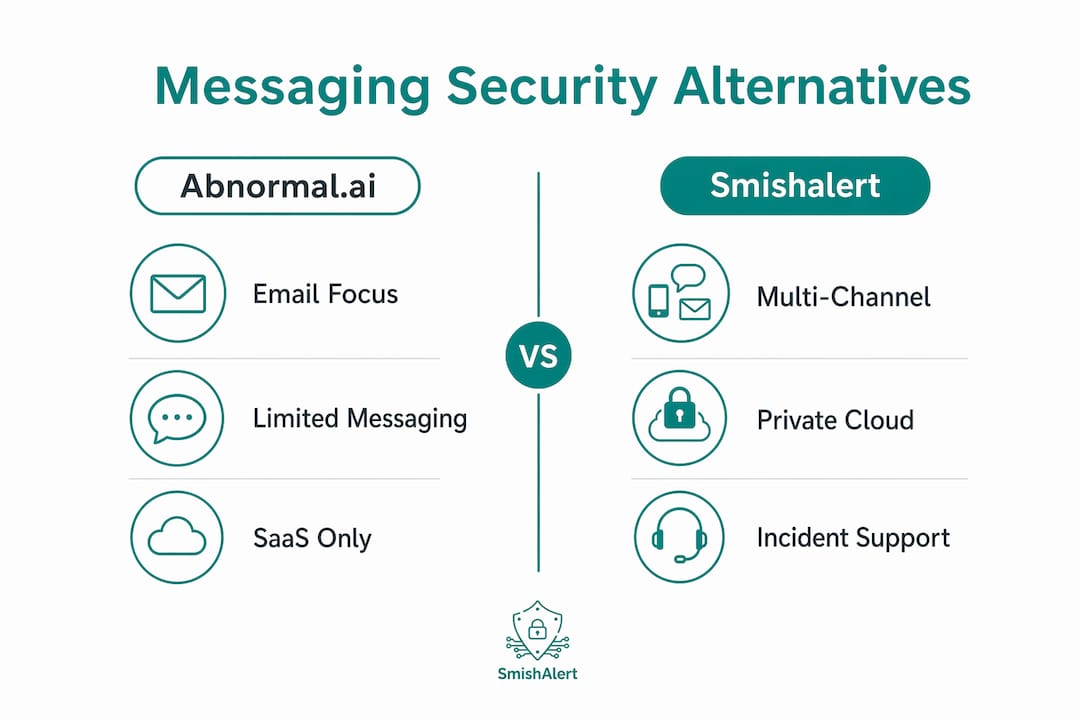
The criteria that most often determine the right choice are explainability of detections, channel coverage beyond email, and deployment compatibility with BYOD or executive-device environments.
Prioritized evaluation checklist:
- Explainability and audit logs — Can analysts see the evidence behind each detection verdict, or does the platform return a black-box score? Analyst-visible detection logic is now a procurement gatekeeper for regulated verticals.
- Detection model control — Can analysts edit rules, run backtests, or tune thresholds without filing a vendor ticket?
- Channel coverage — Does the platform natively cover SMS, iMessage, WhatsApp, and RCS, or only email with messaging as an add-on?
- Deployment model — SaaS, single-tenant, or on-prem/API? Confirm compatibility with FedRAMP, CCPA, and HIPAA data-handling requirements.
- BYOD and executive-device coverage — Does on-device filtering work without full MDM enrollment?
- SIEM/SOAR/MDM integrations — Request sample alert exports and API integration guides during the pilot.
- Full lifecycle support — Triage, remediation, and incident reporting should be included, not sold as separate modules.
- Add-on cost modeling — Advanced modules such as graymail filtering, AI coaching, and security posture are often separate line items; model the fully equipped cost, not the base SKU.
Questions to ask vendors during a 30-day passive pilot:
- What is the SLA for creating new detections against an active attack pattern?
- How does the pilot fee convert to the annual subscription?
- Can you export pilot metrics (missed detections, false positives, analyst time) at the end of the engagement?
- What is the expected time-to-coverage for a novel smishing campaign?
Red flags to surface immediately:
- Detection verdicts with no audit trail or evidence export
- Key modules (graymail, ATO, AI coaching) behind a separate paywall
- No on-device filtering or device-level triage capability
- Pilot metrics locked inside the vendor’s dashboard with no export
Pro Tip: Run a 30-day passive proof-of-value alongside your current solution. Compare “would-have-remediated” counts and missed detections — this is the most direct way to quantify coverage gaps before committing to a subscription.
Why messaging-first protection differs from traditional email security
Email security and messaging security are not the same problem. SMS, iMessage, WhatsApp, and RCS operate outside the corporate mail gateway: they carry unique metadata, have short message lifespans, route through carrier infrastructure, and in many cases use end-to-end encryption that reduces enterprise telemetry to near zero.
Where the differences are sharpest:
- Telemetry access: Email gateways process full message headers, body content, and attachment metadata. Messaging channels deliver far less structured telemetry, making behavioral baselining harder and analyst-visible detection logic more critical, not less.
- Enforcement model: Email security acts at the gateway or inbox API. Messaging protection requires on-device filtering or user-reporting flows to intercept threats before a link is clicked.
- BYOD and executive exposure: Personal devices used for business messaging sit outside MDM scope. Executive impersonation and payroll fraud attacks frequently arrive via personal iMessage or WhatsApp, channels that email-first platforms do not monitor.
- Incident response: Evidence preservation for messaging incidents differs from email. Chain-of-custody exports, SIEM forwarding, and mobile forensic integrations require purpose-built tooling.
Many aggregators conflate email protection and mobile messaging tools under a single “email security” category. A platform that excels at email behavioral AI may provide no meaningful coverage for an SMS-based payroll fraud campaign.
Pro Tip: An effective pilot runs a passive messaging detection layer in parallel with your existing email controls. Preserve user-reported messages with full chain-of-custody metadata — that evidence is what makes incident reporting defensible in a compliance review. See the 2026 SOC guide for operational setup guidance.
Why Smishalert is the recommended messaging-first alternative
Smishalert is the recommended option when messaging-channel coverage, on-device visibility, and audit-ready reporting are the primary procurement criteria.
Core platform capabilities:
- On-device iOS message filtering and Android cross-channel reporting
- Campaign correlation across SMS, iMessage, WhatsApp, and RCS
- SIEM and API integrations with MDM/EMM compatibility
- Audit-ready incident reporting for compliance-sensitive verticals
- Executive-device coverage without requiring full MDM enrollment
- Paid 30-day pilot with the fee credited to the first annual subscription
Primary use cases:
- Executive impersonation detection via personal messaging channels
- Payroll fraud and gift-card scam identification
- Credential-harvesting campaigns delivered over SMS or WhatsApp
- Multi-channel attack correlation (email + messaging in the same campaign)
- Incident reporting for healthcare, finance, and HR/payroll environments
When to layer Smishalert with an email suite: organizations already running Proofpoint or Microsoft Defender for Office 365 for email should treat Smishalert as the messaging-channel layer those platforms do not cover. A direct comparison with Proofpoint and with Abnormal Security is available for procurement teams building internal business cases.
How to assess false positive and false negative rates during evaluation
False positive and false negative rates are not abstract metrics — they directly affect analyst workload and executive trust in the platform. A high false positive rate on executive devices creates alert fatigue and pressure to disable filtering. A high false negative rate means active smishing campaigns go undetected until a credential is compromised.
During a pilot, track missed malicious messages (false negatives) by cross-referencing user-reported threats against automated detections. For false positives, measure how often legitimate messages are flagged and how quickly analysts can clear them. Platforms with editable detection rules and backtesting allow teams to tune thresholds without waiting on vendor release cycles, which is the most direct control over both error types.
Scalability and performance under enterprise load
For organizations in the 200–2,500 employee range, per-user licensing and API throughput are the two variables that matter most at scale. Platforms built on SaaS architectures generally handle volume elastically, but organizations with strict data residency requirements may need single-tenant or private-cloud options that carry different performance SLAs.
Messaging-first platforms face a specific scaling challenge: on-device filtering must operate reliably across a heterogeneous device fleet (iOS versions, Android OEMs, BYOD configurations) without degrading device performance or triggering MDM policy conflicts. Confirm that the vendor’s deployment model has been validated at your target device count before committing to production rollout.
What incident response and remediation support should vendors provide?
Incident response support varies significantly across platforms. At minimum, vendors should provide triage workflows, evidence export (SIEM-compatible alert formats, API-accessible incident data), and documented remediation playbooks for the attack types they detect.
For messaging-specific incidents, the critical deliverable is a chain-of-custody export: timestamped message records, sender metadata, and campaign correlation data that can be handed to legal, HR, or law enforcement. Platforms that lock incident data inside a proprietary dashboard without export capability create compliance risk in regulated verticals. Require a sample incident report during the pilot — not a template, but an actual export from a detected event.
How threat intelligence informs detection models
Detection quality is only as current as the threat intelligence feeding it. Platforms that rely solely on internal telemetry will lag on novel smishing campaigns; those connected to external threat feeds, carrier-level abuse data, or cross-customer campaign correlation can identify new attack patterns faster.
For messaging channels specifically, threat intelligence must account for SMS sender ID spoofing, short-link obfuscation, and carrier routing variations that differ from email-based indicators of compromise. Ask vendors how quickly their detection models update when a new smishing campaign is identified in the wild, and what the SLA is for creating a new detection rule against an active attack pattern.
Key Takeaways
For security teams evaluating alternatives to Abnormal.ai, the decision turns on whether messaging-channel coverage and detection explainability are procurement requirements — and for most compliance-sensitive organizations in 2026, they are.
| Point | Details |
|---|---|
| Messaging coverage is the gap | Abnormal.ai is email-first; SMS, iMessage, and WhatsApp threats require a purpose-built messaging layer. |
| Explainability is now a gatekeeper | Regulated verticals require audit logs and analyst-visible detection logic, not black-box ML verdicts. |
| Model the full cost | Advanced modules are often separate line items; price the fully equipped deployment, not the base SKU. |
| Run a passive 30-day pilot | Collect missed detections, false positives, and analyst time metrics before committing to a subscription. |
| Smishalert for messaging-first orgs | Smishalert covers SMS, iMessage, WhatsApp, and executive devices with a paid pilot credited to the annual subscription. |
The market is moving faster than most security teams realize
The conventional wisdom in enterprise security has long been that email is the primary social-engineering vector and that a strong email security suite covers most of the risk. That framing is increasingly wrong. Attackers have adapted: executive impersonation, payroll fraud, and credential-harvesting campaigns now routinely arrive via personal iMessage or WhatsApp, precisely because those channels sit outside the corporate perimeter and outside most security tooling.
What concerns me more than the channel shift is the explainability gap. Many platforms still return a verdict with no evidence trail. When a detection fires on an executive’s device and that executive pushes back, a security team with no audit log is in a difficult position. The market is moving toward analyst-visible, editable detection logic — and buyers who don’t require it in procurement are accepting a dependency on vendor release cycles for every tuning request.
The other underappreciated risk is add-on sprawl. A base SKU that looks affordable at signature can double in cost once graymail filtering, ATO detection, and security posture modules are added. Model the fully equipped cost before you negotiate.
For most mid-sized organizations in healthcare, finance, or HR-adjacent verticals, the right architecture is an email-first suite for the inbox layer and a dedicated messaging platform for the mobile layer. Treating them as interchangeable is the mistake that leaves the human attack surface partially blind.
Smishalert’s pilot program: what security teams get and how to start
Security teams that need messaging-channel visibility without a long procurement cycle can start with Smishalert’s paid 30-day pilot. The pilot fee is credited toward the first annual subscription, so the cost of evaluation converts directly into production coverage.
What the pilot delivers:
- Passive detection across SMS, iMessage, and WhatsApp during the engagement period
- Campaign correlation and attack-pattern reporting
- Pilot metrics export (missed detections, false positives, analyst time, time-to-detection)
- SIEM/API integration validation in your environment
Smishalert is built for organizations where a single undetected payroll fraud or executive impersonation attack justifies the cost of dedicated messaging protection. Review the full platform capabilities or take the 2-minute self-evaluation to confirm fit before scheduling a pilot conversation.
Further reading and sources used in this guide
- 8 Best Abnormal Security Alternatives in 2026 — Sublime Security — Detailed vendor comparison covering explainability, detection model trade-offs, and pilot guidance; primary source for evaluation criteria in this article.
- Abnormal Security Alternatives and Competitors — PeerSpot — Peer-reviewed roundup covering integrated suite trade-offs and enterprise buyer preferences.
- Abnormal Security Capabilities and Alternatives — CyberSecTool — Market overview noting category conflation between email and messaging security tools.
- Smishalert vs. Abnormal Security — Feature Comparison — Direct capability comparison for procurement teams building internal business cases.
- Mobile Messaging Threat Visibility: 2026 SOC Guide — Smishalert — Operational guidance for SOC teams deploying messaging-channel detection alongside existing email controls.
- Smishalert Threat Intelligence — Live Campaign Examples — Live smishing campaign data useful for validating detection coverage claims during a pilot.
For procurement teams: request detection audit log samples, API integration guides, and pilot SLA documentation from every shortlisted vendor before signing. These documents reveal more about a platform’s actual capabilities than any marketing brief.